
Lieferung heute & morgen

Qualitätsgarantie

Willkommens-Angebote freischalten: KOSTENLOSE Lieferung | Bis zu 80 % RABATT | Kostenlose 30-Tage-JoyPlus-Testphase
App herunterladen
A countertop dishwasher promises to make daily life significantly easier, especially in small kitchens, student dorms, or offices. However, the market is flooded with models whose advertising claims often suggest more than the appliances can deliver in practice. Before you make a purchase, it's crucial to understand the common pitfalls that lead to dissatisfaction and, ultimately, a bad buy.
Many buyers report three central problems:
This guide will help you avoid these problems by breaking down the critical technical features and showing you what to look for when making your choice.
To find the right countertop dishwasher, don't be swayed by marketing buzzwords. Instead, focus on three core technical aspects. These will determine whether the appliance meets your daily needs.
The type of water supply is the most fundamental differentiator and defines the appliance's flexibility.
For models with a tank, ensure the filling port is easily accessible. For all models, check the length and flexibility of the drain hose to ensure you can easily direct the water into your sink.
Inadequate drying is one of the most common frustrations. There are two basic technologies:
The 'place settings' rating is a standardised value based on a set consisting of a dinner plate, saucer, cup, glass, and cutlery. For the daily use of a single person or a couple, however, the flexibility of the interior is more important.
A good small dishwasher or single dishwasher stands out with features like collapsible plate racks, a removable cutlery basket, or a separate cutlery tray. Check the maximum allowable plate size (often 26 cm in diameter) and whether the interior is tall enough to accommodate a small pot, a bowl, or baby bottles. A flexibly designed interior turns a standard appliance into a genuinely helpful tool for daily life.
Instead of making a one-size-fits-all recommendation, we have identified models that meet specific user needs and are designed to avoid the pitfalls mentioned earlier.

Why This Fits Their Persona: This model is extremely adaptable thanks to its dual water supply option. The built-in 5L water tank makes it independent of a fixed water connection, which is ideal for rental apartments or dorms. Its compact dimensions save valuable counter space.
It solves the installation problem with its water tank. The additional 72-hour automatic drying and ventilation function counteracts residual moisture and odour buildup, a common flaw in more budget-friendly units.
Dual water supply (tank and fixed connection) for maximum flexibility. The transparent door with LED lighting allows you to monitor the wash cycle.
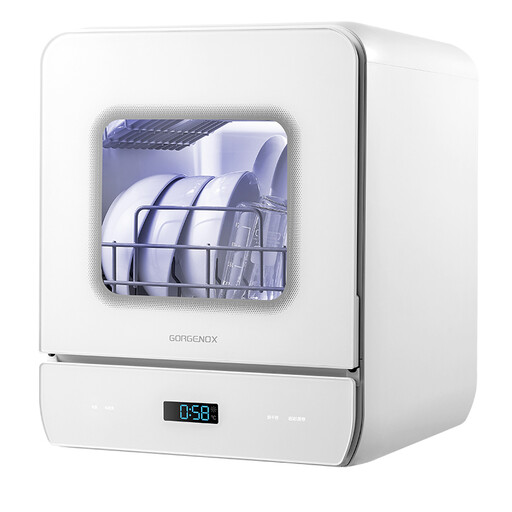
Why This Fits Their Persona: This model is aimed at users with high standards for hygiene and performance. The special "Baby Care" program, with high-temperature steam and UV light, is ideal for sanitising baby bottles and pacifiers. The integrated water softener is a clear advantage for households in areas with hard water.
It directly tackles two of the most common problems: The PTC hot air drying ensures completely dry dishes, while the built-in water softener prevents limescale buildup and water spots. The capacity is optimised for baby accessories with its adjustable racks.
4-in-1 system (Washing, UV Sterilisation, Drying, Storage) and an integrated water softener. Specialised hygiene program for baby items.
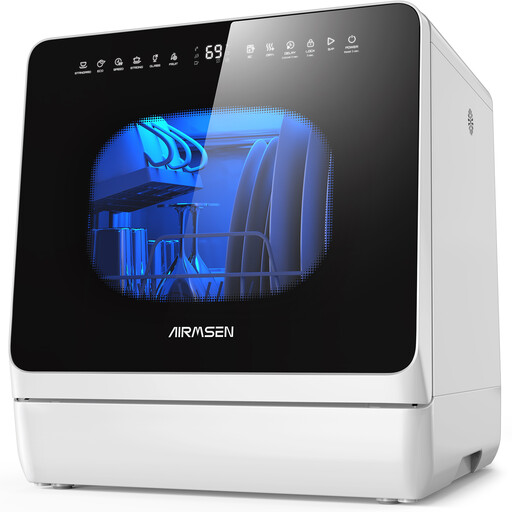
Why This Fits Their Persona: With eight wash programs, a delay start of up to 18 hours, and an integrated water softener, this appliance offers a high degree of control and customisation. It's an excellent choice for users with specific needs (e.g., glass care, quick wash) and for use in an RV, where water quality can vary.
The variety of programs solves the problem of inadequate cleaning for different types of dishes. The integrated water softener prevents limescale buildup, which extends the appliance's lifespan and ensures sparkling results, even with changing water hardness on the road.
Eight wash programs for every type of dish and soil level. The combination of a water tank and a water softener makes it a versatile appliance for home and on the go.
We have compiled a complete, up-to-date list of products that fully meet these strict selection criteria and all relevant safety standards.
A modern mini dishwasher is very efficient. A model with a water tank uses about 5 litres of water per cycle. In comparison, washing the same amount of dishes by hand often uses 10 to 15 litres. Power consumption is around 0.4 to 0.6 kWh per cycle, depending on the program. The appliances are most efficient in Eco mode.
Yes, models with an integrated water tank are designed precisely for this purpose. You only need a stable surface and a standard power outlet. The wastewater can be drained via the included hose into a separate container or directly into the RV's grey water tank. A camping dishwasher like this significantly increases comfort while travelling.
Maintenance is straightforward. Clean the filter system at the bottom of the unit weekly to remove food debris and prevent clogs. Regularly wipe the door seals with a damp cloth. About once a month, run an empty, high-temperature cycle with a dishwasher cleaner to eliminate grease and limescale buildup inside. For models with a water softener, dishwasher salt must be refilled regularly.