Single people with a small kitchen and late shifts
If you’ve got a plate, cup and cutlery to wash after work, compare the space available and your own crockery with the interior, rather than relying on the number of place settings alone.


For washing up after a late shift, a compact tank-fed model could be a good fit if a small load is enough and there’s no suitable water supply where you plan to put it. If you have more dishes, consider a larger model that connects to the water supply, provided there’s room and the inlet and drain connections are suitable. Bomann lists three place settings for the TSG 5702 and six for the TSG 7405, but the stated capacity doesn’t guarantee that your plates and bowls will fit. Also check the duration and noise level for the programme you actually plan to use; the figures on the EU energy label are based on Eco cycles.
If you’ve got a plate, cup and cutlery to wash after work, compare the space available and your own crockery with the interior, rather than relying on the number of place settings alone.
A tank-fed model may be a good fit if that specific appliance is designed for it. You’ll still need to plan for a suitable way to drain the water.
If you often have dishes for two to wash, check whether a model with a water connection and six place settings will suit your plates and bowls. Bomann and Midea both offer models with this stated capacity.
Start by comparing your usual load with the space available, then check the water supply and drainage. For evening use, the duration and noise level of the programme you plan to run are also important.
| What matters | What to check before buying | Who should pay particular attention? |
|---|---|---|
| Will my load fit? | Compare your plates and bowls with the basket layout and loading instructions. | If I want to wash a plate, cup and cutlery in one go after a late shift, I’ll check my crockery and the basket first. Around 33% of consumers are likely to put load size first. |
| Water supply and drainage | Check whether the specific model is tank-fed or connects to the water supply, and how wastewater is meant to drain away. | If there’s no suitable water supply where I plan to put it, I’ll want to know whether it’s designed for tank use and where the wastewater goes. For around 27% of consumers, the water supply is likely to be the main concern. |
| Washing up in the evening | Compare the duration of the programme you want to use and the noise level of the specific appliance. | If I’m starting a wash late, I’ll check whether the programme fits into my evening and whether the appliance will be acceptably quiet where I plan to put it. Around 20% of consumers are likely to prioritise time or noise in the evening. |
| Running costs | Compare Eco consumption figures on a like-for-like basis and factor in how many cycles you expect to run. | If I wash dishes regularly, I’ll want to estimate electricity and water use based on how I’ll use the appliance, rather than looking at the consumption for a single cycle alone. Around 20% of consumers are likely to prioritise running costs. |
The Verbraucherzentrale and the European Commission explain that the consumption figures on the energy label are based on the Eco programme. The German Environment Agency recommends filling the dishwasher properly and using the Eco programme; figures for Eco cycles don’t automatically tell you what to expect from quick programmes.
On appliances designed for tank use, the tank replaces the fixed water supply, not the wastewater drain.
Check the operating mode, drainage route and installation instructions for the specific model before deciding where to put it.
If your usual load doesn’t fit, extra cycles could take more time, water and electricity.
The consumption figures on the energy label relate to the Eco programme; they don’t show the figures for other programmes.
Compare the duration and consumption information for the programme you actually plan to use.
An Eco cycle can take longer than a short wash, so it may not suit every evening after work.
The range includes a compact tank-fed model and a larger countertop dishwasher that connects to the water supply.
Midea offers compact models for smaller loads, as well as a six-place-setting option.
The Aquatica is a compact option for smaller amounts of washing up.
This selection of countertop dishwashers includes compact tank-fed models and appliances that connect to a tap.
 No image available
An option if there’s no fixed water supply where you plan to put it and tank use suits your drainage arrangements.
Integrated 5-litre water tank; 5+1 wash cycles. When using the tank, wastewater is carried through a hose into a container.
 No image available
A compact option if you want to compare tank filling with a tap water supply.
Product title lists: 37 × 50 cm, 5-litre tank, nine programmes and a 1–24-hour timer. The description lists four place settings.
 No image available
For a small load, with the option of using a tank or connecting to the water supply.
Three place settings, seven programmes and 56.3 dB according to the product title. The description lists a 35-minute quick programme.
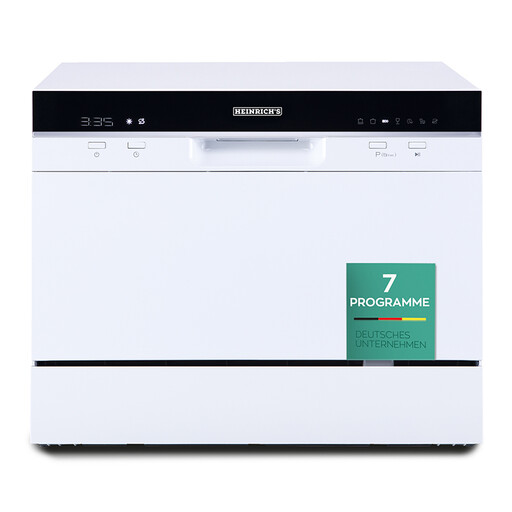 No image available
A larger load may be an option if the water connection is suitable for the space where you plan to put it.
Six place settings, seven programmes and 47 dB according to the product title. The description lists a 30-minute quick programme, along with inlet and drain hoses.
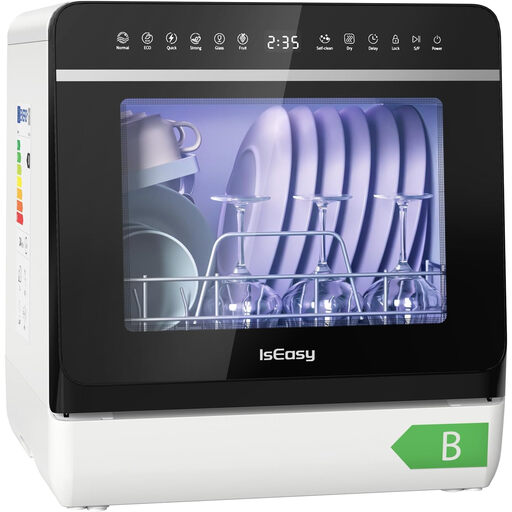 No image available
An option for small loads if you’re looking for an appliance with a manually filled tank.
The description lists three place settings and seven programmes. When using the tank, you’ll need to arrange a way to drain the wastewater.
Only if your dishes actually fit in the basket. Compare the diameter of your plates, your bowls and any extra cookware with the interior dimensions or loading instructions; the number of place settings alone won’t tell you.
No. On appliances specifically designed for it, the tank replaces the fixed water supply, not the wastewater drainage. Plan the drain according to the instructions and the space where you intend to put the appliance.
The German Environment Agency recommends filling the dishwasher properly, using the Eco programme and not rinsing dishes with warm water beforehand. Factor the Eco label figures and the number of cycles you expect to run into your comparison; quick programmes may have different figures.
If the product is faulty, you have statutory rights against the seller; a manufacturer’s guarantee is separate and subject to its own terms. The Verbraucherzentrale explains the difference. When buying, check the seller, model name and available service documents.
The EU energy label for household dishwashers includes, among other things, the energy efficiency class, electricity consumption per 100 Eco cycles, water consumption per Eco cycle, capacity, Eco programme duration and noise emissions. These figures don’t automatically reflect your individual consumption.