First, measure the available surface and the space in front of the appliance when its door is open. Then choose between a compact cutlery tray and a larger appliance with a cutlery basket, based on how much cutlery you actually need to wash. If there’s no permanent water supply, you’ll also need to know how water gets in and out. Eco consumption figures are only useful when considered alongside capacity and your usual load.
Who countertop dishwashers are suitable for
Small kitchen, limited worktop space
If you want to machine-wash cutlery without giving up a large amount of worktop space, check not only the appliance dimensions but also the room needed to open and load it. Midea Germany lists the dimensions of the MDWMT0305EW-WE as 435 × 420 × 465 mm (H × W × D); Bomann gives the dimensions of the TSG 7405 as 43.8 × 55.0 × 50.0 cm (H × W × D).
Regularly washing larger loads of cutlery
If you often wash cutlery alongside crockery, a suitable, easy-to-access cutlery holder is important. Bomann lists a cutlery basket and six place settings for the TSG 7405; Midea describes the three-place-setting MDWMT0305EW-WE as having a foldable cutlery tray.
A kitchen without a permanent water supply
If there’s no permanent water supply, check whether the appliance uses a tank or connects directly to a tap, and plan for wastewater disposal in either case. Midea says the MDWMT0305EW-WE can be used with or without a water connection; Klarstein specifies a direct tap connection for the Aquatica.
What to look for when buying
First, measure the entire space where you plan to put the appliance. Then check that the cutlery holder and water supply will work for your day-to-day needs.
| Priority |
What to look for when buying |
Who it matters most to |
| Space and access |
Measure the width, depth and height of the space; allow for the door to open, access to the controls and the hose route. |
If there’s little free worktop space, the appliance needs to fit in a practical position with enough room to access it when open. Around 36% of consumers put finding a suitable space first. |
| Cutlery holder and capacity |
Check that the basket or tray suits the shape and quantity of your cutlery; don’t mistake place settings for the number of individual cutlery items. |
If you regularly wash cutlery with crockery, the holder needs to suit the load you actually have. Around 29% of consumers prioritise the cutlery holder and usable capacity. |
| Water supply and drainage |
Check whether the appliance is designed for tank use or a compatible tap or appliance connection, and plan how wastewater will drain. |
If there’s no permanent water supply, the water feed needs to work with your kitchen. Around 21% of consumers prioritise finding a suitable connection. |
| Eco consumption and running effort |
Compare electricity use per 100 Eco cycles, water use per Eco cycle, programme duration and place settings together. |
If the space, cutlery holder and connection are all suitable, consumption and how often you run a cycle may help you decide. Around 14% of consumers put running costs and effort first. |
Avoiding common buying mistakes
-
Measuring only the width of the appliance
The appliance dimensions won’t tell you whether the door can open where you plan to put it, or whether you can load it comfortably. You’ll also need space for the hose and access to the controls.
Mark out the space and check the door movement, access and hose route at the intended location.
-
Assuming “no permanent connection” means “no need to plan for water”
Using a tank and connecting directly to a tap are two different ways of operating an appliance. In both cases, wastewater must be drained as described in the instructions.
Check how water is supplied for the exact model and where you can route the drain hose.
With tank operation, refilling is part of the regular upkeep; you’ll also need to set up a suitable drain.
-
Thinking place settings mean a specific number of cutlery items
The stated number of place settings doesn’t tell you whether your cutlery will fit in the basket or tray. The length and shape of your cutlery may limit how much you can load.
Check the interior layout and loading instructions for the specific model against your cutlery, especially if you have long or pointed items.
-
Using the Eco figure alone to estimate everyday consumption
Eco figures are based on a standardised programme; the number of cycles you’ll need also depends on your usual load.
Compare Eco figures on the same basis, and factor in capacity, the number of cycles you expect to run and programme duration. The German Environment Agency also advises against pre-rinsing crockery with warm water.
If the capacity is too small, you may need to run extra cycles.
A guide to relevant brands
Midea
The countertop range includes models with different capacities and cutlery solutions.
- Midea Germany lists three place settings and a foldable cutlery tray for the MDWMT0305EW-WE, and six place settings for the MDWTT0602MW-WE.
- The tray in the smaller model needs to suit your cutlery; details for the larger appliance don’t necessarily apply to the smaller one.
Bomann
The TSG 7405 may suit regular loads of cutlery and crockery if you have room for a wider countertop appliance and the required water connection.
- Bomann lists six place settings, a cutlery basket and inlet and drain hoses supplied with this model.
- The stated width is 55.0 cm; technical specifications alone don’t confirm that every type of cutlery is suitable for the appliance.
Klarstein
The Aquatica is a compact model with two place settings that connects directly to a tap.
- Klarstein lists three programmes and a tap connection for the Aquatica.
- A tap connection is not the same as tank operation. Before buying, check that your tap is compatible, and confirm the drainage setup and cutlery holder for the specific version.
Medion
The MD 37217 is a useful comparison point for compact countertop appliances with different water supply options.
- Medion lists two place settings, six programmes and operation with or without a permanent water connection for this model.
- Medion’s product page marks the model as sold out, so it isn’t a confirmed option currently available to buy.
Countertop dishwashers at Joybuy
This selection includes countertop appliances for limited spaces, including models with a water tank; some also list a cutlery holder. Before buying, check that the dimensions, interior and water supply suit your cutlery and the space where you plan to put the appliance.
 No image available
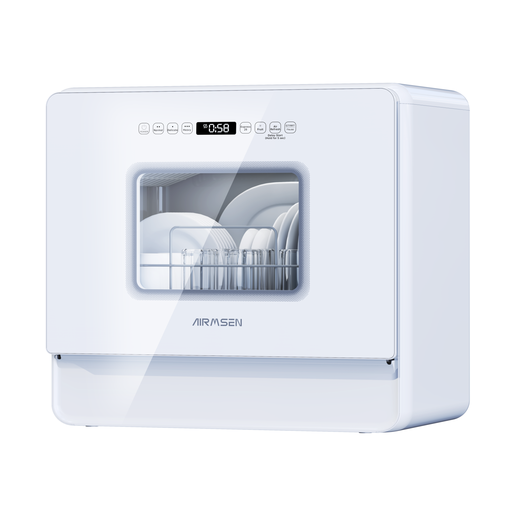
AIRMSEN A01 countertop dishwasher
The integrated tank is useful for kitchens without a permanent water supply; check there’s enough height to refill it where you plan to put the appliance.
5-L water tank; depth 36.1 cm; up to five place settings. The product description specifies a minimum cupboard height of 59.7 cm for refilling.
Joybuy
 No image available
AIRMSEN portable countertop dishwasher
The integrated tank may suit a kitchen without a permanent water supply; check the stated dimensions against your available space.
5-L water tank; dimensions 45.8 × 42.8 × 42.5 cm; four place settings.
Joybuy
 No image available
AIRMSEN countertop dishwasher, 37 × 50 cm
This model offers both tank operation and a direct tap connection; check which option suits the place where you plan to put it.
Integrated 5-L water tank; four place settings; two water supply options.
Joybuy
 No image available
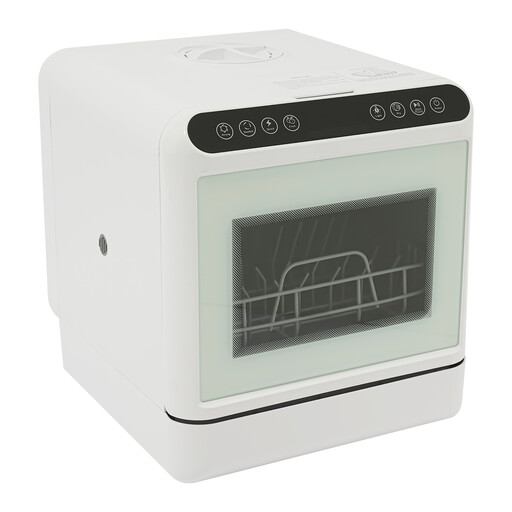
Portable countertop dishwasher
The integrated tank is specified for use without a permanent water supply; check that the capacity suits your usual load.
1.32-gallon water tank; listed for four place settings.
Joybuy
 No image available
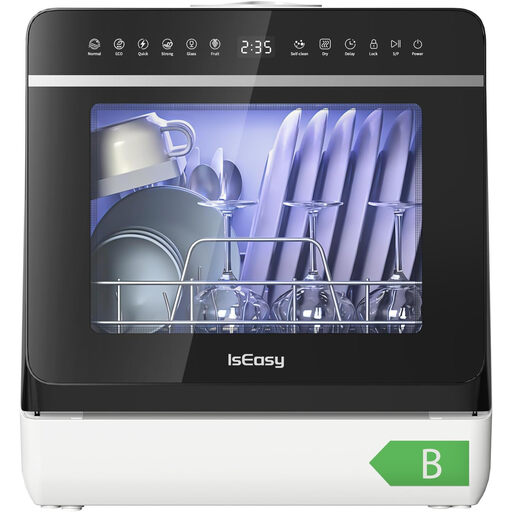
Countertop dishwasher with cutlery basket
The listed cutlery basket may be useful for small loads of cutlery and crockery; check that it suits your cutlery before buying.
Integrated 5-L water tank; three place settings; cutlery basket; dimensions 43 × 43 × 46 cm.
Joybuy
Frequently asked questions
Can all cutlery go in a countertop dishwasher?
No. Check the care instructions for each item of cutlery. According to the consumer advice centre, the glass-and-fork symbol indicates materials suitable for food contact, not that they’re dishwasher-safe. For pointed knives, also follow the loading instructions for your chosen appliance or basket.
If there’s no permanent water connection, do I need no connections at all?
No. A tank model designed for this purpose can be used without a permanent water supply; an appliance designed to connect to a tap needs a compatible tap. In both cases, wastewater must be drained as described in the instructions.
How can I assess consumption when washing cutlery?
Compare Eco consumption figures alongside the capacity and the number of cycles you usually run. The German Environment Agency recommends against pre-rinsing crockery with warm water. Figures on the EU label relate to the Eco programme and don’t guarantee the consumption of every other programme.
What does the EU energy label for dishwashers show?
The European Commission says the label includes information such as electricity consumption per 100 Eco cycles. Water consumption and programme duration for the Eco programme, as well as the number of place settings, are also useful for comparison. Relate these figures to the capacity you can actually use.


