What should you look for when buying?
First, check that your usual load of cutlery will fit in the holder and that the water inlet and outlet can be accommodated where you plan to put the appliance. Then consider the space available, the programme you’ll actually use and comparable consumption figures.
| What matters |
What to check when buying |
Who should pay particular attention? |
| Amount of cutlery and holder |
Check that the amount and length of your usual load will fit the cutlery basket or tray and the interior of the specific model. |
If I mainly have cutlery to wash after a shift, I want to know whether it can be loaded to fit. Around 29% of consumers say cutlery capacity is their main concern. |
| Water supply and drainage |
Check the water-inlet type for the exact model variant, as well as hose routing and safe drainage where you plan to put it. |
If there’s no suitable fixed water supply, I need an appropriate alternative and a way to drain the wastewater. Around 23% of consumers say water supply is their top priority. |
| Washing up after a late shift |
Compare the duration of the programme you’ll actually use and the noise rating for the specific model. |
If I wash up late, I want to make sure the appliance and its running time suit my living situation. Around 18% of consumers prioritise using their dishwasher after a shift. |
| Space and access |
Allow for the appliance’s dimensions, room to open the door and the routing of the inlet and outlet hoses. |
If my worktop space is limited, the appliance needs to fit in the intended spot and remain accessible. Around 18% of consumers say space is their main concern. |
| Running costs |
Compare kWh per 100 Eco cycles, litres per Eco cycle and the expected number of washes on a like-for-like basis. |
When weighing up running costs, I want to consider comparable Eco figures and how often I expect to use the appliance. Around 12% of consumers check running costs first. |
Joybuy products for smaller loads
The Joybuy products below are compact countertop dishwashers with different water-supply options. For each model, check whether the tank or hose connection, cutlery holder and drainage suit the space where you plan to put it.
 No image available
AIRMSEN countertop dishwasher, 5+1 programmes
Worth considering if you’d like to use a tank or tap water supply and a short programme suits your needs.
Built-in 5-litre tank; described as using either tank or tap water; 29-minute Quick programme; wastewater hose listed.
View at Joybuy
 No image available
AIRMSEN countertop dishwasher, 9 programmes, 37 × 50 cm
Could be a good fit if you’re looking for an alternative water supply and a compact appliance.
Built-in 5-litre tank; 9 programmes; stated dimensions: 37 × 50 cm.
View at Joybuy
 No image available
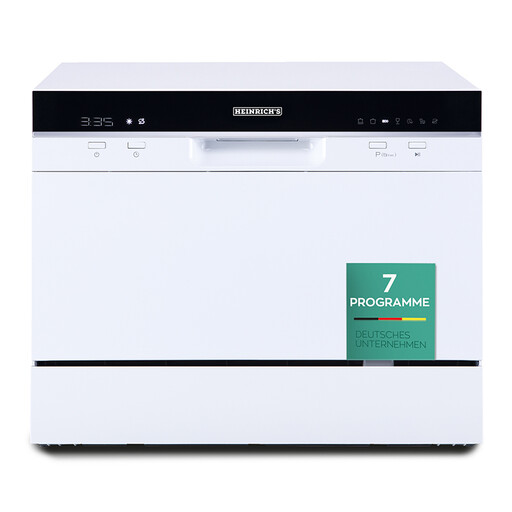
Heinrich's HTG 8840 countertop dishwasher
The stated capacity and cutlery basket may be useful for washing cutlery alongside other dishes.
Capacity for 6 place settings; cutlery basket; 30-minute Quick programme; stated noise level of 47 dB; water connection listed. Make sure there’s a suitable spot for the connections and drainage.
View at Joybuy
 No image available
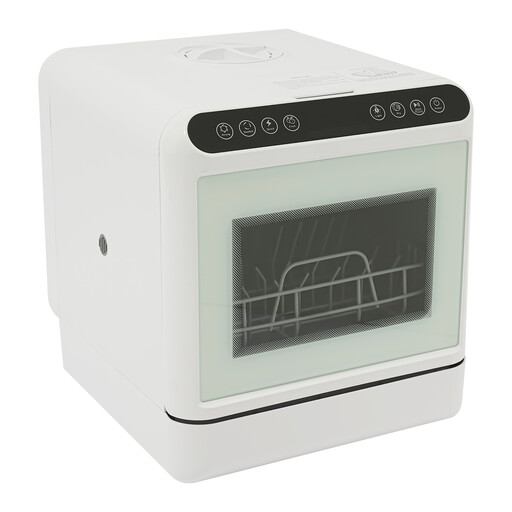
Compact countertop dishwasher with 1.32Gal water tank
Could be an option if you’re looking for a built-in tank and space to load dishes on more than one level.
Built-in 1.32Gal tank; two-tier rack; described as suitable for 4–6 people.
View at Joybuy
 No image available
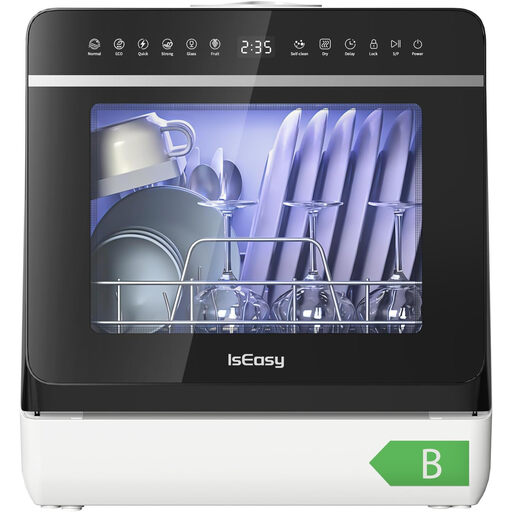
Countertop dishwasher with 5-litre tank, 3 place settings
The stated capacity and cutlery basket may suit a small load of cutlery, provided the items fit inside.
Built-in 5-litre tank; capacity for 3 place settings; cutlery basket and 7 programmes listed; wastewater hose included. Make sure you can drain it where you plan to put the appliance.
View at Joybuy
Frequently asked questions
Is a quick programme enough if I’m only washing cutlery after a late shift?
It depends on how dirty the cutlery is and what the instructions for the specific appliance say. Bomann lists a 30-minute programme for the TSG 7405, but EU label figures for consumption and duration relate to the Eco programme and don’t prove how well the quick programme will clean.
Can I put a tank-fed dishwasher anywhere without a water connection?
No. Even a model with a tank needs a suitable place to stand and a way to drain the wastewater. Medion describes several water-inlet options for the DWT30, but it still needs an outlet.
How can I compare running costs more effectively?
Compare Eco label figures on a like-for-like basis and factor in how many wash cycles you expect to run. You can’t work out the cost of another programme directly from an Eco figure. Also check the instructions to see what care the specific appliance needs.
Can I use a household countertop dishwasher to clean cutlery for guests at a food business?
There’s no single answer that applies to every model. Under European Union Regulation (EC) No 852/2004, food businesses must provide suitable facilities for cleaning, disinfecting and storing work equipment, where necessary. You’ll need to check whether a particular household appliance meets the procedures required by the business in question. Private use after a work shift is a different matter.
Which energy label details are useful for comparing models?
The European Commission lists details on the EU energy label for dishwashers including the A to G efficiency class, energy consumption per 100 Eco cycles, water consumption per Eco cycle, capacity, Eco programme duration and noise emissions. These figures make it easier to compare models on a like-for-like basis, but they don’t show whether an appliance is suitable for workplace hygiene requirements.


