What should you look for when buying?
First, check whether the cutlery and other items you want to wash will fit in the basket together. Then consider the water supply and drainage at the installation point, the available worktop space, and comparable figures for consumption and maintenance.
| Consideration |
What to check before buying |
Who should pay particular attention? |
| Cutlery space and load capacity |
Check the cutlery basket or tray, the basket layout and the dimensions of the items you usually wash. Picture a typical load with everything you want to wash together. |
If several suitable pieces of cutlery and other items need washing after food prep, the space actually available in the basket matters to me. Around 33% of consumers say usable load capacity is their top priority. |
| Water supply and drainage |
Check whether the model uses a tank or a water connection, and where the drain hose can run from your chosen installation point. |
If there’s no permanent water supply where I plan to put it, I’ll need a practical way to fill the tank and drain wastewater. Around 27% of consumers say water supply and drainage are their main concern. |
| Worktop space and capacity |
Compare the appliance dimensions with your worktop, door clearance and remaining space. Treat place settings as a stated capacity, not a guarantee that every kitchen utensil will fit. |
On a small worktop, I’ll need to leave room for food preparation as well as the appliance. Around 20% of consumers put available space first. |
| Running costs and maintenance |
Compare electricity and water figures using the same Eco programme basis. Follow the instructions for your specific model when cleaning the filter and, where applicable, managing water softening. |
If ongoing resource use and maintenance matter to me, I’ll compare the figures for the programme I’m actually likely to use. Around 20% of consumers list running costs and maintenance as their main concern. |
Joybuy products for small and flexible loads
The Joybuy products below include compact appliances with built-in tanks, as well as versions that also offer a tap or water connection.
 No image available
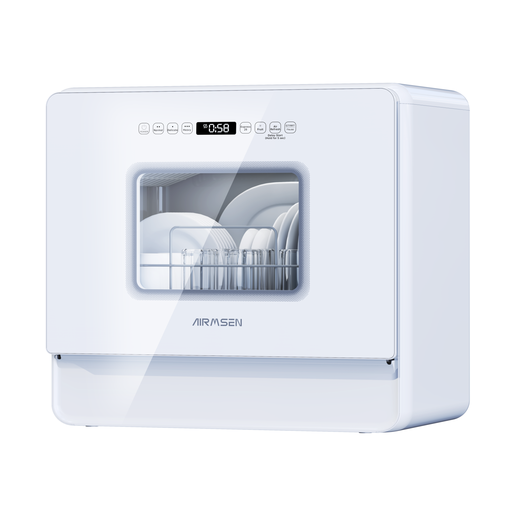
AIRMSEN A01 Large Slim Countertop Dishwasher
The product description lists a capacity of up to five place settings and a built-in tank for washing a load together.
Tank: 5 litres. Appliance depth: 36,1 cm. According to the description, you’ll need a clearance of at least 59,7 cm to refill the tank.
The description lists a two-tier basket and three spray arms.
View at Joybuy
 No image available
AIRMSEN Portable Countertop Dishwasher
A good option if you want to choose between filling the tank by hand and connecting the appliance to a tap.
Built-in tank: 5 litres. The product description lists 5+1 wash cycles and a double-tempered glass door.
When using the tank, the description says wastewater is carried by a hose into a container.
View at Joybuy
 No image available
AIRMSEN Tabletop Dishwasher, 37 × 50 cm
The product description lists a capacity of up to four place settings and two ways to supply water, making it suitable for a small combined load.
Tank: 5 litres. Width: 37 cm. According to the description, a separately available adaptor may be needed to connect it to a tap.
View at Joybuy
 No image available
Heinrich's HTG 8855
The title lists three place settings for small cutlery and dish loads; the description includes a cutlery basket.
Built-in tank: 5 litres. Works with or without a water connection. The product details list seven programmes and a noise level of 56,3 dB.
View at Joybuy
 No image available
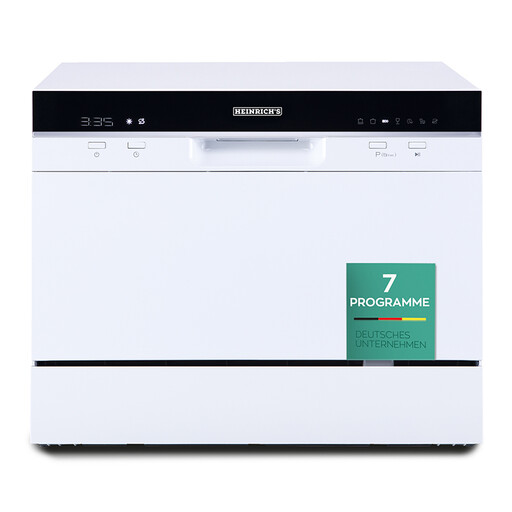
Heinrich's HTG 8840 White
If there’s a water connection at the installation point, the title lists six place settings; the additional information includes a cutlery basket.
The specifications list seven programmes, energy class D and a noise level of 47 dB.
View at Joybuy
Frequently asked questions
Can a tank model be installed without a permanent water connection?
With a model designed for this, such as the Bomann TSG 5702, the built-in tank can replace a permanent water supply. You’ll still need to make sure there’s a suitable place for the appliance, a convenient way to fill it and somewhere for the drain hose to run.
Does a Hygiene programme mean you don’t need to keep ingredients and utensils separate?
No. The German Federal Institute for Risk Assessment warns about cross-contamination during food preparation, particularly from raw foods. Keep preparation steps and utensils hygienically separate; a programme name doesn’t prove that prepared food will be protected in every case.
How do I compare electricity and water costs?
Compare the label figures for kWh per 100 Eco cycles and litres per Eco cycle. To estimate your own costs, you’ll also need to consider how many wash cycles you expect to run and your electricity and water rates. Don’t assume Eco figures apply to Quick or Intensive programmes without checking.
What labelling is relevant when buying a new household dishwasher online in Germany?
New household dishwashers that require a label must comply with EU energy-labelling rules. Online listings must display the energy label or a permitted class arrow that links to the label and product information sheet. The label includes details such as Eco consumption, capacity, programme duration and noise levels; it isn’t a hygiene certificate.
Can any cutlery with the food-contact symbol go in the dishwasher?
No. The glass-and-fork symbol indicates that an item is suitable for food contact, not that it’s dishwasher-safe. Follow the manufacturer’s care instructions for each piece of cutlery. For this scenario, the cutlery is assumed to be dishwasher-safe.


