If there’s no suitable mains water connection available during your kitchen renovation, a tank-fed countertop dishwasher could be an option for a few compatible lunchbox parts – but you’ll still need a safe way to drain the wastewater. If you want to wash several boxes in one cycle, a larger model with a water connection may be suitable, provided you have the space, water supply and drainage. You’ll also need to consider the dimensions of each box part, its care instructions and the specific appliance’s consumption figures – not just its place-setting capacity.
Who might benefit from a countertop dishwasher?
Households without a mains water connection
If you only need to wash a few lunchbox parts during your renovation, you could consider a model with a manually filled tank. You’ll still need to drain the wastewater safely; Bomann and Daan Tech both specify a drain hose for the models mentioned here.
Households with several lunchboxes
If you want to wash boxes alongside other dishes, check the interior space and connection options of the specific appliance. Bomann lists the TSG 7405 as having capacity for six place settings and a water connection, but this doesn’t tell you how many lunchboxes will fit.
Households short on space
If you have limited worktop space, the appliance’s height, width and depth matter, as does the space in front of it when the door is open. The dimensions published for models by Bomann and Midea are useful for comparison, but you’ll still need to measure your intended space.
What to look for when buying
| What to consider |
What to check before buying |
Who it matters to |
| Water supply and drainage |
Check whether the specific model uses a tank or a mains connection, which hoses are included and whether there’s a safe way to drain wastewater where you plan to put it. |
If I can’t use a mains water supply during my renovation, I still need a reliable way to drain the wastewater. Around 36% of shoppers are likely to have this as their main concern. |
| Space for box parts |
Measure your largest boxes and lids, then check them against the basket, door opening and cutlery tray. The spray arms must be able to move freely. |
If I want to fit several boxes and lids in as few cycles as possible, the usable shape of the interior matters more than a general place-setting capacity. Around 29% of shoppers are likely to prioritise load capacity above all. |
| Worktop space and door clearance |
Measure the height, width and depth of the space available during the renovation, and allow room for the door, hoses and plug socket. |
With limited worktop space, I want to be sure the appliance will fit in my temporary kitchen area with the door open. Around 21% of shoppers are likely to consider available space the deciding factor. |
| Consumption and care |
Compare Eco programme figures on a like-for-like basis, and check the care instructions, water hardness and how you plan to use the appliance. |
If I want to keep running and maintenance demands manageable, I don’t want to compare consumption figures from different programmes as if they were the same. Around 14% of shoppers are likely to consider these demands first. |
Avoiding common misconceptions
-
“No water connection” means you don’t need to drain the wastewater
A tank can replace a mains water supply, but it can’t drain the wastewater for you.
Before buying, check how you’ll drain the water where you plan to put the appliance, and what’s included with the specific model.
-
Place settings equate to a specific number of lunchboxes
An appliance’s stated capacity refers to a standardised amount of crockery, not the shape and size of your boxes, lids or seals.
Measure your largest individual parts and check them against the basket and door opening. If everything won’t fit at once, you may need to run extra cycles.
You may need to spend more time on washing if large boxes or lids won’t fit in the appliance together.
-
Every item labelled dishwasher-safe can go on every programme
Whether individual containers and seals are suitable, and what temperature limits apply, depends on their care instructions – not just the appliance’s programme list.
Check the care instructions for each container, lid and seal separately, and only use a programme that’s approved for them.
-
Eco consumption figures apply to every programme
Figures for the Eco programme can’t automatically be applied to quick or intensive programmes.
Compare consumption figures only for the same programme, and consider which programmes you’re likely to use.
Relevant brands at a glance
Bomann
The models mentioned here range from the tank-capable TSG 5702 to the mains-connected TSG 7405.
- According to Bomann, the TSG 5702 has a built-in 5-litre tank and a drain hose; the TSG 7405 is designed for six place settings.
- The TSG 7405 requires a water connection. Place-setting capacity doesn’t prove that specific lunchboxes will fit.
Midea
Midea offers the MDWMT0305EW-WE countertop dishwasher, with capacity for three place settings and a body width of 420 mm.
- According to Midea, this model comes with a foldable cutlery tray and Eco and intensive programmes.
- The available programmes don’t confirm that specific lunchboxes or lids are suitable; their care instructions are what matter.
Daan Tech
Daan Tech describes Bob as a compact, manually filled appliance with a basket for three place settings.
- Manual filling can be useful if you can’t use a mains water supply; according to the manufacturer, a drain hose is included.
- Even when you fill it manually, you’ll still need to drain the wastewater safely.
Klarstein
According to Klarstein, the Aquatica is a countertop dishwasher for two place settings that connects directly to a tap.
- Connecting to a tap can save you from having to set up a permanent water supply line.
- You’ll need a suitable tap and a way to drain the wastewater while the appliance is running. Place-setting capacity doesn’t replace checking that your box parts fit.
Medion
According to Medion, the DWT51 (MD 37766) combines bucket-fed water and a mains water connection with a rated capacity of five place settings.
- The alternative water supply may be useful if your connection options vary.
- Neither bucket operation nor place-setting capacity proves that your boxes will fit without checking.
Joybuy product options
These countertop dishwashers include models with water tanks and versions that connect to a water supply. For each appliance, check that your boxes, lids and seals fit and are suitable for the programme you want to use.
 No image available
AIRMSEN countertop dishwasher with 5-litre tank
Tank operation may be worth considering if there’s no mains water supply available where you’re renovating; according to the description, wastewater can be drained through a hose into a container.
External dimensions: 45,8 × 42,8 × 42,5 cm. The description says it shouldn’t be used to wash heat-sensitive plastics.
View at Joybuy
 No image available
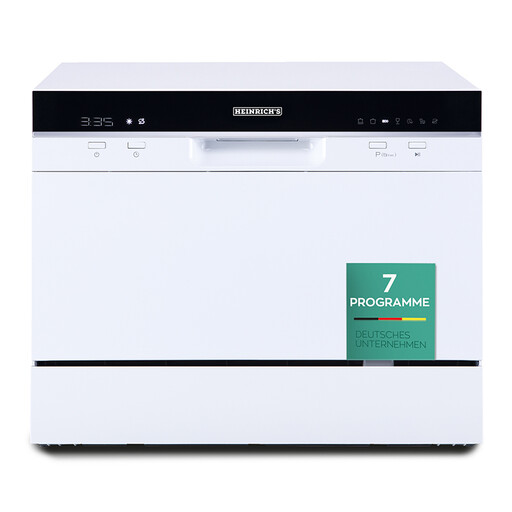
Heinrich's HTG 8855
The stated 5-litre tank and the option to use the appliance with or without a water connection may be useful if your water supply is temporarily limited.
The product name lists capacity for three place settings, seven programmes and a water softener. Check that each box part will fit inside.
View at Joybuy
 No image available
Heinrich's HTG 8840 White
This model may be suitable if you want to wash several items of crockery in one cycle and have a water connection available.
The product name lists capacity for six place settings; the description gives seven programmes and water consumption of 6,5 litres per cycle.
View at Joybuy
 No image available
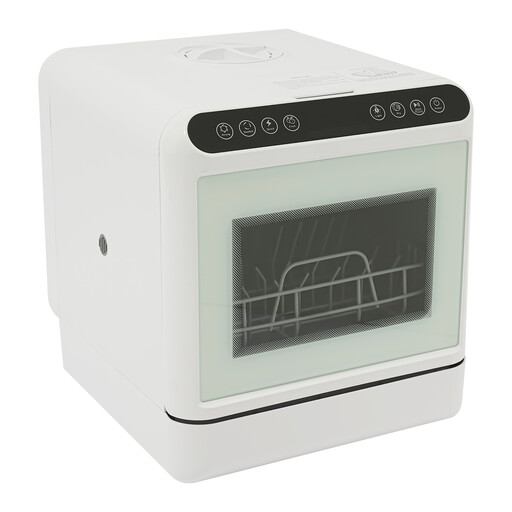
Compact countertop dishwasher with 1.32-gallon tank
The description lists a built-in water tank and an outlet for situations where you can’t use a mains water supply.
The description also lists hot-air drying and a 72-hour storage function.
View at Joybuy
 No image available
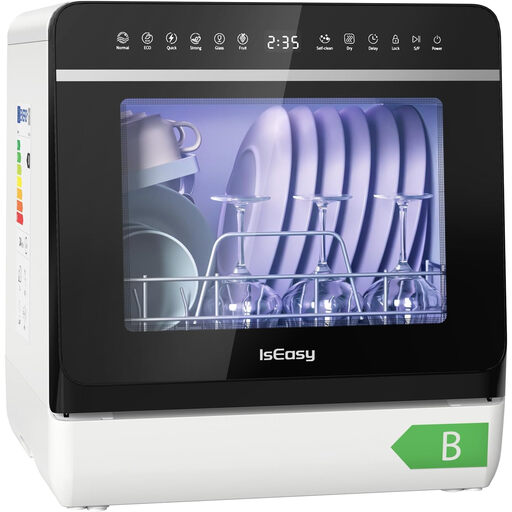
Countertop dishwasher with 5-litre tank
The tank mentioned in the product title may be useful if there’s no mains water connection available during your renovation.
The description lists capacity for up to three place settings, seven programmes and a drying function. Check separately that your box parts will fit.
View at Joybuy
Frequently asked questions
Does the glass-and-fork symbol mean my lunchbox is dishwasher-safe?
No. The symbol indicates that the item is suitable for contact with food, not that it can be washed in a dishwasher. Check the care instructions for the container, lid and seals separately; a general indication that an item is dishwasher-safe doesn’t automatically mean it can go on every temperature setting.
Does a tank-fed model need no water connection at all during a kitchen renovation?
A manually filled tank can replace a mains water supply, but not the drain. According to the respective manufacturers, the Bomann TSG 5702 and Bob both come with drain hoses.
How do I compare the consumption of different appliances?
Compare kWh per 100 Eco cycles and litres per Eco cycle on a like-for-like basis, and take into account how many cycles you’re likely to run. Figures for a different programme aren’t directly comparable.
Who is responsible if there’s a fault, and where should an old appliance go?
In Germany, the seller is generally responsible for the statutory warranty; this is separate from a manufacturer’s guarantee. Waste electrical appliances should be taken to a separate collection point, such as a local authority recycling centre. Any take-back scheme offered by the retailer is subject to its own conditions.
Is an energy label compulsory for household dishwashers?
Yes. Germany’s Federal Environment Agency describes energy labelling for household dishwashers as compulsory. The label helps you compare products; it isn’t a special permit for using an appliance during a kitchen renovation.


