People short on worktop space
If you cook on a single hob, position the appliance so you still have usable worktop space next to it. Compare the dimensions of the specific model with the space available, and allow room to open the door.


If space is limited or there’s no fixed water supply, a compact tank model could be a good starting point for smaller loads. If you have a suitable water connection and several boxes to wash, a larger connected model may be a better fit. Before you buy, measure the available space and your lunchboxes, including their lids, and plan how the water will drain away. The number of place settings doesn’t guarantee that your boxes will fit, and the EU label’s consumption figures apply to the Eco programme.
If you cook on a single hob, position the appliance so you still have usable worktop space next to it. Compare the dimensions of the specific model with the space available, and allow room to open the door.
If you regularly wash boxes, lids and other crockery, the rack design and the actual interior dimensions matter. The number of place settings alone won’t tell you whether all the parts of your lunchbox will fit.
A model with a water tank could be an option if there’s no fixed water supply where you plan to put it. You’ll still need to work out how to drain the wastewater safely.
A good fit if: there’s no suitable fixed water supply, you mainly wash small loads and the specific appliance fits the available space.
Bear in mind: You’ll need to fill the tank, and a suitable drain is still required. For the Bomann TSG 5702, the manufacturer lists a 5-litre tank, 3 place settings and external dimensions of 46,0 × 43,0 × 44,0 cm (H × W × D).
A good fit if: you have suitable water supply and drainage, regularly wash several boxes or additional crockery, and have enough space for the appliance.
Bear in mind: According to the manufacturer, the Bomann TSG 7405 has 6 place settings and measures 43,8 × 55,0 × 50,0 cm (H × W × D). Even with a larger appliance, the rack still needs to suit your boxes.
The percentages refer to consumers choosing a countertop dishwasher for dishwasher-safe lunchboxes in a kitchen with just one hob.
| Priority | What to check when buying | Who it matters most to |
|---|---|---|
| Available space | Compare the appliance’s width, depth and height with the space next to the hob, and allow room for the door to open. | If you want to keep some worktop space free next to your single hob, the appliance needs to fit the space available. For around 33% of consumers, available space is the top buying priority. |
| Lunchbox fit | Measure the box, lid and removable parts, then compare them with the rack and shelves of the specific model. Check the washing instructions for each part. | If you want to wash the box and lid together, you’ll need to consider the dimensions of each part. For around 27% of consumers, how well the lunchbox parts fit is the top priority. |
| Water supply and drainage | Check whether there’s a fixed water supply, and work out how to route the hose and drain the water safely in the intended location. | If there’s no fixed water supply, you’ll need a suitable alternative as well as a plan for drainage. Around 27% of consumers give water supply and drainage the highest priority. |
| Consumption and care | Compare Eco figures on a like-for-like basis, and plan to clean the filter and use detergent as directed in the appliance manual. | If you want to keep ongoing running and maintenance demands to a minimum, consider consumption figures and filter care together. For around 13% of consumers, these demands are the top priority. |
The place-setting figure doesn’t tell you the dimensions of your box. If the box or lid doesn’t fit properly in the rack, you may still need to wash some items by hand.
Measure the box and each part individually, then compare them with the rack, shelves and interior of the specific model.
If some parts don’t fit, you’ll have extra washing-up to do by hand.
An integrated tank can replace a fixed water supply, but it doesn’t remove the need to drain away used water.
Check the installation instructions before buying, and plan how to route the drain hose safely where you intend to put the appliance.
Depending on where you put it, you may need to do extra work to ensure the water can drain away safely and effectively.
The figures on the EU dishwasher label relate to the Eco programme and its specified conditions. They don’t automatically show how much a Quick or Intensive programme will use.
Compare Eco figures on the same programme basis, and refer to the appliance-specific manual for information about other programmes.
The TSG 5702 and TSG 7405 models offer different tank and water-connection options for countertop appliances.
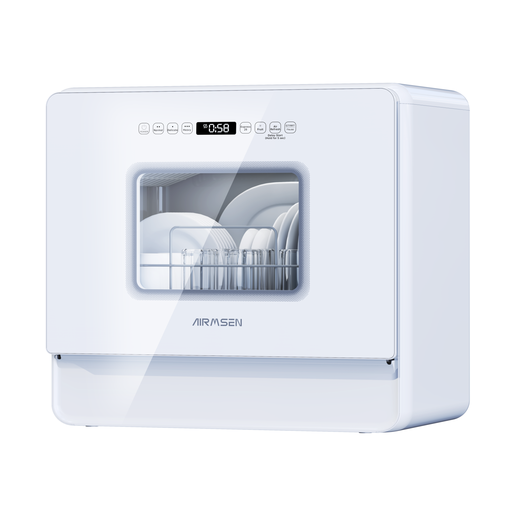
The MDWMT0305EW-WE countertop dishwasher is a compact model with a water tank option.
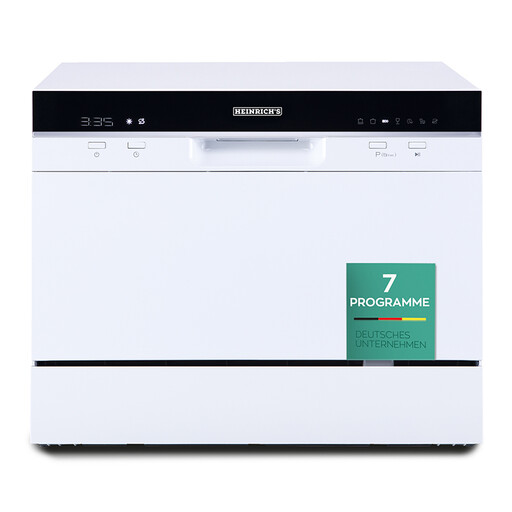
The DWT60 (MD37496) countertop dishwasher is an option for larger loads, provided there’s a suitable water supply where you plan to put it.
The Amazonia 6 is a countertop model with a nominal capacity of 6 place settings.
The selection includes compact countertop models with water tanks, as well as a model with a water connection for larger loads.
 No image available
A tank option for smaller loads if there’s no fixed water supply where you plan to put the appliance.
5-litre water tank; up to 5 place settings; two-tier rack; stated depth: 36,1 cm.
 No image available
A compact countertop appliance with a tank option for smaller loads when there’s no fixed water supply.
5-litre water tank; up to 4 place settings; external dimensions 45,8 × 42,8 × 42,5 cm; 5 wash programmes plus drying; two water-supply options.
 No image available
The tank option is worth considering if there’s no fixed water supply where you plan to put the appliance.
5-litre water tank; up to 4 place settings; stated width 37 cm; 9 wash programmes according to the product title.
 No image available
A countertop appliance with a tank option for small loads and locations without a fixed water supply.
5-litre water tank; 3 place settings; 7 programmes; extra drying function; delay timer up to 18 hours; 56,3 dB; energy class C.
 No image available
An option for larger loads if there’s a suitable water supply where you plan to put the appliance.
6 place settings; water connection; 7 programmes; automatic door opening for drying; energy class D.
No. The glass-and-fork symbol indicates that an item is suitable for food contact, not that it’s dishwasher-safe. Check the separate washing and care instructions from the manufacturer for the box, lid and individual parts.
For the Bomann TSG 5702, the manufacturer says it can be used with its integrated tank without a fixed water supply. You’ll still need to plan for drainage according to the instructions for the specific appliance you choose.
The German Environment Agency recommends removing larger food scraps and using the Eco programme with a full load wherever possible. Clean the filter and other accessible parts as directed in the appliance manual. Eco consumption figures don’t describe every other programme.
The EU dishwasher label shows, among other things, electricity use per 100 Eco cycles, water use per Eco cycle, programme duration, capacity and noise levels. Compare figures on the same Eco basis; actual running costs also depend on how you use the appliance and your tariffs.
Waste electrical and electronic equipment should be taken to an authorised collection point, such as a local authority collection centre. The German Federal Ministry for the Environment also explains that retailers have take-back obligations in certain circumstances. If you’re not buying a replacement, retailers only have to take back appliances where no external dimension exceeds 25 cm.