Renovating without a water supply
If there’s temporarily no usable water connection at your chosen spot, an appliance with a manually filled tank could be an option. You’ll also need to plan a suitable route for the wastewater.


If there’s no usable water supply at your temporary setup, a countertop dishwasher with a manually filled tank could be an option – but you’ll still need a safe way to drain the wastewater. If you have a water connection, a larger appliance may be more practical for bigger loads, but it will need more space. Above all, check that your mugs with handles fit in the rack and that there’s room for the appliance, door and hoses at your chosen spot.
If there’s temporarily no usable water connection at your chosen spot, an appliance with a manually filled tank could be an option. You’ll also need to plan a suitable route for the wastewater.
If you regularly need to wash several mugs, compare their height and handles with the rack layout and cup holders of the specific model.
When space is temporarily limited, the appliance’s actual dimensions matter, as does the room needed for the door to open, hoses and power cable.
First, work out how the appliance will get water at your renovation setup and where the wastewater will go. Then compare how well your mugs fit, the space available and the stated running costs.
| What matters | What to check before buying | Who should pay particular attention? |
|---|---|---|
| Water supply and drainage | Check whether the appliance uses a tank or a connection, and plan a safe route for the drain hose to the wastewater outlet. | If there’s no fixed water supply at my renovation setup, water provision is my priority. Around 36% of consumers first look for a suitable option that doesn’t need a fixed water supply. |
| Mug fit | Measure your largest mug, including its handle, and check the rack, cup holders and clearance for the spray arms. | If I want to fit several mugs in a load regularly, usable rack space matters more to me than the place-setting capacity. Around 29% of consumers prioritise having enough room for their mugs. |
| Space available | Compare the appliance’s dimensions with the space available, allowing room for the door to open, hoses and power cable. | With limited worktop space, the appliance needs to fit in the temporary location along with its door and connections. Around 21% of consumers put a small footprint first. |
| Running costs | Compare EU label figures on a like-for-like basis: electricity per 100 Eco cycles and water per Eco cycle. | If the appliance will be used frequently during the renovation, I want to be able to assess its consumption and upkeep clearly. Around 14% of consumers focus above all on keeping running costs manageable. |
Germany’s consumer advice centre explains how to compare electricity and water consumption using Eco programme data. These figures cannot necessarily be applied to every short programme.
Even an appliance with a manually filled tank drains the wash water through an outlet.
Before buying, check your intended location and the route the drain hose will take.
The stated capacity doesn’t tell you how many of your mugs, handles and all, will actually fit in the rack.
Measure your largest everyday mug, then check where it sits in the rack and how much clearance there is around the spray arms.
For some appliance listings, the model details in the title and description may differ.
Before ordering, check the full model number in the listing against the product data sheet.
The TSG 5702 is an example of a compact countertop appliance with an integrated tank and drain hose.
The DWT60 (MD37496) is listed as a model that connects to a water supply and holds six place settings; the DWT51 (MD 37766) uses a bucket to supply water.
The range includes compact countertop appliances and wider models that the manufacturer says hold six place settings.
The Amazonia Nano 10047351 is a compact countertop appliance that could be worth considering for a temporary setup.
These appliances are described as having a manually filled water tank, making them suitable for a temporary setup. Plan for drainage and available space using the details for each specific model.
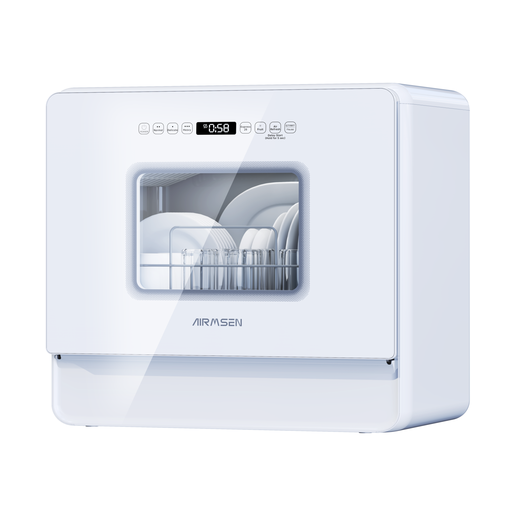 No image available
If there’s no fixed water supply, the manually filled tank could work for your renovation setup.
The description lists two rack levels, three spray arms and capacity for up to five place settings.
The appliance is 36.1 cm deep. According to the description, you’ll need at least 59.7 cm of clearance above it to refill the tank.
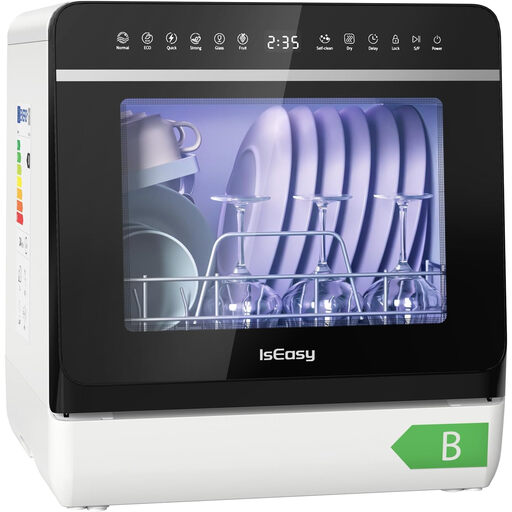
 No image available
Tank operation is an option if there’s no fixed water supply at your temporary setup.
The description lists capacity for up to four place settings, two spray arms and dimensions of 45,8 × 42,8 × 42,5 cm.
Wastewater drains through a hose into a sink or container. The safety instructions for this model require an earthed 220–240-V socket and prohibit the use of extension leads.
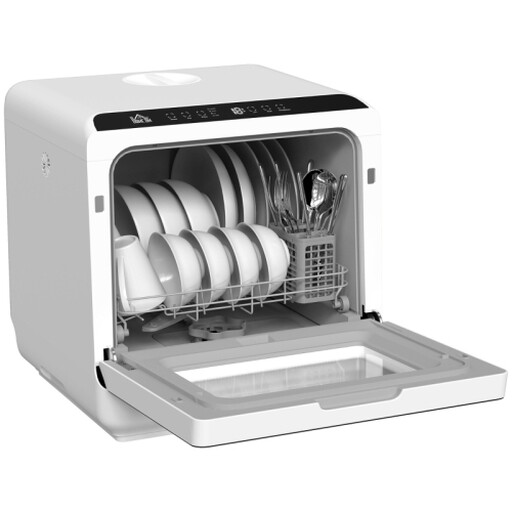
 No image available
The integrated tank suits a location without a fixed water supply.
The description lists a tap connection as another option, capacity for up to four place settings and two spray arms.
This model is listed as 37 cm wide. The safety instructions require an earthed power supply on a dedicated circuit and prohibit the use of extension leads.
 No image available
The tank operation described could be an option if there’s no fixed water supply at your chosen spot.
The description lists three place settings, seven programmes and a spray system with 14 nozzles.
The dimensions are listed as 43 × 43 × 46 cm; the inlet and drain hoses are included.
 No image available
Described as offering both tank and tap water supply, this appliance can suit locations with different water connection options.
The description lists four place settings, five programmes, two spray arms and a drying function.
The appliance dimensions are listed as 45 × 44 × 45,8 cm.
According to the manufacturer, a model with an integrated tank can operate without a fixed water supply, but it still needs a suitable drain. The Bomann TSG 5702 comes with a drain hose; set it up according to the instructions for the specific model.
No. Check the care instructions for each mug. A label showing that an item is suitable for contact with food doesn’t automatically mean it’s dishwasher-safe. Even glass marked as dishwasher-safe may come with additional care instructions.
Compare the EU label figures for electricity consumption in kWh per 100 Eco cycles and water consumption in litres per Eco cycle. To estimate your own costs, you’ll also need your expected number of washes and your actual electricity and water prices. Eco figures don’t necessarily apply to every short programme.
Follow the instructions for your chosen model when it comes to the filter, detergents and descaling. If there’s a fault, remember that your statutory rights against the seller are separate from any voluntary guarantee.
Household dishwashers are covered by EU ecodesign and energy-labelling requirements. The European Commission says the label includes details such as consumption, capacity and noise level. Germany’s Federal Network Agency also lists CE marking, product identification and German-language instructions among the checks it carries out when monitoring electrical appliances on the market. A claim in a product listing alone isn’t independent proof that a particular appliance complies with the requirements.