What should you consider when choosing one?
Start with the load you plan to wash, then check the water supply and available space. Only then compare operating information on the same Eco Label basis.
| Buying priority |
What to check |
Who it matters most to |
| Cutlery and dishes in one cycle |
Check the cutlery basket or tray alongside the actual load of plates and glasses. |
If I want to wash cutlery, plates and glasses after a meal in one cycle, I won’t rely on the place-setting capacity alone. Around 36% of consumers prioritise getting everything clean in one cycle. |
| Water supply and drainage |
Check whether the model uses a tank or a fixed water supply, and make sure there’s a safe route for the drain hose. |
If I don’t have a suitable fixed water supply, the model’s water supply needs to suit my home; I’ll still need to plan for drainage. Around 29% of consumers don’t have a suitable water supply. |
| Available space |
Check the exact model’s height, width and depth, as well as the space needed to operate and connect it where you plan to put it. |
If my worktop space is limited, I need dimensions that will fit the intended spot, with enough room for the door and hoses. Around 21% of consumers say available space is their main consideration. |
| Energy use and noise |
Compare kWh per 100 Eco cycles, litres per Eco cycle, Eco programme duration and noise levels on the same basis. |
If the appliance will be near a living area in the evening, I’ll pay attention to the noise level as well as Eco programme consumption. Around 14% of consumers prioritise energy use and noise. |
Countertop dishwashers at Joybuy
This selection includes compact countertop models for shared meals, including options with a tank or tap water supply and appliances with different place-setting capacities. Before choosing, check the actual load and the connection you’ll need.
 No image available
AIRMSEN countertop dishwasher with 5-l water tank
The product information describes a compact countertop dishwasher with either a tank or tap water supply. Check that it will fit your cutlery and dishes.
It lists four complete place settings, a 5-l tank and energy efficiency class D.
View at Joybuy
 No image available
Heinrich's HTG 8855 countertop dishwasher
The product information describes both tank and tap water supply. Before buying, check that the capacity will suit your cutlery and dishes.
View at Joybuy
 No image available
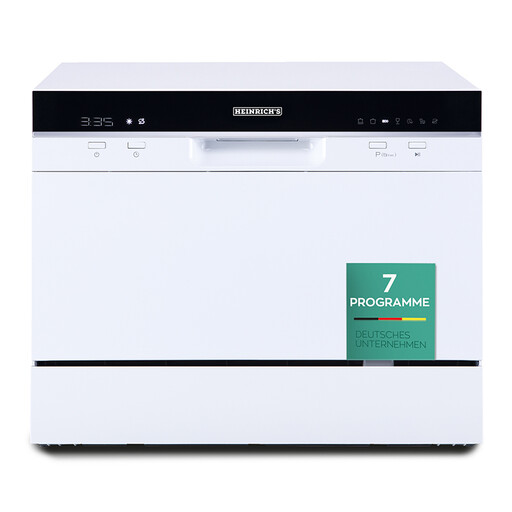
Heinrich's HTG 8840 White
With six place settings and a cutlery basket, this model may suit consumers who want to load cutlery and other dishes together, according to the product information.
It’s described as having a water connection, seven programmes, using 6.5 l of water per cycle and producing 47 dB of noise.
View at Joybuy
 No image available
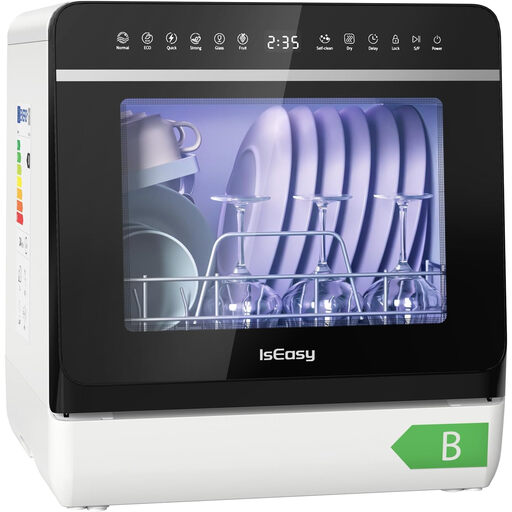
Countertop dishwasher with 5-l water tank
This compact countertop model is described as suitable for consumers who want to wash dishes without a fixed water connection. Check how the drain can be routed where you plan to put it.
The product information lists three place settings, a cutlery basket and a 5-l water tank.
View at Joybuy
 No image available
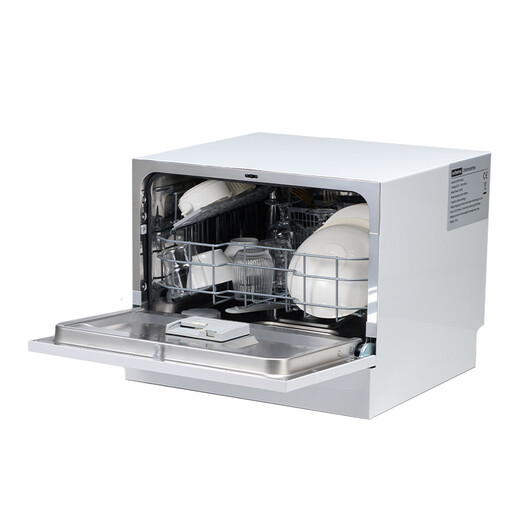
Ochama countertop dishwasher, 6 standard place settings
The product description lists six standard place settings and includes cutlery as a possible load. Check how this compares with your own dishes.
The product title lists a 30-minute quick programme and a 24-hour delay start; the description lists eight functions and a water softener.
View at Joybuy
Frequently asked questions
Is three place settings enough for the cutlery from a shared meal?
You can’t tell from the place-setting capacity alone. Check your cutlery, plates and glasses together against the load you plan to wash. Midea lists a fold-down cutlery tray for its three-place-setting model; the Bomann model with six place settings is listed with a cutlery basket.
How can I load cutlery safely and use the Eco programme?
Follow the instructions for the model you have. The Bomann instructions say that cutlery shouldn’t protrude above the basket; sharp points should face down in the cutlery basket or lie flat in the dish basket. The German Environment Agency recommends removing food scraps, avoiding a warm-water pre-rinse and using the Eco programme with a full load.
What information should I compare to check energy use?
Compare EU Energy Label figures on the same basis: energy for 100 Eco cycles, water per Eco cycle, Eco programme duration and noise level. The European Commission lists these as dishwasher label information; actual costs also depend on how you use the appliance and your own tariffs.
What energy labelling applies to household dishwashers in Germany?
Household dishwashers on the EU market use the EU Energy Label. According to the European Commission, the label used since 1 March 2021 includes a scale from A to G, energy consumption for 100 Eco cycles, water consumption per Eco cycle, capacity, Eco programme duration and noise level. The label doesn’t recommend a particular efficiency class.
If something goes wrong, what’s the difference between statutory rights and a guarantee?
Your statutory rights against the seller are separate from a voluntary manufacturer’s guarantee. The German consumer advice centre describes a general two-year statutory warranty in Germany; rules for certain repairs have changed since 31 July 2026.


