Choose a countertop dishwasher by first checking the available space, including room to open the door, and then making sure it can fit the crockery you use every day. A tank model can do away with a fixed water supply, but you’ll still need a suitable way to drain the water and will have to refill the tank regularly. For suitable appliances, compare Eco consumption figures and noise levels on a like-for-like basis too.
Who is a countertop dishwasher suitable for?
People with a narrow kitchen run
If a dishwasher and a single hob have to share the same worktop, the appliance’s dimensions and the space needed to open the door both matter. The consumer advice centre recommends comparing factors such as place settings and consumption figures when choosing a dishwasher.
People who cook for themselves and wash up every day
If you cook every day, remember to check the dimensions of the frying pan or saucepan you use regularly, as well as your plates and cutlery. The stated number of place settings alone doesn’t tell you whether your own cookware will fit in the basket.
People without a suitable fixed water supply
Tank filling and flexible connection options may affect where you can put the appliance, but you’ll still need a reliable way to drain the wastewater. Manufacturers’ specifications for connection types and supplied hoses vary by model.
What should you look for when buying?
First, check that the appliance will fit and that the water supply and drainage will work. Then see how the interior and running costs fit into your everyday routine.
| Concern |
What to check before buying |
Who should pay particular attention? |
| Space beside the hob |
Measure the appliance’s width, height and depth, as well as the room needed for the door to open at the intended location. |
If the hob already takes up worktop space, I want to know in advance how much will still be usable once the appliance is in place. Around 36% of consumers prioritise the space available. |
| Whether crockery and cookware will fit |
Check your plates, frying pan and saucepan against the basket layout and door opening of the specific model; place settings don’t guarantee a fit. |
If you cook every day, you’ll probably want to avoid having to hand-wash the frying pan you use most often. For around 29% of consumers, fitting their everyday crockery and cookware is the main priority. |
| Water supply and drainage |
Check whether tank filling or a water supply connection will work at the intended location, and how to drain the wastewater according to the appliance instructions. |
If there’s no suitable fixed water supply, I need a practical alternative without overlooking drainage. Around 21% of consumers prioritise the water connections. |
| Consumption and noise |
Compare Eco electricity consumption per 100 cycles, water consumption per cycle, programme duration and noise on a like-for-like basis. |
If I use the appliance regularly, I want to compare its consumption and noise figures, and consider how often I can load it efficiently. For around 14% of consumers, running costs and performance are the main concern. |
For dishwashers, the EU energy label shows details including electricity consumption on the Eco programme per 100 cycles, water consumption per cycle, place settings, programme duration and noise. The German Environment Agency bases its comparison with hand-washing on a full load using the Eco programme.
Common buying mistakes to avoid
-
Assuming place settings mean there’s room for a frying pan and saucepan
The stated number of place settings doesn’t prove that your own cookware will fit. If a frying pan you use regularly is too large, you’ll still need to wash it by hand.
Measure the larger items you use regularly and check their dimensions against the basket and door opening of the specific model.
-
Assuming “no fixed water connection” means “no tap or drain needed”
A tank can replace a fixed water supply, but the wastewater still needs to drain away. Other connection types also require a water supply and drainage arrangement that suits the model and its location.
Check the water supply and drainage requirements for the specific appliance and planned location before choosing a connection type.
-
Assuming low consumption figures mean savings, regardless of how full the appliance is
The German Environment Agency’s comparison of dishwashers with hand-washing is based on a full load using the Eco programme.
Compare Eco figures on the same basis and consider how often you can fill the appliance efficiently with the crockery you use every day.
Key brands at a glance
Bomann
According to the manufacturer, the TSG range includes a tank model with 3 place settings and a countertop model with 6 place settings.
- Bomann says the TSG 5702 has an integrated tank and comes with water inlet and drain hoses.
- The TSG 7404’s higher stated capacity doesn’t tell you whether a particular saucepan or frying pan will fit.
MEDION
The DWT30 (MD370022) is aimed at buyers who want to choose between tank, mains connection and bucket operation.
- MEDION lists 3 place settings and three operating modes for this model.
- Check that the water supply and drainage arrangements suit your planned location. The manufacturer’s claims about cleaning or drying aren’t independent evidence of performance.
Midea
According to the manufacturer, the MDWMT0305EW-WE and MDWTT0602MW-WE countertop models differ in features including width and stated capacity.
- Midea lists the MDWMT0305EW-WE as 420 mm wide, with 3 place settings.
- The MDWTT0602MW-WE is wider at 550 mm. Its higher stated capacity also means it takes up more space.
Klarstein
According to the manufacturer, the Aquatica is a 42 cm-wide countertop model that connects to a tap.
- Klarstein lists a capacity of 2 place settings for this model.
- A tap connection isn’t the same as an integrated tank, so check that the water supply and drainage arrangements will work where you plan to put it.
Joybuy products for small kitchens
This Joybuy selection includes compact countertop dishwashers, including tank models and appliances with a connection option. Check the dimensions and water supply and drainage arrangements against your available space.
 No image available
AIRMSEN portable countertop dishwasher with 5-litre tank
A compact tank model may be worth considering if there’s no fixed water supply at the intended location.
The product title lists an integrated 5-litre tank and 5+1 wash cycles. According to the product information, wastewater must be directed to a sink or container using the drain hose.
Joybuy
 No image available
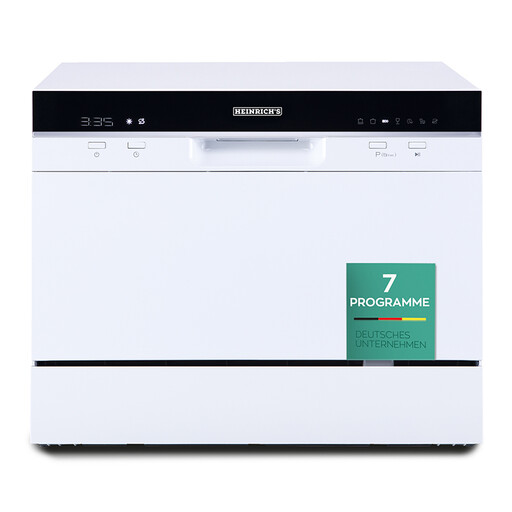
Heinrich's HTG 8855 countertop dishwasher
This model may suit you if a compact appliance with tank operation or a water connection works with your planned water supply and drainage arrangements.
The product title lists 3 place settings, 7 programmes and 56.3 dB. The drain hose is specified as 1500 mm long, so check that it will reach the intended drain.
Joybuy
 No image available
Heinrich's HTG 8840 Weiss countertop dishwasher
This appliance may be an option if you need more stated capacity and have a water connection at the intended location.
The product title lists 6 place settings and 7 programmes; the product information gives a noise level of 47 dB. Only compare noise figures measured on the same basis.
Joybuy
 No image available
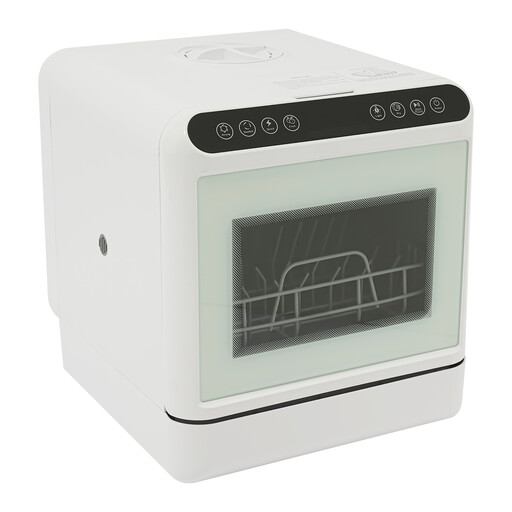
Portable compact countertop dishwasher with 1.32-gallon tank
An integrated tank may be useful if there’s no fixed water supply at the intended location; check how the appliance drains too.
The product title lists a 1.32-gallon tank, hot-air drying, a 72-hour storage function and suitability for 4–6 people.
Joybuy
 No image available
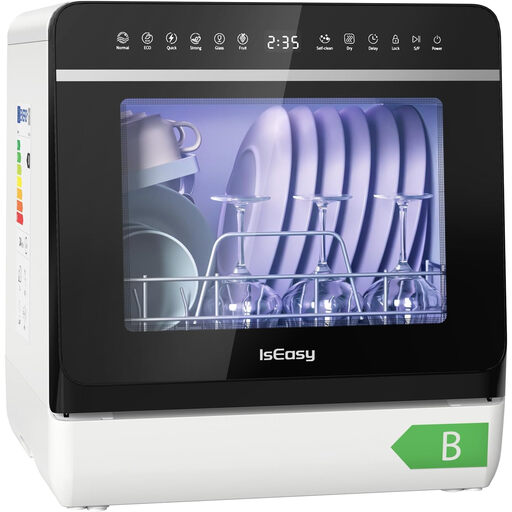
Mini countertop dishwasher with 5-litre water tank
A tank model may suit you if you want to avoid a fixed water supply and have a suitable way to drain the wastewater.
The product title lists a 5-litre water tank.
Joybuy
Frequently asked questions
Can I use a tank model straight away anywhere without a fixed water connection?
No. A tank model still needs suitable drainage and a suitable place to stand. For the Bomann TSG 5702, the manufacturer lists a 5-litre tank and water inlet and drain hoses.
What do the consumption figures on the energy label mean?
Compare electricity consumption in kWh per 100 Eco cycles and water consumption in litres per Eco cycle. The label also lists place settings, Eco programme duration and noise; figures from other programmes aren’t directly comparable. The consumer advice centre describes these details as important factors when choosing a dishwasher.
How can I run my dishwasher as efficiently as possible?
The German Environment Agency recommends using the Eco programme with a full load wherever possible. Arrange the crockery so the items don’t block one another, and follow the appliance instructions for detergent and care.
Who should I contact in Germany if the appliance develops a fault?
The seller is generally responsible for your statutory rights if the product is faulty. The consumer advice centre states that in Germany the period is two years from delivery; this is separate from any voluntary manufacturer’s guarantee.
What labelling should I check when buying online?
For household dishwashers that must carry an energy label, the EU energy label must also be clearly visible when you shop online. Check that the label and product information relate to the model being sold; the old plus classes have not been used for dishwashers since 2021.


