Class leaders with lots of place settings
If plates, cups and cutlery from several participants build up after a class, the usable load per cycle matters. Bomann and Midea offer countertop models rated for six place settings.


If a class leaves you with dishes from several participants and you can arrange water supply and drainage at the chosen spot, start by looking at countertop models with capacity for six place settings. For smaller loads or where there’s no fixed water supply, a model specifically designed for manual filling may be suitable. You’ll still need to consider drainage and whether your plates and bowls will actually fit. A short programme doesn’t offer the same consumption figures as an Eco programme.
If plates, cups and cutlery from several participants build up after a class, the usable load per cycle matters. Bomann and Midea offer countertop models rated for six place settings.
If there’s no suitable fixed water supply where you plan to place the dishwasher, models that can be filled manually may be an option. Midea and MEDION describe models with these connection options, but you’ll still need to arrange safe drainage.
If you also need the worktop for preparing and cooking food, the appliance dimensions and basket layout must suit the space available and the dishes you use. Midea gives the dimensions of the MDWMT0305EW-WE as 435 × 420 × 465 mm.
For a weekend cookery class, the number of dishes per session, water supply and space in the work area are the main factors in deciding which type of appliance will suit you.
Suitable if: you regularly have dishes from several participants and can access a suitable water inlet and drain.
Consider: the higher stated capacity takes up more space, and doesn’t tell you whether large bowls or cookware will fit in the basket.
Suitable if: there’s no fixed water supply and a smaller load will do, or you can split the dishes between several cycles.
Consider: manual filling doesn’t remove the need to plan for wastewater, or for extra cycles when you have a larger group.
| What to consider | What to look for | Who it matters to |
|---|---|---|
| Load per cycle | Compare the place-setting capacity and basket layout with your own plates, bowls, mugs and cutlery. | If I want to fit as much class crockery as possible into one cycle, I’ll check the shape of my dishes as well as the place-setting capacity. Around 36% of consumers prioritise capacity. |
| Water supply and drainage | Check the inlet type, hose reach and whether there’s a safe, usable drain for the specific model. | If there’s no fixed water supply at the class venue, I’ll need a suitable way to fill the dishwasher and safely drain the wastewater. Around 29% of consumers prioritise the water supply at the installation spot. |
| Space and dish fit | Measure the space, including room to open the door and route the hoses; check larger items against the loading instructions. | If there’s little worktop space or my bowls are an unusual size, the dishwasher needs to fit without taking over the preparation area. Space and dish fit account for around 21% of consumers’ top priorities. |
| Wash time and consumption | Check the programme duration and suitability for the types of soiling you usually have; compare Eco consumption figures only with equivalent Eco figures. | If dishes are needed again between classes, the programme duration and clear consumption figures matter. Around 14% of consumers prioritise wash time and running costs. |
The stated number of place settings won’t necessarily include the plates, bowls and cookware you actually use in your class.
Check the loading diagram against the dishes you typically use, and compare their dimensions with the basket and holders in the specific model.
If everything doesn’t fit, you may need extra cycles or to wash some items by hand.
Even with manual filling, wastewater needs to be drained safely. The connection equipment varies by model.
Check the water inlet and drain separately, and plan the installation spot so the drain hose can be routed safely.
Even with a flexible water supply, you’ll still need a suitable location and a safe way to drain wastewater.
Comparable figures on the EU energy label relate to the Eco programme and don’t show how much a quick programme uses.
Compare Eco figures on a like-for-like basis, and check the quick programme’s duration and suitability separately.
The TSG 7405 is a countertop model rated for six place settings.
Midea’s German model range includes the six-place-setting MDWTT0602MW-WE and the three-place-setting MDWMT0305EW-WE countertop dishwashers.
The LIFE Mini DWT20 (MD370764) is designed for up to two place settings.
The Aquatica, article number 10047348, is designed for two place settings and connects to a tap, according to Klarstein.
The selection includes countertop models for six place settings as well as more compact options, including models with a water tank. Check the connection type, drainage and capacity of each model individually.
 No image available
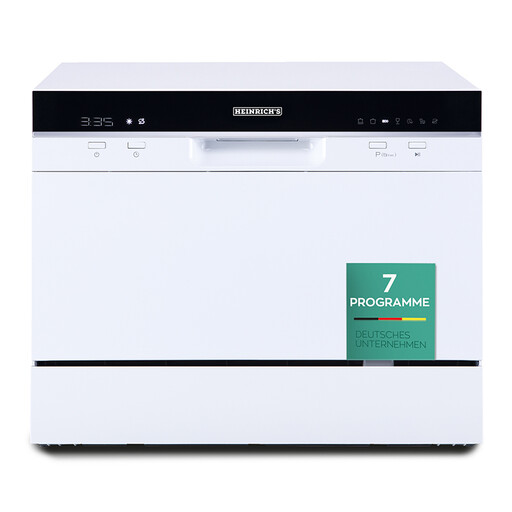
An option if you need room for several place settings per cycle and a short programme to fit around classes.
Rated for six place settings, it has seven programmes and a 30-minute quick programme. Water inlet and drain hoses: 1500 mm and 1720 mm respectively.
 No image available
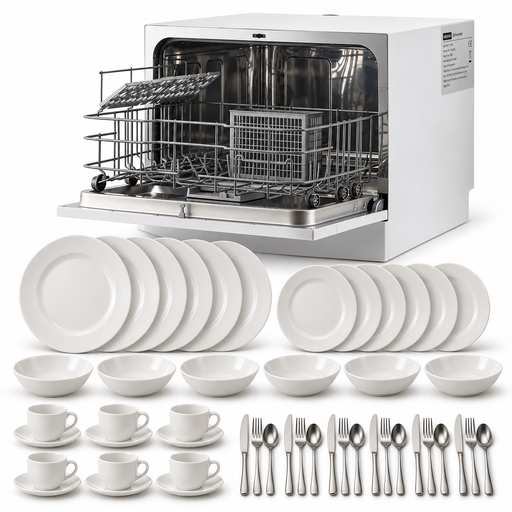
An option for classes where you need room for several place settings per cycle and a short programme.
Rated for six standard place settings, it has eight functions and a 30-minute quick programme. The product information says it’s intended for domestic use; if you’re running a commercial cookery class, check its suitability for that use separately before buying.
 No image available
The water tank option may suit you if there’s no fixed water supply where you plan to place the dishwasher; check that its stated capacity meets your class’s needs.
Rated for four place settings, it has nine programmes and measures 37 × 50 cm. A separately sold adapter may be needed to connect it to a tap.
 No image available
A more compact option for smaller loads when you need flexibility in how you supply water.
Rated for three place settings, it has seven programmes, a 5-litre water tank or direct tap connection, and a 35-minute quick programme. Larger classes may require extra cycles.
 No image available
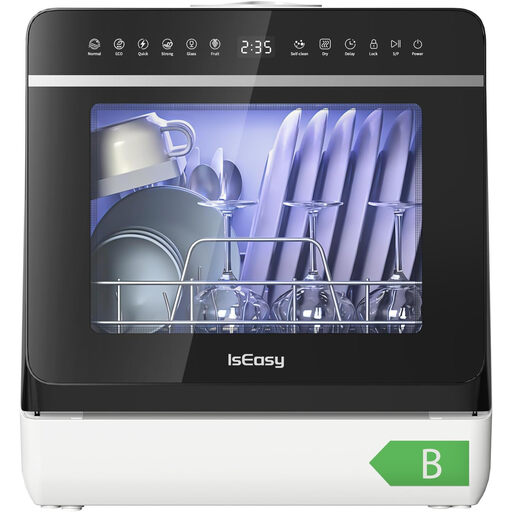
The water tank version mentioned in the product name may be useful if there’s no fixed water connection where you plan to place the dishwasher; check that its specific capacity suits your class.
The product name mentions a water tank and a flexible hose.
Measure the space, including room to open the door, and check the routes for the water inlet and drain for the specific model. Even a model that’s filled manually needs a suitable way to drain wastewater.
Compare figures on a like-for-like basis: kWh per 100 Eco cycles and litres per Eco cycle. Don’t apply these figures to a quick programme. The German Environment Agency recommends using the Eco programme and running the appliance with a full load to save energy and water.
Allow for detergent and appliance care in line with the instructions for your model. Running costs depend on the programme you actually use, how often you run the dishwasher and local tariffs.
It depends on whether the class is run as a food business. If it is, the operator is responsible for food safety under Regulation (EC) No 852/2004 and must meet the relevant hygiene requirements; the German Federal Office of Consumer Protection and Food Safety explains the obligations of food businesses. This doesn’t automatically confirm that a particular domestic appliance is suitable for commercial use.