Hosts with lots of mugs to wash
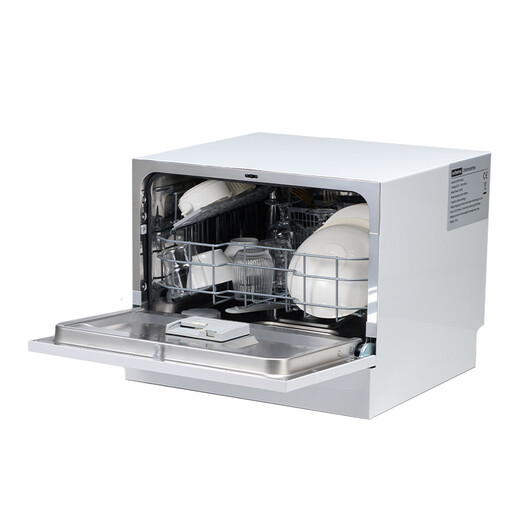
If you want to wash mugs and other dishes together after a meal, check the basket and cup rack against the mugs you use. Bomann lists a cup rack and capacity for six place settings for the TSG 7405.


The key things to consider are the dimensions of your dishwasher-safe mugs, the usable basket space and where you’ll put the appliance. Place settings don’t guarantee a particular number of mugs. If there’s no fixed water supply, a model with a tank or flexible water-supply options may suit you. For larger shared loads, a model connected to the water supply may be a good fit, provided you have water inlet and drainage points.
If you want to wash mugs and other dishes together after a meal, check the basket and cup rack against the mugs you use. Bomann lists a cup rack and capacity for six place settings for the TSG 7405.
A model with manual water filling may work if you can still arrange suitable drainage where you plan to put it. MEDION lists tank and bucket filling for the DWT30, while Midea describes the MDWMT0305EW-WE as usable with or without a water connection.
For this, the length of a suitable programme matters. Bomann lists a 30-minute quick programme for the TSG 7405, and the Verbraucherzentrale recommends comparing programme durations.
A good fit if: There’s no fixed water supply where you plan to put it and your mugs fit in the basket.
Consider: The tank doesn’t remove the need to plan for suitable drainage. A capacity of three place settings doesn’t guarantee space for three large mugs and other dishes.
A good fit if: You regularly want to wash mugs and other tableware together, and have water inlet and drainage points. Bomann lists capacity for six place settings for the TSG 7405.
Consider: The connection, available space and actual mug height all need to suit your location and load.
A good fit if: A small load is enough and you’d find a water connection or manual filling useful where you plan to put it. Midea lists these options for the MDWMT0305EW-WE, which has capacity for three place settings.
Consider: Flexible water supply doesn’t give you more interior space. If you have lots of mugs, you may need to run several loads.
| What matters when buying | What to check | Who it matters to |
|---|---|---|
| Number of mugs and interior space | Measure your mugs, including the handles, and check the basket and cup rack against the available dimensions. | If you want to wash mugs and other dishes together after dinner, usable basket space matters more than the place-setting capacity alone. Around 36% of consumers put suitable mug capacity first. |
| Water supply and drainage | Check whether the exact model uses a tank or a water connection, and read the drainage instructions. | If you don’t have a fixed water supply, you’ll want to know whether the water supply will work where you plan to put the appliance and where the waste water can drain. Around 29% of consumers prioritise water supply and drainage. |
| Wash time in the evening | Check programme duration and suitability for the load and level of soiling. Consider quick and Eco programmes separately. | If you need your mugs again that same evening, the duration of a suitable programme is key. Around 21% of consumers prioritise wash time. |
| Electricity and water consumption | Compare figures for the same programme and take the expected load into account. | If you plan to use the appliance regularly, compare its consumption as well as its capacity. Around 14% of consumers put running consumption first. |
The stated capacity doesn’t tell you how many of your handled mugs will actually fit.
Measure the mugs you use most often and check the basket design, cup rack and available interior height for the exact model.
If the fit isn’t right, you may need to run extra loads or continue washing some items by hand.
On appliances designed for it, a tank can replace a fixed water supply, but it doesn’t take care of draining the used water.
Before buying, check the instructions for the exact model to see how drainage will work in the space you have in mind.
The Verbraucherzentrale explains that the consumption figures on the energy label relate to the Eco programme. A quick programme works differently.
Compare duration and consumption on a like-for-like programme basis, and choose a quick cycle suited to the load and level of soiling.
The details below apply to the specific models mentioned and aren’t a general assessment of each brand’s full range.
The TSG 7405 is a connected option for larger shared loads of dishes.
The LIFE Mini Dishwasher DWT30 (MD370022) is a compact option with several ways to supply water.
Midea offers both a compact model with flexible water supply and a separate option with capacity for six place settings.
The Amazonia Nano 10047351 is a compact countertop option for spaces where room is limited.
This selection of Joybuy products includes compact countertop dishwashers for mugs, including models with tank or connection options. For each model, check how your mugs fit in the basket and what drainage is required.
 No image available
The integrated tank is useful if there’s no fixed water supply where you plan to put it. Remember to plan for drainage too.
The product title lists 9 programmes, 37 × 50 cm and energy class D.
 No image available
Described as usable with or without a water connection. Check how you can arrange drainage where you plan to put it.
The product title lists 3 place settings, 7 programmes, 56,3 dB and energy class C.
 No image available
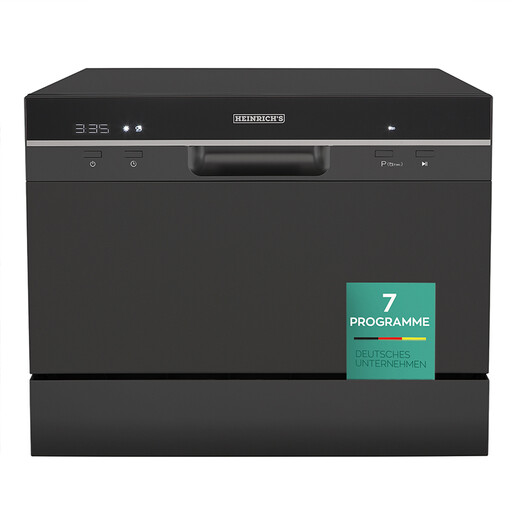
The stated capacity could be useful for washing mugs alongside other dishes. Check that your mugs fit in the basket before buying.
The product title lists 6 place settings, 7 programmes and energy class D.
 No image available
The stated capacity and quick programme could work well for shared evening loads. Check the basket dimensions against your mugs.
The product title lists 6 standard place settings and a 30-minute quick cycle.
 No image available
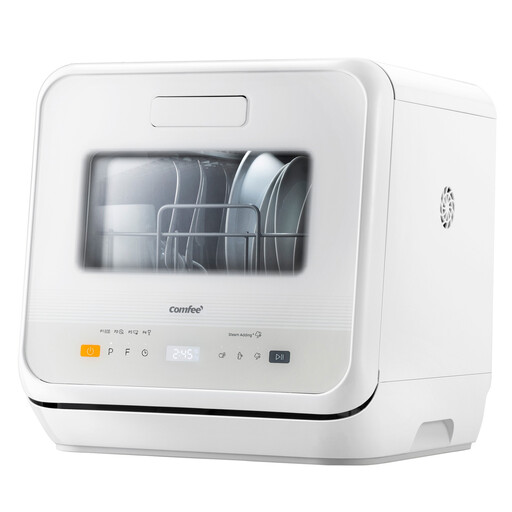
The tank is an option if there’s no fixed water supply. You’ll still need to make sure drainage is suitable for the location.
The product title lists 6+3 programmes and energy class D.
Not necessarily: place settings don’t guarantee space for a particular number of large mugs. Measure your mugs and handles, then check the dimensions against the basket, cup rack and interior of the specific model.
No. A tank can replace a fixed water supply, but the used water still needs to drain as set out in the instructions for that appliance. Check the location, power supply and drain hose before use.
Follow the care instructions from the mug’s manufacturer. According to the Verbraucherzentrale, the glass-and-fork symbol indicates that an item is suitable for food contact, not that it’s dishwasher-safe.
Compare figures on the same programme basis: the Verbraucherzentrale identifies electricity consumption per 100 Eco cycles and water consumption per Eco cycle as relevant figures. For efficient use, the Umweltbundesamt recommends running the Eco programme with a full load wherever possible. Also follow the appliance’s care instructions.