When several people need the same cutlery after a shared meal, the usual load needs to suit the dishwasher’s capacity and the time when the cutlery will be needed again. A larger countertop model with a cutlery basket and delay start can make it easier to wash a shared load. If space is limited or there’s no permanent water connection, a smaller model with an alternative way to fill it may be worth considering, though you may need to run extra cycles. Also check the water supply, drainage and consumption figures for the specific model.
Who are countertop dishwashers suitable for?
Households who cook together
If you need your cutlery and crockery again before the next time you cook together, the key considerations are the size of your usual load, the cutlery storage and the programme duration. The Verbraucherzentrale recommends comparing place settings and the length of the Eco programme too.
Small kitchens without a permanent water connection
If you have limited worktop space or no permanent water supply, check the dimensions and the specified filling method for the model you’re considering. Midea describes its MDWMT0305EW-WE model as usable with or without a water connection; its lower capacity may mean extra cycles for larger shared loads.
What should you look for when buying?
Larger countertop model with a permanent connection
A good fit if: you regularly have a larger load of cutlery and crockery after shared meals, and the installation space has water supply and drainage available.
The trade-off: The models listed with six place settings take up more space than Midea’s three-place-setting mini model. A delay start alone won’t tell you when the programme will finish.
Smaller model with an alternative filling method
A good fit if: space is limited or you can’t use a permanent water supply, and your usual load is small. Midea lists three place settings for the MDWMT0305EW-WE and says it can be used with or without a water connection.
The trade-off: The lower capacity may mean extra cycles for larger shared loads. You’ll also need to make sure the drainage works at the installation location.
| What matters |
What to check before buying |
Who is this particularly important to? |
| Shared loads |
Compare place settings, appliance dimensions and cutlery storage with your usual load; check whether the cutlery basket or tray will work with your crockery. |
If cutlery and bowls build up after cooking together, I want to know whether they’ll all fit in one load. Around 33% of consumers prioritise fitting a shared load. |
| Getting the timing right |
Check the delay-start function and the duration of the programme you actually plan to use; allow time to unload before your next cooking session. |
If I need the cutlery again for a particular meal, I want to be able to plan when the cycle starts and finishes. Around 27% of consumers prioritise planning when they buy. |
| Space and connections |
Measure the available space and check the water supply, drainage, hose routing and socket against the instructions for the specific model. |
If there’s not much room where I plan to put it, or I can’t use a permanent water supply, I need to check the installation and water connections first. Around 27% of consumers prioritise connection or space requirements. |
| Everyday consumption |
Compare Eco programme figures on a like-for-like basis and consider how many full loads you’re likely to run. |
If I want to understand the ongoing running costs, I need figures that reflect how I expect to use the appliance. Around 13% of consumers prioritise consumption. |
Common buying mistakes
-
Assuming place settings guarantee a certain cutlery capacity
Three place settings with a cutlery tray and six place settings with a cutlery basket describe appliances with different features. The number alone won’t tell you whether your particular cutlery and bowls will all fit.
Use your usual shared load as a guide and check the basket or tray on the exact model.
If the whole shared load won’t fit, you may need to run extra cycles.
-
Confusing “no permanent water connection” with “no need to plan for drainage”
An alternative way to fill the dishwasher doesn’t automatically take care of where the used water goes.
Before buying, check the instructions for the specific model to confirm how to fill it, how to drain it and how much space it needs.
You’ll need to arrange a suitable installation and drainage at the intended location.
-
Comparing quick programmes with Eco consumption figures
The EU label shows consumption figures and programme duration for the Eco programme; a separate quick programme is a different setting.
Compare appliances on the same Eco basis, then check which programmes fit your shared schedule. The Umweltbundesamt recommends using the Eco programme with a full load wherever possible and not pre-rinsing dishes.
Brands and model ranges to consider
Midea
The manufacturer’s German product information includes a mini model with three place settings and a countertop model with six.
- For the MDWMT0305EW-WE, Midea lists a foldable cutlery tray and says it can be used with or without a water connection. For the MDWTT0602MW-WE, the manufacturer lists a cutlery basket and a delay-start function of 1–24 hours.
- The larger capacity requires more space. Manufacturer specifications are not a comparative cleaning test.
Bomann
According to the manufacturer, the TSG 7405 is a countertop model for six place settings with a cutlery basket.
- Bomann lists delay-start options of 2, 4 or 6 hours, with inlet and outlet hoses included.
- The stated appliance dimensions are 43,8 × 55,0 × 50,0 cm. Check that the available space and connections will work at your chosen location.
Medion
The manufacturer describes the DWT60 (MD37496) as a countertop dishwasher for six place settings.
- For this version, Medion lists seven programmes and a water connection.
- Check the specific listing to make sure it’s this exact model variant and that it’s suitable for your installation location.
Klarstein
The Amazonia Nano range offers compact countertop models that may suit kitchens with limited space.
- For the black version, the manufacturer lists a width of 42 cm, six programmes and a maximum noise level of 58 dB.
- Before buying, check the water connection details against the instructions for the exact variant. Manufacturer claims don’t prove an independent cleaning advantage.
Countertop dishwashers at Joybuy
The options below include countertop models for larger shared loads and more compact models with an alternative way to fill them. Compare capacity, cutlery storage and connection requirements with your available space and cooking schedule.
 No image available
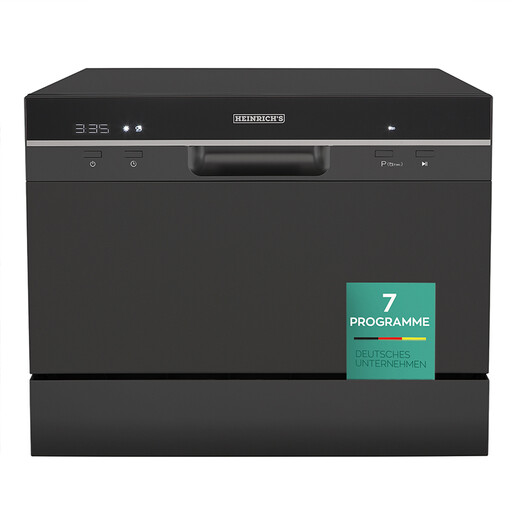
Heinrich's HTG 8840 Black
The listed capacity of six place settings and cutlery basket may suit shared loads.
The product name lists seven programmes, a 24-hour delay start and a 30-minute programme.
View at Joybuy
 No image available
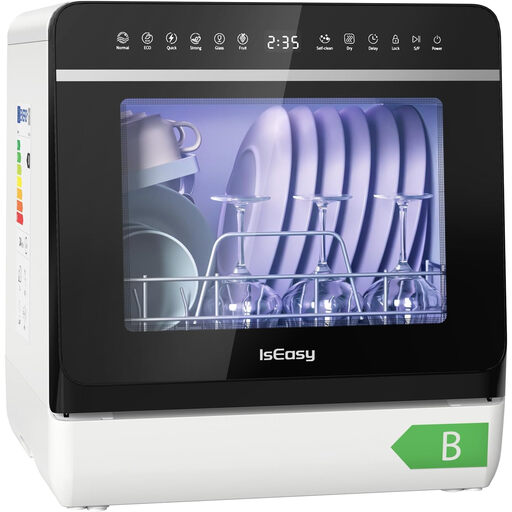
Countertop dishwasher with a 5-litre water tank
The water tank is worth considering if you can’t use a permanent water connection where you plan to install the dishwasher.
The product name lists a 5-litre water tank. If you have a larger shared load, check the capacity of the specific listing before buying.
View at Joybuy
 No image available
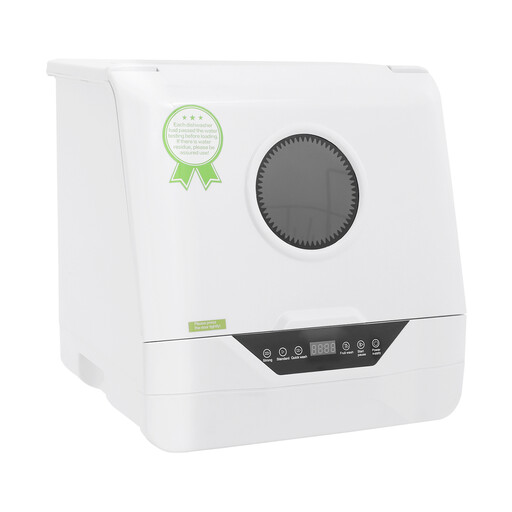
Compact countertop dishwasher, 220 V, 800 W
This countertop design may suit a worktop. Check that the appliance dimensions fit your available space first.
The product name lists 220 V, 800 W and four wash modes.
View at Joybuy
 No image available
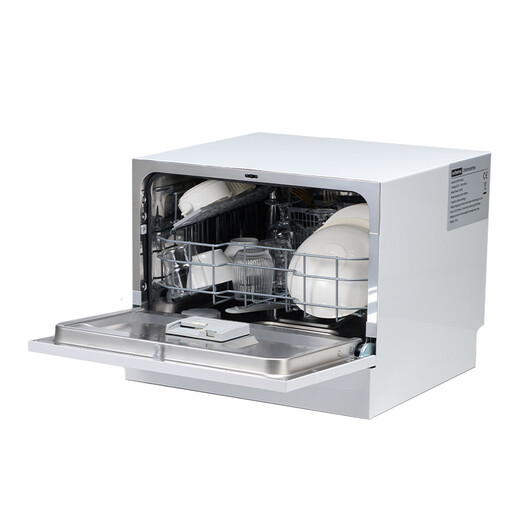
Ochama countertop dishwasher for six standard place settings
The listed capacity of six standard place settings may suit households that collect cutlery and crockery together.
The product name lists a 30-minute quick programme, a 24-hour delay start and eight functions.
View at Joybuy
 No image available
Heinrich's HTG 8855
According to the product name, this model can be used with or without a water connection, which may make it worth considering if there’s no permanent supply at your chosen location.
The product name lists three place settings, a cutlery basket, seven programmes and a 24-hour delay start. Larger shared loads may need extra cycles.
View at Joybuy
Frequently asked questions
Is the glass-and-fork symbol enough to tell whether cutlery is dishwasher-safe?
No. According to the Verbraucherzentrale, the glass-and-fork symbol indicates that an item is suitable for food contact, not that it’s dishwasher-safe. Check the manufacturer’s guidance for the specific cutlery instead.
How can you organise shared wash cycles without unnecessary pre-rinsing?
The Umweltbundesamt recommends using the Eco programme with a full load wherever possible and not pre-rinsing dishes, especially with warm water. Also agree on when you’ll need the cutlery again; the finish time depends on the programme you choose.
What information helps you compare consumption?
The EU label includes figures such as electricity use per 100 Eco cycles and water use per Eco cycle. The Verbraucherzentrale also recommends considering place settings and Eco programme duration. Include the expected number of wash cycles in your comparison.
Does a countertop dishwasher in Germany need an EU energy label?
EU energy labelling applies to household dishwashers. The Umweltbundesamt describes the A to G scale used since 1 March 2021. Check the label for the exact model on offer rather than relying on older energy-class information.


