Single person without a permanent water supply
You’re looking for a compact appliance for cutlery and a small amount of crockery, and you can fill the tank and safely drain the wastewater.


If you only have a small amount of cutlery and crockery to wash each day, a compact countertop model with a suitable cutlery holder is an obvious choice. If you don’t have a permanent water supply, consider a model with a tank. If you tend to save up several meals’ worth of dishes, a larger model with six place settings and a cutlery basket may suit you better, but it will need more space and a suitable water connection. Before buying, check that your longest cutlery fits and consider how the Eco programme’s consumption figures compare with the way you plan to use it.
You’re looking for a compact appliance for cutlery and a small amount of crockery, and you can fill the tank and safely drain the wastewater.
You’d like to wash cutlery and crockery from several meals together, and have the space and a suitable water connection for a larger countertop model.
The appliance’s width and depth, the space in front of the open door and the cutlery holder itself matter more to you than extra programmes.
Start by checking the cutlery holder and water supply and drainage, then consider the space required and consumption in relation to your usual loads.
| Buying priority | What to check before buying | Who is it important to? |
|---|---|---|
| A suitable cutlery holder | Check whether the specific model has a cutlery basket or tray, and read its manual for interior space and loading limits; measure your longest items. | If I want to fit my longest knife or serving cutlery inside, I don’t want to rely on the place-setting capacity alone. Around 29% of consumers say finding a suitable cutlery holder is their top priority. |
| Water supply and drainage | Check whether the specific model uses a tank or a water connection, and how the wastewater can be drained safely. | If there’s no permanent water supply, a tank could work for me—as long as I can fill it and drain the water where the appliance will be installed. Around 24% of consumers pay particular attention to flexible water supply options. |
| Space and load capacity | Measure the width, depth and height, as well as the clearance needed for the open door at the intended location; don’t assume capacity means there’s room for large pans. | With a small worktop, I want to know whether the appliance will really fit with its door open before choosing a model with a larger capacity. Space and usable capacity are the main considerations for consumers who choose an appliance based on these factors first; this accounts for around 24%. |
| Consumption and care | Compare Eco electricity consumption per 100 cycles, water per Eco cycle, programme duration and noise level; also check the model’s care instructions. | When I live alone, I want to know how often I’ll have a sufficiently full load and how much care the appliance will need. Around 23% of consumers pay particular attention to consumption and ongoing care. |
A cutlery basket and a fold-down cutlery tray offer different ways to arrange your cutlery. The number of place settings alone won’t tell you whether there’s room for long knives or serving cutlery.
Measure longer items and check the interior space and loading instructions for the exact model.
A tank can replace a permanent water supply, but the wastewater still needs to be drained safely.
Plan the drainage according to the appliance instructions and check whether the required hose routing is possible where you intend to install it.
Depending on where you install the appliance, you may also need a suitable way to route the waste hose safely.
An Eco figure refers to a defined programme cycle. With small loads, the load size and the number of times you start the appliance also affect actual consumption.
Compare appliances with similar capacities and think about how often you’ll be able to run a sufficiently full load.
The TSG 5702 and TSG 7405 models offer two different sizes for smaller loads and loads saved up over time.
The MDWMT0305EW-WE is a compact countertop model with a fold-down cutlery tray.
The Aquatica is a countertop option for small loads that connects directly to the tap.
The GSP206-030D is a 55 cm-wide countertop model for larger loads saved up over time.
The R01 is a compact countertop model that lets you choose between a tank and a tap water supply.
This selection focuses on countertop models with tanks for small loads or a flexible water supply. For each model, also check that the cutlery holder is right for you, how much space it needs and how you’ll manage drainage.
 No image available
The integrated tank is an option if you don’t have a permanent water supply; check that the cutlery holder can accommodate your longest items.
Listed features include a 5-l tank, 9 programmes and dimensions of 37 × 50 cm.
 No image available
Three place settings and an integrated tank are useful for small loads without a permanent water supply; check that your cutlery will fit properly.
Listed features include a 5-l tank, 7 programmes, a 24-hour delay start, 56.3 dB and energy efficiency class C. The model is also listed as suitable for connection to a water supply.
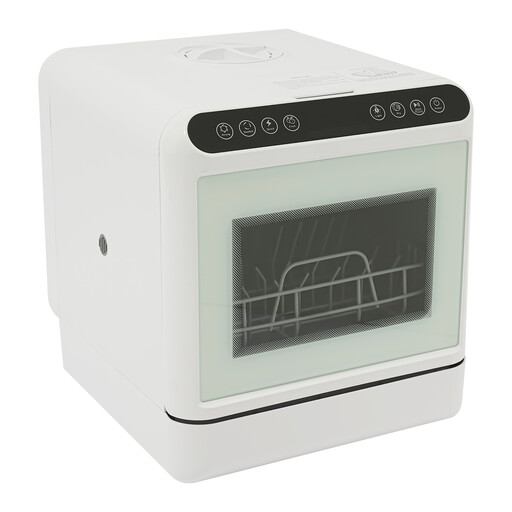 No image available
The stated capacity for 4–6 people may be more than you need for a single load of cutlery; check the space required and the interior before choosing.
The product name lists an integrated 1.32-Gal tank, hot-air drying and a 72-hour storage function.
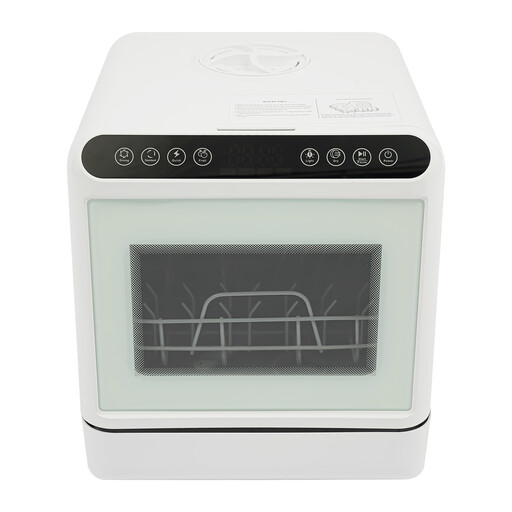 No image available
The integrated tank may be useful if a permanent water supply isn’t an option; check in advance that the cutlery holder and dimensions are suitable for your space.
The product name lists a 6-l tank and touch controls.
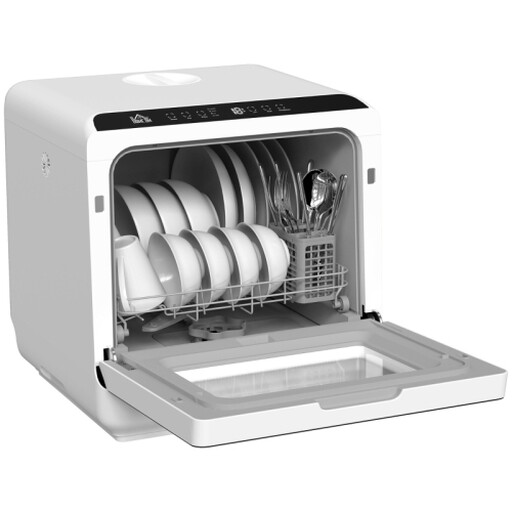 No image available
The tank offers flexible water supply; check that the cutlery holder suits your items and that the appliance will fit in the space you have in mind.
Listed features include a 6-l tank, 5 programmes, an LED display and a drying function.
Yes. An integrated tank can replace a permanent water supply, but it can’t drain the wastewater. For the Bomann TSG 5702, the manufacturer lists an inlet hose and a drain hose; set up the drainage according to the instructions for the model you choose.
No. According to the German Environment Agency, pre-rinsing—especially with warm water—isn’t necessary. The agency recommends using the Eco programme with a full load; also follow your dishwasher’s loading instructions.
The EU energy label shows, among other things, electricity consumption in kWh per 100 Eco cycles, water consumption per Eco cycle, programme duration, capacity and noise level. For your needs, it’s also important how often you can run a sufficiently full load.
No. According to the consumer advice centre, the glass-and-fork symbol indicates that an item is suitable for contact with food, not that it’s dishwasher-safe. Check the care instructions from the cutlery manufacturer.
Yes. The EU explains that the energy label must also be visible in online shops for household dishwashers covered by the rules. Dishwashers use the A to G scale.