Fruit drink fans with limited worktop space
If you usually need ice for just a few glasses, make sure the machine, its open lid and the required clearances all fit on your worktop.


If you usually make just a few fruit drinks, start by checking the machine’s dimensions, the clearance it needs to operate, the ice basket and how easy it is to clean – not just its stated daily output. For several guests, a larger water tank and ice basket can mean fewer refills, but they take up more space. Daily output doesn’t tell you how much ice is ready at once.
If you usually need ice for just a few glasses, make sure the machine, its open lid and the required clearances all fit on your worktop.
If you’re making several drinks, consider the time until the first batch is ready and the ongoing supply separately from the water tank and ice basket capacities.
If you use the machine often, easy-to-reach parts and a practical way to deal with leftover water matter. A rinse programme won’t necessarily replace the rest of the cleaning routine.
First, check that the machine fits in the space you have, including room to open the lid and any model-specific clearances. Then compare the ice output and cleaning requirements with how much ice you need for your drinks.
| What matters | What to check before buying | Who is it important to? |
|---|---|---|
| Space required | Check the width, depth and height, access to the lid and the clearance specified in the instructions for the exact model. KLAMER lists dimensions of 22 × 29 × 28 cm and 20 cm of clearance around its compact model. | If I’m making just a few fruit drinks in a small kitchen, I need to consider the space required, including ventilation clearance. Around 36% of consumers are likely to prioritise space requirements. |
| First batch and ongoing supply | Compare cycle time, the number of cubes per cycle and the ice basket separately. CASO gives a cycle time of 6–13 minutes for the IceMaster Pro 3301; this is a manufacturer’s figure. | If I need ice at short notice for several glasses, I look at when the first batch will be ready and how quickly more will follow. Around 29% of consumers are likely to prioritise a fast supply of ice. |
| Cleaning | Check which parts are easy to reach or removable, how to drain leftover water and the care instructions for the specific model. For the Freeze 48935, UNOLD lists a drain and a rinse function for the water circuit. | If my machine regularly comes into contact with water and ice, I want to be able to clean the tank and basket easily and drain any leftover water. Around 21% of consumers are likely to prioritise easy cleaning. |
| Enough ice for several drinks | Compare the water tank and ice basket separately; daily output doesn’t tell you how much ice is ready at once. GASTROBACK lists a 2,8-l tank and a 1,5-kg ice basket for the Bartender Pro 41143. | If I’m preparing several fruit drinks in a row, a larger supply matters more to me than the smallest footprint. Around 14% of consumers are likely to prioritise having ice ready for guests. |
The stated daily output doesn’t tell you how much ice is in the basket at any one time. Some models take several minutes between production cycles.
Compare cycle time, the number of cubes per cycle, the water tank and the ice basket separately.
Access to the lid and model-specific ventilation clearances can increase the space required beyond the machine’s dimensions.
Before buying, check the setup instructions for the exact model and measure the usable space, including the required clearances.
Rinsing the water circuit won’t necessarily replace emptying, cleaning and drying the machine.
Check which parts are accessible or removable, and follow the care instructions for the model you buy.
The range includes a compact machine and a separate 120-W model with a larger tank; don’t confuse their features.
According to CASO, the IceMaster Pro 3301 offers two selectable ice sizes and a 2,2-l tank.
The Freeze 48935 is worth considering if you want a way to drain leftover water and a rinse function for the water circuit.
The Bartender Pro 41143 is aimed at users who want a larger tank and ice basket for making several drinks and have enough space for it.
The KB14 is a countertop machine with two ice sizes and a 2,1-l tank.
The machines below are countertop ice makers for preparing fruit drinks. Compare their tank and basket capacities, as well as their stated ice output, with the space you have and the amount you need.
 No image available
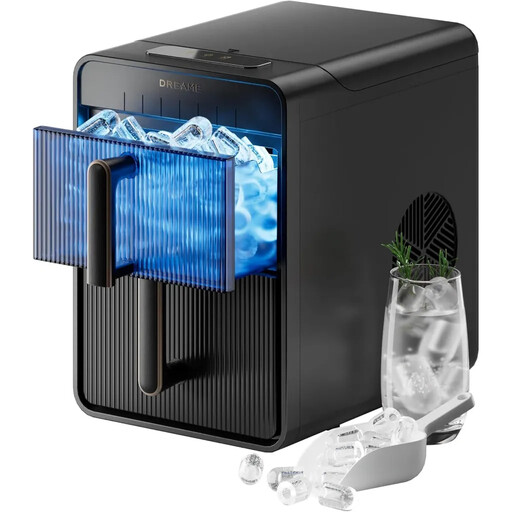
For ice needed at short notice, Dreame lists a production cycle of 6–8 minutes.
The product details list a 900-ml water tank, two ice sizes and a self-cleaning function. The stated daily output of 12 kg shouldn’t be confused with the amount of ice ready to use.
 No image available
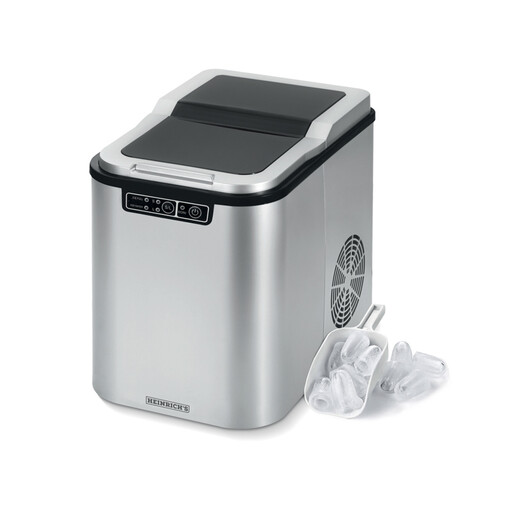
If you’re making several drinks in a row, the stated output and larger tank may be worth comparing with smaller machines.
The listed specifications include nine ice cubes in nine minutes, two ice sizes and a 2,2-l water tank. The dimensions are given as 36,0 × 24,9 × 32,7 cm, and a self-cleaning function is also listed.
 No image available
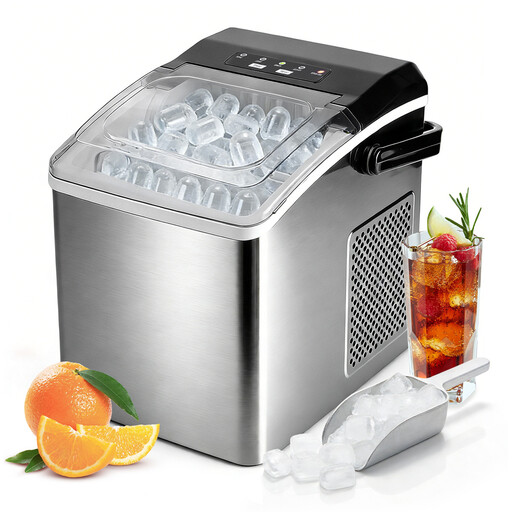
The stated short cycle time may appeal if you need ice for drinks at short notice.
The product description lists nine ice cubes in six minutes, two ice sizes, a 1,3-l water tank and a self-cleaning function.
 No image available
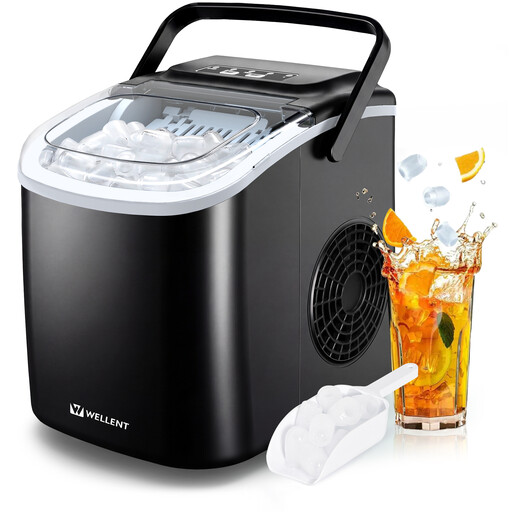
The stated dimensions can help you check whether it will fit on a limited worktop.
The listed specifications include dimensions of 20,2 × 28,1 × 26,4 cm, a 0,8-l water tank, a 0,45-kg ice basket, two ice sizes and a self-cleaning function. The first batch is said to be ready after six minutes.
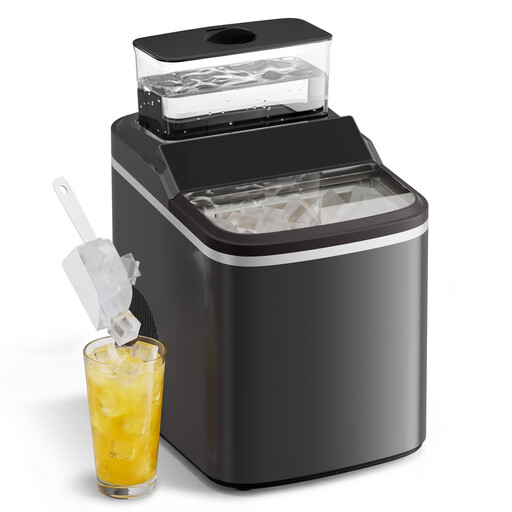 No image available
An external tank is worth considering if you want to refill the water without using the tank inside the machine.
The product details list an external 1,5-l water tank, a 0,75-kg ice basket and twelve ice cubes per cycle in 8–15 minutes. Automatic cleaning and a daily output of 18 kg are also listed; this daily figure doesn’t tell you how much ice is ready to use.
As well as measuring the machine’s height, check that you can open the lid and allow the clearance specified in the instructions for the exact model. KLAMER recommends at least 20 cm of clearance around its Compact ice maker; this figure doesn’t automatically apply to other models.
Use drinking-quality water and follow the care instructions for the specific model. KLAMER recommends completely emptying, cleaning and drying its 120-W machine before storing it for a long period. A rinse function doesn’t prove that the machine has been fully disinfected.
By affixing the CE marking, the manufacturer declares that the product meets the applicable EU requirements; it isn’t an independent quality mark. Materials that come into contact with water or ice are also subject to the relevant food-contact rules, including Regulation (EC) No 1935/2004.
No. The German Federal Environment Agency recommends disposing of electrical appliances separately, for example at a recycling centre. Retailer take-back schemes depend on the legal requirements for the relevant scheme.
In Germany, the seller is generally responsible for the statutory warranty if goods are faulty. The Federation of German Consumer Organisations gives a two-year period from delivery for new goods; any voluntary manufacturer’s guarantee has separate terms.