Bakers with limited worktop space
You need a freestanding oven that fits the space you have in mind, taking account of the door swing and the model-specific ventilation clearances.


First, choose an oven that fits your chosen spot, allowing for the door swing and the manufacturer’s installation clearances. Then compare the usable tray area with the heating mode your recipe calls for. A small countertop oven is better suited to smaller batches, while a larger tray usually means the oven takes up more space. A fan setting isn’t essential for every recipe: both Dr. Oetker Deutschland and Einfach Backen also recommend conventional top and bottom heat, but at different temperatures.
You need a freestanding oven that fits the space you have in mind, taking account of the door swing and the model-specific ventilation clearances.
You want to be able to select the heating mode and temperature specified in your chosen recipe, rather than assuming that conventional top and bottom heat settings will work unchanged with a fan oven.
You’re comparing the usable tray area with the number of macaroons you plan to bake, and weighing up extra baking rounds against the space a larger oven needs.
First check the space available, including clearances. Then look at the heating mode you need and the area of the tray you can actually use. For its recipe, Dr. Oetker Deutschland recommends around 120 °C with fan-assisted heat or 140 °C with conventional top and bottom heat. Einfach Backen gives 150 °C with a fan oven or 170 °C with conventional top and bottom heat for a different recipe.
| What to consider | What to check before buying | Who it matters most to |
|---|---|---|
| Positioning and clearances | Check the model’s external dimensions, door swing and installation requirements against the space available. | If worktop space is limited, consider not just the oven’s width but also the door clearance and ventilation gaps. Finding a suitable spot is the top priority for around 33 % of consumers. |
| Heating mode to suit your recipe | Check that you can select the heating mode and temperature specified in your chosen recipe. | If you want to follow a recipe as closely as possible, the heating mode and temperature need to match. Around 27 % of consumers consider this particularly important. |
| Tray area and batch size | Compare the size of the usable tray supplied with the oven with the number of macaroons you plan to bake; oven capacity in litres alone won’t tell you enough. | If you want to arrange a larger batch on the tray, its usable area matters. Batch size is the main consideration for around 27 % of consumers. |
| Cleaning and running costs | Check what’s included and read the cleaning instructions. Estimate electricity costs using energy consumption in kWh and your own tariff. | If maintenance and ongoing costs influence your choice, check the accessories included and how much cleaning is involved. These are the top buying priorities for around 13 % of consumers. |
You may need to allow for model-specific ventilation clearances as well as the oven itself. Rommelsbacher requires 4 cm of clearance at the sides and 1 m above the BG 1055/E.
Measure the space you plan to use, including the clearances specified in the manual and room for the door to open.
Capacity in litres doesn’t tell you the tray area. Rommelsbacher specifies a tray measuring 32.5 × 28.5 cm for the BG 1550. How many macaroons will fit also depends on their size and the spacing between them.
Compare the tray dimensions with the batch you plan to bake, rather than focusing on oven capacity alone.
Recipes for coconut macaroons don’t all use the same settings. Dr. Oetker Deutschland recommends around 120 °C with fan-assisted heat, while Einfach Backen gives 150 °C with a fan oven for its recipe.
Choose your recipe, then follow its instructions for the heating mode and temperature.
Statutory rights are generally claims against the seller, while a voluntary guarantee has its own terms and conditions.
Keep your proof of purchase and read the guarantee terms alongside information about your statutory rights.
The KB M19 is a freestanding countertop oven with a 19 l capacity, optional fan-assisted cooking and separately selectable top and bottom heat.
The BG 1055/E has an 18 l capacity and selectable top and bottom heat or fan-assisted cooking. The BG 1550 is a 30 l alternative.
The TO 2068 is a freestanding oven and toaster with a capacity of around 20 l, fan-assisted cooking and top and bottom heat that can be switched on separately or together.
The TO 26 SilverStyle has a 26 l capacity, fan-assisted cooking and top and bottom heat. It’s an option if you plan to use your oven for more than just macaroons.
This selection of Joybuy ovens includes compact countertop models and larger ovens for different batch sizes. Compare the heating mode, temperature range, tray and space required for each model.
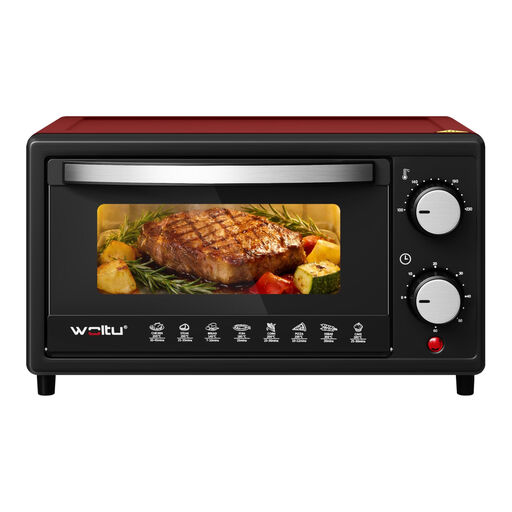 No image available
A compact choice if you’re looking for a countertop oven for smaller batches, with conventional top and bottom heat.
10 l; external dimensions 37 × 26.5 × 21 cm; upper and lower heating elements; 100–230 °C; baking tray included.
 No image available
If you want different heating modes for different recipes, check that the settings described match the instructions for your chosen recipe.
28 l; 100–230 °C; top heat, bottom heat and combined heating modes.
 No image available
A compact-capacity option for smaller batches if you’re looking for hot-air circulation.
6.5 l; 80–200 °C; described 360° hot-air circulation; stainless steel basket.
 No image available
A larger-capacity option if baking space is more important to you than having the smallest possible oven.
32 l; external dimensions 52.3 × 36 × 32.2 cm; 1,600 W; 100–250 °C; baking tray included.
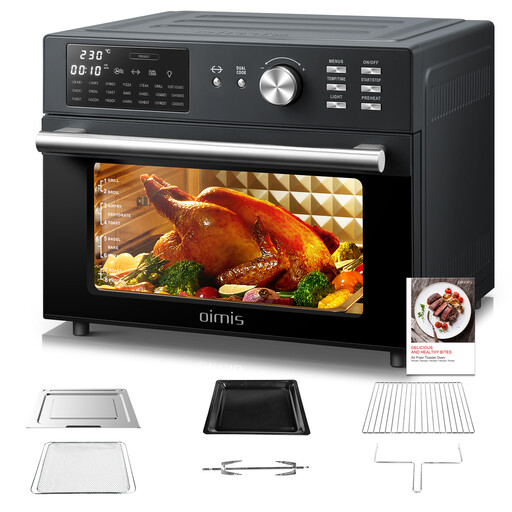 No image available
A larger option if you want to use the described airflow as well as bake; remember to factor in the space it needs.
30 l; external dimensions 456 × 430 × 365 mm; described 360° airflow heating.
No. Recipes published by Dr. Oetker Deutschland and Einfach Backen also recommend conventional top and bottom heat, at different temperatures from those given for fan ovens. Follow the heating mode and temperature specified in the recipe you’re using; the two recipes don’t give one standard temperature.
Only if you can meet the requirements for that specific model in the spot you have in mind. Rommelsbacher requires 4 cm of ventilation clearance at the sides and 1 m above the BG 1055/E, and says the model shouldn’t be used as a built-in oven. For the Steba KB M19, the manual specifies, among other things, a 10 cm gap between the back of the oven and the wall. Rommelsbacher’s requirements don’t apply to Steba.
It depends on the tray dimensions, the size of the macaroons and how much space they need between them. Compare the dimensions of the tray supplied with the oven with the batch you plan to bake; the oven capacity in litres alone won’t tell you how many will fit on a tray.
Rated power alone won’t tell you the cost of a baking round. You’ll need the actual energy used in kWh for the way you use the oven, as well as your electricity price per kWh. Remember to include any extra baking rounds in your comparison.
Your statutory rights against the seller are separate from any voluntary manufacturer’s or retailer’s guarantee. The Verbraucherzentrale says that consumers generally have a two-year statutory warranty against the seller. For sales contracts from 31 July 2026, it also describes a one-off 12-month extension if you choose repair when a product is faulty. Check guarantee terms separately.