Interviewers recording a quiet storyteller
If you’re recording someone who speaks quietly, you can test the microphone distance before the interview. The Library of Congress recommends testing your recording equipment before the interview.


For quiet craft interviews, a microphone positioned in one place can work well if the person telling the story is seated calmly and you can test the distance beforehand; if they’ll be moving around, a clip-on microphone worn close to the body is a natural choice. If you need to record two voices separately, you’ll need suitable inputs and two external microphones. The Oral History Society describes this recording setup, while Zoom lists two XLR/TRS inputs for the H4essential. Shure Support notes that the MV7+ Denoiser does not remove background voices, so microphone placement and a test recording remain essential.
If you’re recording someone who speaks quietly, you can test the microphone distance before the interview. The Library of Congress recommends testing your recording equipment before the interview.
If the person telling the story moves around during a demonstration, moving the microphone with them is an alternative to using a fixed desk microphone. RØDE describes the Wireless ME as a system with a microphone on the transmitter and a receiver for a compatible recording device; Tascam describes the DR-10L Pro as a portable recorder with a clip-on microphone.
If you want to record or edit questions and answers separately, plan for two suitable microphone channels. The Oral History Society lists two external microphones as a recording option; Zoom specifies two XLR/TRS inputs for the H4essential.
For a quiet craft interview, your choice will depend mainly on whether you need to record one voice from a fixed position, two separate voices, or allow freedom of movement. How the recording is stored and backed up afterwards may also be important.
| What you need | What to check when buying | Who is this important to? |
|---|---|---|
| Make a quiet voice easy to understand | Whether you can position the microphone close to the speaker and listen back to a test recording through headphones. | If I’m recording someone who speaks quietly in a fixed position, I want to be able to position the microphone appropriately and check the sound on site. Around 33% of consumers prioritise clear audio from a fixed position. |
| Record two voices separately | The number and type of inputs, plus suitable microphones and cables for both recording channels. | When recording questions and quiet answers, I want to position both microphones appropriately and edit the voices separately. Around 27% of consumers prioritise separate recording channels for an interview. |
| Movement during a demonstration | Attachment, receiver connection and power supply; test the complete recording setup while moving around. | If the person telling the story moves around while working, I want to be able to move the microphone with them. Around 27% of consumers prioritise freedom of movement during a demonstration. |
| Back up the recording | Which device stores the file, which format is used, and how the recording is transferred and backed up. | To make sure I can find an interview again later, I want to plan the storage and transfer process in advance. For around 13% of consumers, managing interview files is the main consideration. |
Shure Support explains that the MV7+ Denoiser does not remove background voices. Poor microphone placement can therefore still cause problems, even with noise reduction switched on.
Position the microphone towards the quiet voice and listen to a test recording made in the actual workshop conditions.
If an unrepeatable passage is lost because the audio is unintelligible, you may not be able to record it again.
RØDE confirms that the Wireless ME transmitter does not record audio on its own. If recording on the connected device does not work, no backup copy will be created.
Before the interview, follow the signal path all the way to the saved file and test the recording.
The setup may require an additional compatible device and its power supply.
The H4essential has two XLR/TRS inputs, but you’ll still need suitable microphones and connections for two external microphone channels.
Check the inputs and what’s actually included before putting together the equipment you need.
Depending on the setup, you may also need two microphones, cables and, where necessary, mounts.
Tascam lists the DR-10L Pro as a discontinued product on its European downloads page.
For a specific listing, check the model’s status, what’s included and whether support is available.
The MV7+ is an option for a fixed recording position with a computer.
The Wireless ME is a wireless option for interviews where the microphone moves with the person telling the story.
The H4essential combines built-in microphones with inputs for external microphones.
The AT2020USB-X is a USB condenser microphone for a fixed position with a computer.
The DR-10L Pro is a mobile setup combining a portable recorder and a clip-on microphone.
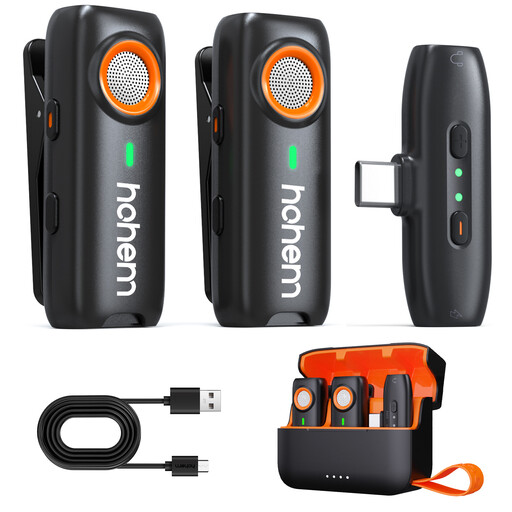
The Joybuy products below are wireless microphones for mobile interviews. Check that the receiver and connection are compatible with your recording device.
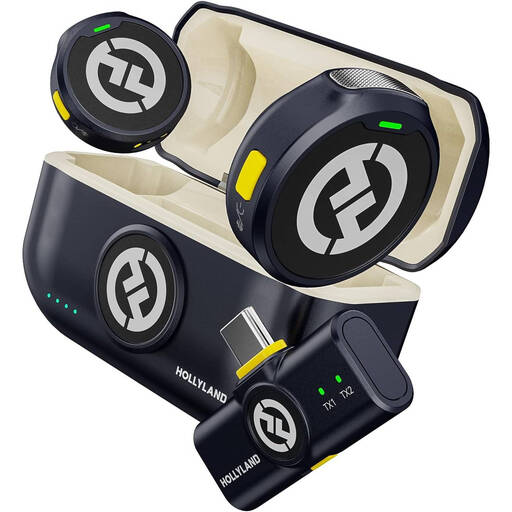 No image available
Two transmitters and a USB-C receiver are useful for interviews with two people talking; check that your recording device supports the connection. The product title states a range of 300 m, noise cancellation and up to 30 hours of operating time.
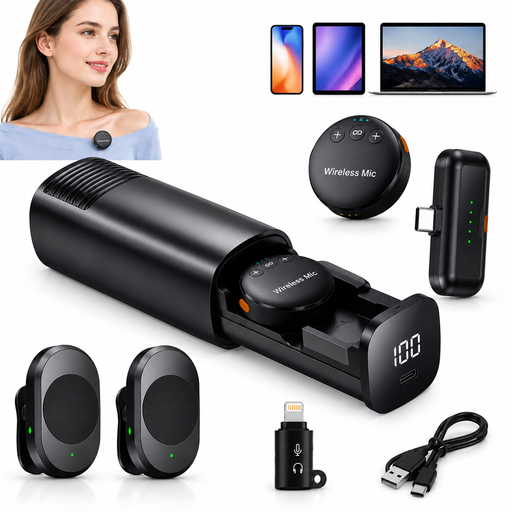 No image available
Two transmitters are designed for interviews with two people; check that the receiver connections match your recording device. The product title lists 2.4 GHz, latency under 20 ms, a range of up to 40 m, a 500 mAh charging case, and USB-C and Lightning connections.
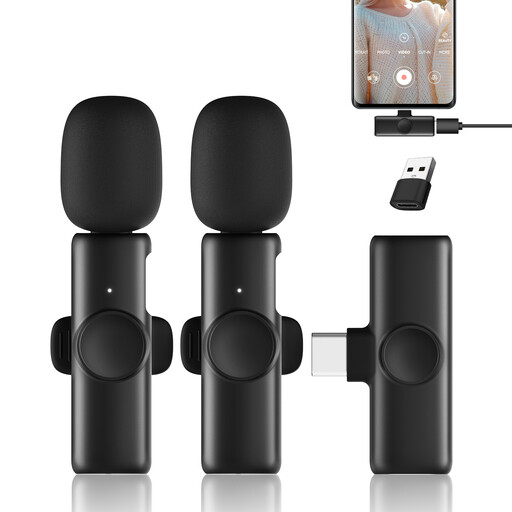 No image available
This set, with two transmitters and one receiver, is suitable for an interview with two people talking. The product title lists 2.4 GHz and USB-C compatibility with Android phones; check the recording setup for your specific device.
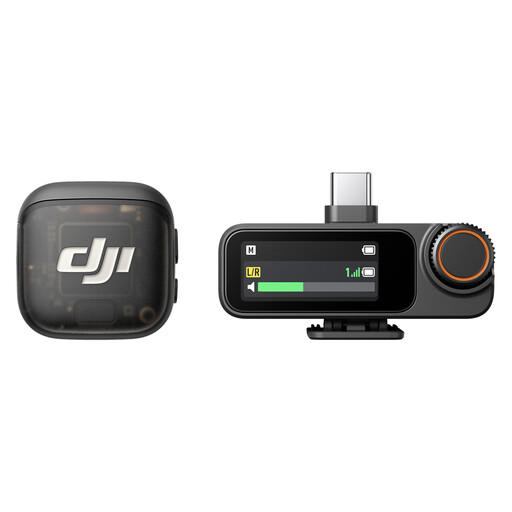 No image available
The transmitter and receiver make up a mobile recording setup; check that the connection is compatible with your smartphone or camera. The product title lists use with iPhone, cameras and Android, as well as up to 28 hours of battery life.
 No image available
The lavalier design is intended to keep the microphone close to someone who is moving around. The product title lists three-level DSP noise cancellation, a range of up to 100 m, 20 hours of battery life and TF card backup recording; according to the product information, the TF card is not included.
Record a short passage at the planned location, using the actual speaking volume, and listen back to it. Also check the power supply and storage, and test both recording channels if you’re using two microphones. The Library of Congress recommends testing your equipment before the interview.
No. 32-bit float is no substitute for suitable microphone placement and a test recording. Zoom lists this feature for the H4essential, but it does not, on its own, guarantee that a quiet voice will be clear in the room.
Check the complete recording setup: to use separate external microphones with the H4essential, you’ll need suitable microphones and connections; depending on your setup, a mount or storage medium may also be relevant. Tascam Europe lists the DR-10L Pro as discontinued, so an older recommendation does not confirm that it’s currently available.
Not without authorisation: Section 201 of the German Criminal Code (StGB) makes it a criminal offence to record another person’s non-public speech without permission. Get agreement from everyone involved before recording. You’ll also need to establish an appropriate legal basis for any subsequent processing of personal data; if you rely on consent, the BfDI’s guidance says it must be given freely. Recording, storing and publishing the material should be considered separately.
No. The changes described by the Verbraucherzentrale (German Consumer Advice Centre) as taking effect from 31 July 2026 do not establish a blanket right to repair for every microphone. The overview sets out specific requirements and product categories. Check the details of your purchase and distinguish between statutory consumer rights and a voluntary guarantee.