
Lieferung heute & morgen

Qualitätsgarantie

Willkommens-Angebote freischalten: KOSTENLOSE Lieferung | Bis zu 80 % RABATT | Kostenlose 30-Tage-JoyPlus-Testphase
App herunterladen
A craft knife set may look straightforward at first glance: a few knives, blades and perhaps a storage box seem enough for cardboard, film or carpet. In practice, though, the details make all the difference to handling, cutting control and ongoing costs. If you focus only on the number of knives or marketing terms such as ‘professional craft knife’, you could end up with a set that isn’t suited to the work you do.
This buying guide explains which features to look for in a craft knife set, and which types are best suited to DIY, packaging, craft projects and regular renovation work.
A set with several craft knives can be handy if you need to equip multiple workstations. But it’s important to check whether replacement blades are included and whether they fit the relevant knife. For example, five lightweight 9 mm craft knives are useful for sharing between people working with cardboard and paper, but they’re no substitute for a sturdy 18 mm model for thicker materials.
Blade life depends on the blade material, the thickness of the material being cut and the pressure applied. With snap-off blades, you don’t replace the whole blade; you remove just the blunt segment. This is convenient, but it relies on a secure blade lock and a controlled break point. Even a high-quality blade can be damaged by excessive sideways pressure.
A slippery plastic handle or a loose slider makes straight cuts harder. For longer jobs involving cardboard, carpet or PVC, a grippy handle and a blade guide that locks securely are more important than eye-catching design. A package opener for quick jobs has different requirements from a utility knife for renovation and cutting materials to size.
Blade width affects stability, precision and cutting depth:
Also check whether you can buy standard replacement blades. This means you won’t have to rely on the blades included in one particular set.
Several of the models featured here use SK5 carbon steel blades. SK5 refers to the type of steel used, but on its own it doesn’t guarantee a particular cutting performance or lifespan. Blade thickness, coating, segmentation and the replacement mechanism are also worth considering.
A black or coated blade may reduce exposure to moisture, but it’s no substitute for dry storage. Take care when snapping off a segment. Dispose of blunt or damaged segments in a puncture-resistant container, not loose in your household rubbish.
An auto-lock, slide lock or liner lock holds the blade in a set position. Make sure the blade won’t retract accidentally or shift under normal pressure. Depending on the design, handles made from aluminium, ABS or TPR each have different benefits:
A belt clip makes your knife easy to reach during fitting, storage or renovation work. For use at a desk, a compact storage box is often enough.
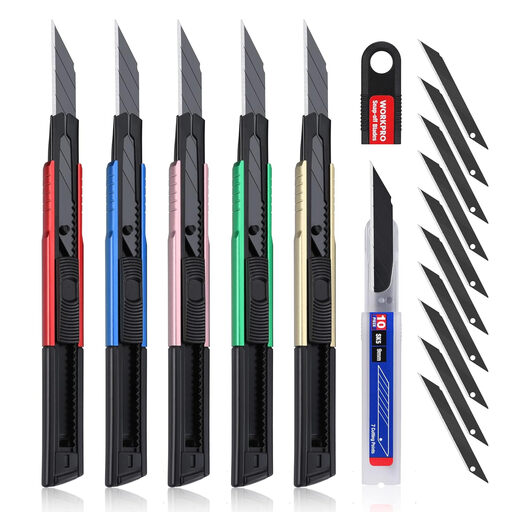
Why this product suits this user type: Five 9 mm craft knives are handy for use at several workstations at home or in the office, or for simple DIY jobs. The set includes ten replacement blades and a storage box.
The set combines several knives with replacement blades. An auto-lock holds the blade in several positions, and the end cap lets you change segments without extra tools.
Aluminium handle, 9 mm SK5 blades, weighs 20 g per knife and has an integrated belt clip.
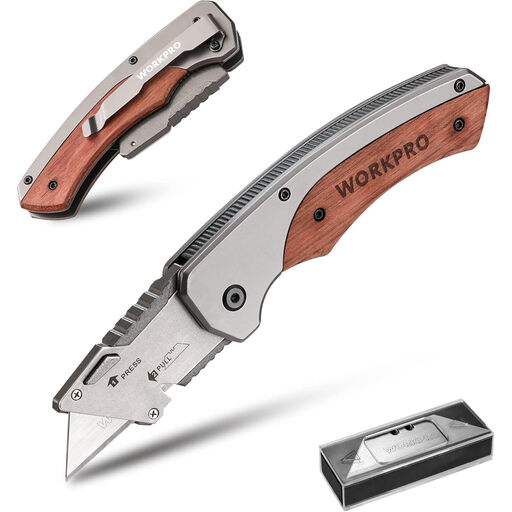
Why this product suits this user type: Its folding design is ideal if you want to carry and safely store a single utility knife. The wooden handle is paired with a metal body and a liner lock.
The liner lock keeps the knife open during use. A quick-change mechanism and a separate box for all eleven SK5 blades make replacement easy.
Folding design, weighs 170 g, 60 mm blade and a belt clip for use on the go.
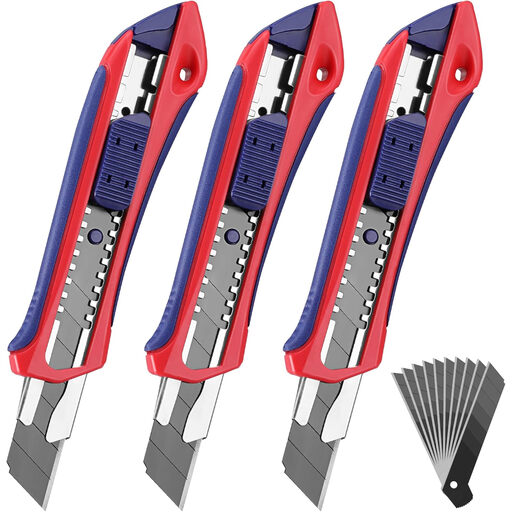
Why this product suits this user type: Three 18 mm craft knives are designed for regular cutting, packaging and renovation work. The TPR in the handle helps you maintain control during longer jobs.
The 18 mm snap-off blades are designed for thicker materials. A blade lock prevents uncontrolled movement, and you can replace blunt segments one at a time.
Three knives, ten SK5 replacement blades, 0.5 mm blade thickness and an ABS/TPR handle measuring 160 mm long.
We’ve put together a complete, regularly updated list of products that meet these strict selection criteria and fully comply with the safety regulations in force in the EU.
A 9 mm craft knife is often enough for thin to medium cardboard. For thicker corrugated cardboard, multiple layers or regular packaging work, an 18 mm craft knife set offers a wider blade and usually a more stable guide.
It depends on the material, the length of the cut and the pressure applied. Replace a segment as soon as the cut starts to look ragged, requires more force or the blade is damaged. There’s no reliable fixed timeframe.
18 mm snap-off blades can be used for some carpet and flooring jobs, provided the knife is suitable and the blade can be extended far enough. For very dense or thick materials, check the manufacturer’s guidance on intended use.