
Lieferung heute & morgen

Qualitätsgarantie

Willkommens-Angebote freischalten: KOSTENLOSE Lieferung | Bis zu 80 % RABATT | Kostenlose 30-Tage-JoyPlus-Testphase
App herunterladen
Digital fabrication is transforming how engineers, designers, and small business owners work. Precise data capture and material-specific processing are the cornerstones of efficient prototyping, reverse engineering, and small-batch production. Creality offers specialised tools for these tasks, whose technical parameters demand a closer look. This article analyses the specifications and applications of select 3D scanners and laser engravers from the brand.
Choosing the right device depends on the specific requirements of your project. Objective criteria are crucial for making an informed decision.
A professional 3D scanner is used to accurately capture physical objects to create digital 3D models. The following parameters should be evaluated:
A 10W laser cutter or engraver uses a focused laser beam for material processing. The relevant specifications are:
Based on an analysis of technical specifications, we present two devices from Creality designed for different application areas.

Why We Recommend This Product
The Creality Raptor Pro combines two scanning technologies in one device: a blue light laser for high precision and an infrared scanner for rapid capture of large objects. With an accuracy of up to 0.02 mm, it meets metrology-grade requirements. Its wireless connectivity and ability to scan many objects without markers significantly streamline the workflow.
Pros
Who It's For
This device is aimed at professional users in engineering, product design, and quality assurance who need a precise tool for reverse engineering, digitising components, or cultural heritage preservation.
Why We Recommend This Product
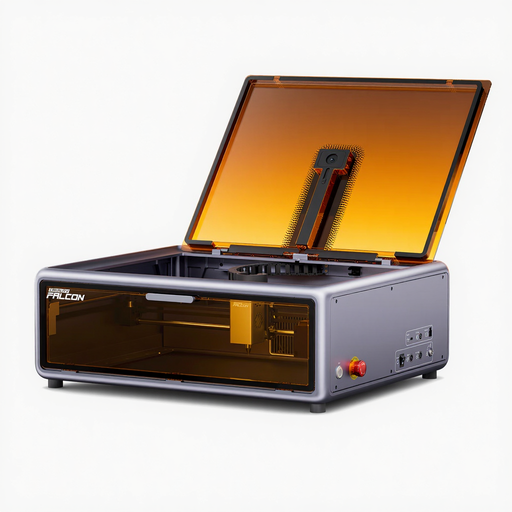
The Creality Falcon A1 focuses on user safety and versatility. Its fully enclosed housing classifies the device as a Class 1 Laser (FDA standard), allowing for operation in workshops, offices, or educational settings without additional safety measures. The 10W diode laser provides sufficient power for a wide range of engraving and cutting tasks.
Pros
Who It's For
This device is designed for small business owners, makers, designers, and educational institutions seeking a safe and reliable tool for processing materials like wood, acrylic, leather, and cardboard to create prototypes, personalised products, or educational materials.
While laser engravers are optimised for surface treatment and cutting sheet materials, other tasks, such as printing documents or graphics on paper, require specialised technologies. The market offers a wide range of devices for such applications. You can find an overview of available models in our Laser Printers category.
1. What is the difference between a blue light laser scanner and an infrared scanner? A blue light laser scanner projects laser lines onto an object and captures its shape with a camera. This technology is highly precise and insensitive to ambient light, making it ideal for industrial components. An infrared scanner uses an invisible light pattern (structured light), which is particularly well-suited for the rapid capture of organic, irregular shapes like faces or large objects, often with less detail accuracy than a laser scanner.
2. Can a 10W laser cutter actually cut wood? Yes, a diode laser with 10W of optical power can cut wood. The maximum cutting depth per pass depends on the type and density of the wood. Softwoods like balsa or thin plywood (e.g., up to 5 mm) can typically be cut in a single pass. For harder or thicker woods, multiple passes may be necessary. The speed must be adjusted accordingly to achieve clean cut edges.
3. What is reverse engineering and how does a 3D scanner help with it? Reverse engineering is the process of analysing a physical component to understand its design, construction, and function in order to create a digital model of it. A professional 3D scanner is a key tool in this process. It captures the exact geometry of the component and converts it into a 3D CAD model. This model can then be used for reproduction, modification, failure analysis, or to create spare parts when original design drawings are unavailable.