
Lieferung heute & morgen

Qualitätsgarantie

Willkommens-Angebote freischalten: KOSTENLOSE Lieferung | Bis zu 80 % RABATT | Kostenlose 30-Tage-JoyPlus-Testphase
App herunterladen
As a Joybuy Product Recommendation Officer, I continuously monitor the market for 3D printing materials. Many FDM printer users face a recurring challenge: reducing print time without compromising on model detail and stability. Especially for larger projects or small-batch production, printing speed can become a critical factor.
This article serves as a guide. It provides objective information about Creality High Speed PLA Filament and explains the key features relevant for achieving fast yet reliable printing results. The goal is to offer you an informed basis for selecting the right material for your 3D printer.
Choosing the right filament is crucial to fully unlock the potential of high-speed printers. The following criteria will help you navigate the options and find a material that meets your requirements.
Not every PLA filament is designed for high speeds. Standard PLA can lead to issues like under-extrusion or poor layer adhesion at speeds above 150 mm/s. High-speed filaments like Creality Hyper PLA are developed with a special formula that allows for higher fluidity and faster cooling. Pay attention to the manufacturer's specified maximum print speed, which can reach up to PLA 600mm/s for specialised materials. Also, check if the filament is optimised for your printer model, such as PLA for Creality Ender series.
A consistent filament diameter is fundamental for a flawless printing process. A high-speed PLA filament 1.75mm should have a tight diameter tolerance, ideally ±0.03 mm or better. Deviations can lead to nozzle clogs or inconsistent material feed. High-quality raw materials and a low shrinkage rate are also important. A good filament resists warping, meaning the corners of the model do not lift off the print bed during cooling.
An often-underestimated feature is the quality of the spool winding. A neat, uniform winding prevents the filament from tangling and interrupting the print. A 1kg PLA spool should also be vacuum-sealed and supplied with a desiccant pack. This packaging protects the material from moisture, which can significantly degrade print quality and lead to brittle filament.
Based on objective product characteristics, we have compiled a selection of filaments from Creality designed for users who value efficiency and quality.
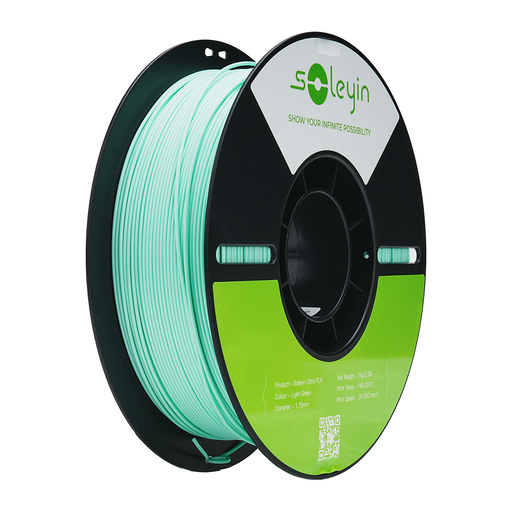
Why It Stands Out: This filament is designed as a versatile option for a wide range of FDM printers. It combines moderate high-speed capability with very high dimensional accuracy and reliability, making it a solid choice for everyday use.
Advantages:
Who Is It For? Users looking for a reliable and precise filament solution for print speeds in the 30-300 mm/s range who value a high success rate for their print projects.
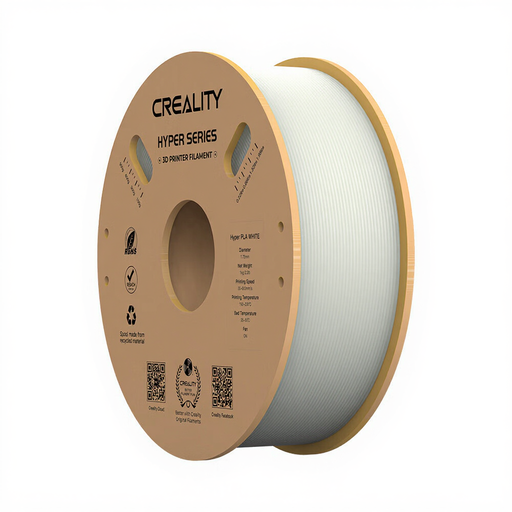
Why It Stands Out: Creality Hyper PLA was specifically developed for maximum print speeds. Its formula enables high fluidity and rapid solidification, allowing for stable print results even at extremely high speeds.
Advantages:
Who Is It For? Owners of high-speed 3D printers who want to push their devices to their performance limits. Ideal for rapid prototyping and the efficient production of larger objects.
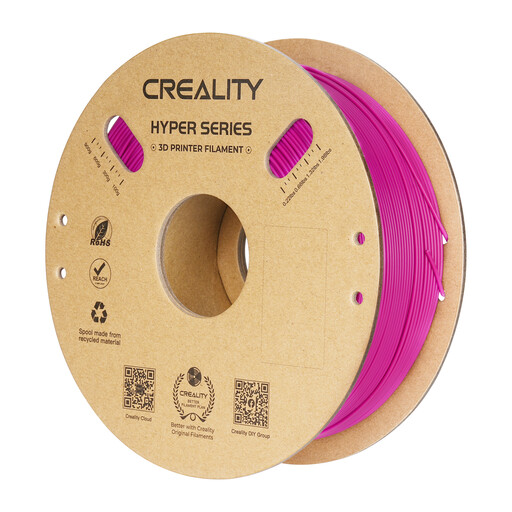
Why It Stands Out: This variant of Hyper PLA combines extreme speed with improved material toughness and an aesthetically pleasing matte finish. It is therefore suitable not only for prototypes but also for final parts.
Advantages:
Who Is It For? Makers and prosumers who want to print both functional and visually appealing parts at high speed, for example, for cosplay props, decorative items, or robust prototypes.
The products presented here are a selection from Creality's range. If you are looking for other colours, materials, or specific properties, you can find more options in our main category.
Discover our entire range of high-speed filament to find the perfect option for your next project.
1. What is the difference between regular PLA and high-speed PLA? High-speed PLA, such as Creality Hyper PLA, contains special additives that reduce its viscosity in a molten state and increase its cooling speed. This allows for faster yet stable material deposition at high print speeds, whereas regular PLA would be prone to stringing or incomplete extrusion at the same pace.
2. Can I use Creality High Speed PLA on any 3D printer? In principle, Creality High Speed PLA Filament is compatible with most FDM printers that use 1.75 mm filament. However, to achieve the maximum speeds of up to 600 mm/s, a 3D printer that is mechanically and in terms of software designed for such speeds is required. The filament can also be used on slower printers, where it often provides improved print quality at moderate speeds.
3. How do I avoid warping with high-speed PLA filament? Although high-quality filament resists warping or exhibits very little, a few measures can help to completely eliminate this effect. Ensure good first-layer adhesion by using a clean and properly levelled print bed. A heated print bed (approx. 50–60 °C for PLA) is also helpful. For larger models, using a 'brim' or 'raft' in your slicer settings can increase the surface area for adhesion and counteract warping.