
当日/次日达

品质保障

开启新人专享福利: 全场免邮 | 低至 2 折 | 免费试用 30 天 JoyPlus 会员
下载 Joybuy
The search for a high-performance 3D printer for demanding projects can quickly become overwhelming. Manufacturers advertise high speeds, large build volumes, and multi-color capabilities. However, not every claim holds up in practice. As a Joybuy Product Recommendation Officer, I'll help you identify the crucial features and distinguish marketing promises from real performance data. This way, you can avoid costly mistakes and find the right machine for your needs.
Before we dive into the technical details, let's highlight three common issues that can arise when choosing a printer in the high-end price range:
To avoid these pitfalls, you should carefully examine three core parameters. These will determine whether a printer like the Creality K2 Plus Combo 3D Printer is suitable for your projects.
For producing large prototypes, functional parts, or small-batch runs, a large-format 3D printer is essential. A build volume of 350x350x350 mm provides the flexibility to print models in a single piece rather than having to assemble them later. Just as important is the heated build chamber. Active heating up to 60°C, as offered by the K2 Plus, ensures a constant ambient temperature. This minimises thermal stress in the part and is a fundamental requirement for successfully printing high-performance polymers like PA-CF (Polyamide Carbon Fiber) or ABS.
A high-speed 3D printer is not defined by its maximum speed alone. The decisive factor is acceleration, measured in mm/s?. High acceleration values (e.g., 30,000 mm/s?) allow the print head to quickly reach its nominal speed and decelerate again. This is especially important for small, detailed segments and significantly reduces the total print time. A rigid frame construction, often made of die-cast aluminum, is fundamental to suppressing vibrations at high speeds and maintaining precision.
Modern multi-color 3D printers like the K2 Plus Combo use an integrated system (Creality CFS) that automates color changes and minimises material waste. It can manage up to 16 colors without requiring manual intervention. Another key feature is a 3D printer with an AI camera. This monitors the printing process in real-time, detects failures like "spaghetti" (tangled filament), and can pause the print to save material and time.
Based on these criteria, we have compiled some models for different user profiles.
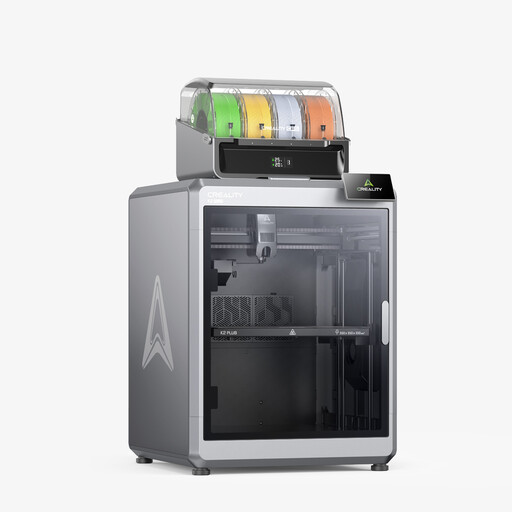
Why This Fits Their Persona: Ideal for users who produce large, complex, and multi-color models with engineering materials. The device combines a large build volume, high speed, and an advanced multi-color system in one package.
The actively heated build chamber (up to 60°C) and 350°C hotend enable reliable printing of carbon fiber filaments. The integrated CFS system is optimised for efficient multi-color printing.
Large 350x350x350 mm build volume; Integrated 16-color printing system; Dual AI cameras for failure detection.
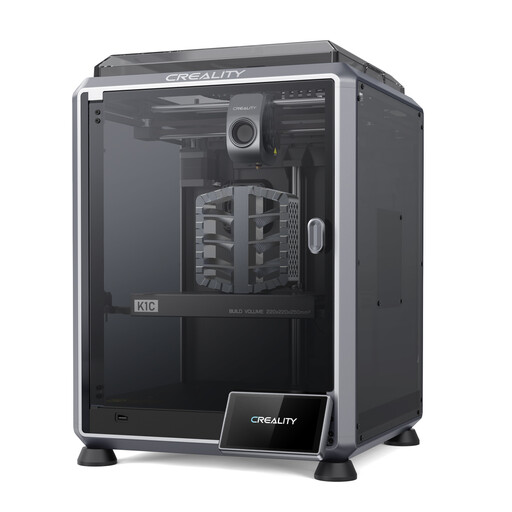
Why This Fits Their Persona: Perfect for users who value high speed and the ability to process carbon fiber filaments but don't need a huge build volume or multi-color printing.
This model is designed out of the box for printing CF filaments, thanks to its enclosed chassis, 300°C nozzle, and clog-free extruder. The AI camera is included as standard.
CoreXY system for high speeds (up to 600 mm/s); Standard AI camera and air filtration; Optimised for carbon fiber filaments.
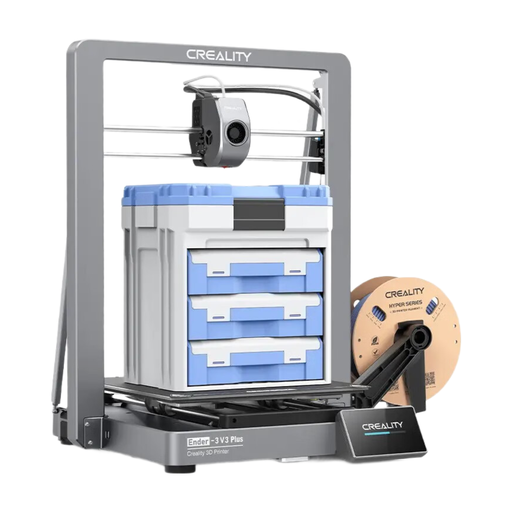
Why This Fits Their Persona: A great choice for makers looking for a very large build volume and high print speeds, but who can do without an enclosed chamber and an integrated multi-color system.
This model delivers its advertised high speed thanks to the CoreXZ structure and a stable metal frame. It focuses on core features (large volume, high speed) without costly extras.
Very large build volume (300x300x330 mm); High print speed up to 600 mm/s; Attractive price-to-performance ratio for its size.
We have compiled a complete, up-to-date list of products that fully meet these strict selection criteria and all relevant safety regulations.
A heated build chamber is crucial for printing materials with high thermal shrinkage like ABS, ASA, or Nylon. It ensures the model cools down evenly, prevents it from detaching from the build plate (warping), and improves layer adhesion. For printing PLA or PETG, it's not strictly necessary, but it significantly expands a printer's material versatility.
Modern systems like the Creality Filament System (CFS) use a unit that holds multiple filament spools. Before a color change, the print head moves to a purge device (wipe tower), extrudes a small amount of the old material to clean the nozzle, and then loads the new color. Intelligent systems optimise this process to reduce the filament waste that could be substantial with older systems.
While printers like the K2 Plus have become more user-friendly with features like fully automatic leveling and AI monitoring, they are primarily aimed at advanced users, prosumers, and small businesses. The complexity of multi-color printing and processing engineering filaments requires a certain foundational understanding of the subject. For absolute beginners, models from the Ender series are often a more accessible starting point.