Students planning lunches in advance
You want to use one pack to complement several canteen lunches, and check that its weight suits your usual portions.


A 250 g pack could be a good fit for several canteen lunches, provided it contains enough for the portions you have planned and you like the particular variety. If you’re specifically looking for wholegrain rye crispbread, Wasa Whole Grain Rye in a 260 g pack is another option; Wasa states that it contains 20 g of fibre per 100 g. If you’re sharing a supply, check the ingredients and allergen information on the pack you buy, and store it somewhere dry.
You want to use one pack to complement several canteen lunches, and check that its weight suits your usual portions.
You’re looking for crispbread with clear ingredient and nutritional information, and will choose your lunch toppings separately.
If several people are eating from the same tin, you’ll need to take the ingredients and allergen information for the variety you actually buy into account.
First, consider how many lunches you want the pack to cover. Then compare the variety and its nutritional information. If you’re sharing a supply, you’ll also need to check the ingredients, allergens and storage instructions.
| Criteria | What to check when buying | Who it matters most to |
|---|---|---|
| Pack size and quantity | Compare the weight with the portions you have planned; choose a dry place to store the crispbread once opened. | If I’m planning crispbread for several canteen lunches, I don’t want to assume how far a pack will go based on its name alone. For around 44% of consumers, having enough in stock is the main priority. |
| Wholegrain and nutritional information | Check the type of grain and the ingredients list; compare fibre and other nutritional values per 100 g for the specific variety. | If you’re looking for wholegrain rye for lunch, you’ll want to know which grain the pack contains and whether the flavour goes with your planned toppings. Around 33% of consumers make this their main priority. |
| Ingredients, allergens and storage | Check the allergen and may-contain information on the pack you buy, as well as its storage instructions. | If I’m sharing a tin, the ingredients need to suit everyone eating from it, and the crispbread needs to stay dry. This is the main concern for around 23% of consumers. |
The name alone won’t tell you how many of your lunch portions a pack will cover. The listings available include packs of 250 g and 260 g, among other sizes.
Compare the weight with your usual portion and the number of lunches you have planned.
ALDI SÜD notes that different suppliers can mean different nutritional information.
Before choosing several packs to stock up, check the ingredients list and nutritional information for the variety in store.
REWE lists wholegrain rye flour as an ingredient in Wasa Whole Grain Rye and warns that it may contain traces of sesame. Information can vary between varieties.
Check the information on the pack you buy together before putting the crispbread in a shared tin.
According to the Verbraucherzentrale, food in sealed packaging that has been stored correctly can often still be safe to eat after its best-before date. This doesn’t tell you what condition any individual pack is in.
Follow the storage instructions and check the packaging and food in each case. REWE recommends storing Wasa Whole Grain Rye in a dry place away from light.
The Whole Grain Rye variety is listed as wholegrain rye crispbread in a 260 g pack.
ALDI Nord stocks GOLDÄHREN crispbread in 250 g packs; ALDI SÜD also lists a 250 g wholegrain variety.
EDEKA24 stocks several types and pack sizes of crispbread, including Wasa Whole Grain Rye at 260 g.
REWE lists the 260 g pack of Wasa Whole Grain Rye, with information on its ingredients, nutritional values and storage.
Ryvita describes Original Crispbread as rye crispbread; the product information available relates to the British version.
These Wasa varieties could work as crispbread with toppings or as a supply for lunches you’ve planned. Compare their pack sizes and ingredient information; varieties aren’t interchangeable just because they weigh the same.
 Image unavailable
An option if you’d like an oat and sesame variety to serve with lunch toppings.
The pack contains 230 g. If you’re sharing a supply, check the ingredients and allergen information on the pack you buy.
 Image unavailable
This variety could suit your lunch if you’re specifically looking for wholegrain rye crispbread.
The pack contains 260 g. Wasa states that Whole Grain Rye contains 20 g of fibre per 100 g; REWE lists wholegrain rye flour, salt and yeast as ingredients in this variety, and warns that it may contain traces of sesame.
 Image unavailable
This variety could be a good choice if you’d like sesame and flaxseed in crispbread for lunch.
The pack contains 210 g. Check the ingredients and allergen information on the specific pack if needed.
 Image unavailable
If you’re looking for rye crispbread made with sourdough to serve with lunch toppings, you could consider this variety.
The pack contains 235 g. Compare the amount with the portions you have planned and check the information on the pack.
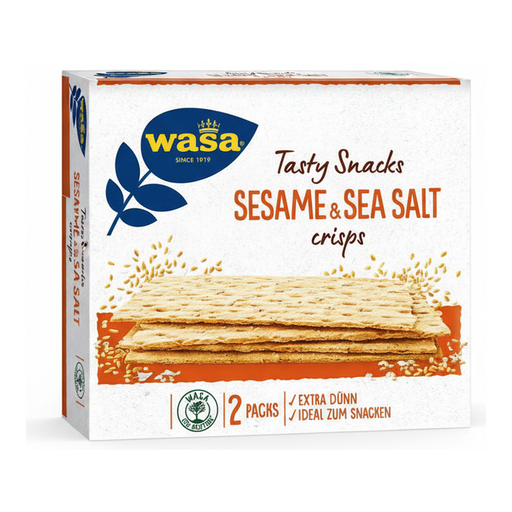 Image unavailable
This round sesame and sea salt variety could work if you’re planning to serve crispbread with toppings.
The pack contains 190 g. Before stocking up, check that this amount will cover the number of lunches you have planned, and check the allergen information.
Compare the weight with the amount you actually plan to eat at each lunch. A label such as “family pack” won’t tell you whether it’s enough for your portions.
Read the ingredients and allergen information on the pack you’re planning to buy and, if relevant, share with others. For Wasa Whole Grain Rye, REWE lists wholegrain rye flour as an ingredient and warns of possible traces of sesame; check other varieties separately.
Follow the storage instructions on the pack and keep any opened supply dry. REWE recommends storing Wasa Whole Grain Rye in a dry place away from light.
No, the best-before date isn’t an automatic throw-away date. The Verbraucherzentrale explains that food in sealed packaging that has been stored correctly can often still be safe to eat afterwards; check the condition of the specific pack and its contents.