Households with frequent coffee breaks
If several people eat crispbread regularly, the pack size should suit how much you get through. If you’re stocking up, it’s also important to check the best-before date and storage instructions.


If you have regular coffee breaks in a household with several people, the biggest pack of crispbread isn’t necessarily the right choice. What matters is how much you actually get through, choosing a variety that suits your favourite toppings, and checking that its ingredients and allergens are suitable for everyone who’ll be eating it. If you opt for a larger pack, you’ll also need to think about storage.
If several people eat crispbread regularly, the pack size should suit how much you get through. If you’re stocking up, it’s also important to check the best-before date and storage instructions.
If you’re choosing between wholegrain rye and varieties with oats, bran or seeds, you can compare the ingredients and nutritional information per 100 g for each variety.
For these households, the information on the specific pack is key. Depending on the variety, gluten-containing cereals, sesame, milk ingredients or warnings about possible traces may be relevant.
First, check whether the variety is suitable for everyone who’ll be eating it. Then weigh up the pack size, nutritional information and recipe against your household’s habits.
| Criterion | What to check | Who it matters to |
|---|---|---|
| Pack size and how much you use | Compare the net weight, best-before date and storage instructions with how much you usually get through. | If several of us at home eat crispbread regularly, I want to choose a pack we can finish in good time. For around 40 % of consumers, stocking up is likely to be the main consideration. |
| Ingredients and allergens | Check the ingredients list and highlighted allergens for the specific variety, and look out for possible traces. | If someone in the household needs to avoid certain ingredients, choosing a suitable variety comes first for me. Around 30 % of consumers are likely to see ingredients and allergens as their most important selection criteria. |
| Wholegrain and fibre | Compare the types of grain in the ingredients list and the fibre content per 100 g. | I want to know which grains are in each variety and how the stated fibre content compares. For around 20 % of consumers, this comparison is likely to come first. |
| Organic and recipe | Check the organic certification and ingredients list on the pack you’re considering. | An organic variety or a particular, straightforward recipe matters more to me than pack size. Around 10 % of consumers are likely to prioritise this preference. |
The term alone doesn’t tell you how much crispbread is inside. Product listings from REWE, ALDI SÜD and EDEKA24 include packs with different net weights, including 230 g, 250 g, 275 g and 410 g.
Check the stated weight and consider how quickly your household will get through the pack.
REWE lists 26 g of fibre per 100 g for Wasa Hafer & Sesam. However, the ingredients include several types of grain and sesame, and the product page also mentions possible traces of milk.
If certain ingredients matter to your household, check the ingredients and allergen information on the specific pack first.
ALDI SÜD notes that GOLDÄHREN Vollkorn-Knäckebrot may come from different suppliers, so the nutritional information can vary.
Check the information on the pack you’re actually buying.
When planning your supplies, follow the storage instructions for the variety you’ve chosen. Lebensmittelverband Deutschland explains that the best-before date applies to unopened food stored appropriately.
Choose a pack size that suits how much you use, and follow the storage instructions on the packaging once it’s open.
Wasa offers a range of crispbread varieties, including wholegrain rye and oat and sesame options.
ALDI SÜD lists a 250 g pack of its wholegrain variety.
EDEKA24 stocks a 250 g pack of wholegrain rye crispbread with the organic control body code DE-ÖKO-001.
These crispbread varieties offer different grain and sesame options for your coffee break. Choose based on the variety you want, the pack size and the information on each product.
 No image available
An option if you’re looking for an oat and sesame variety for your coffee break. If allergies are a concern, check the pack for information on rye, wheat, oats and sesame, as well as possible traces of milk.
 No image available
A wholegrain rye option for households that prefer this type of grain. Rye contains gluten, so be sure to check the allergen information on the specific pack too.
 No image available
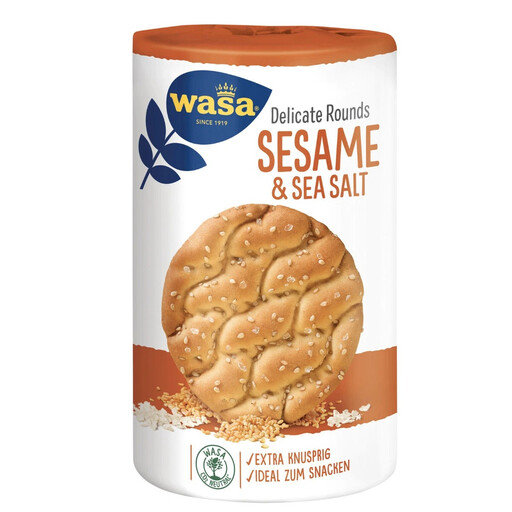
For a coffee break when you’d prefer a variety with sesame and sea salt. Check the information on wheat and sesame when choosing.
 No image available
An option for households that consider organic certification and sesame when choosing a variety. Check the ingredients list on the specific pack, particularly if gluten-containing cereals or sesame are a concern.
 No image available
An option if you’re looking for rye sourdough crispbread for your coffee break. Check the allergen information on the specific pack carefully, as the available information about milk and sesame isn’t entirely consistent.
No, the term alone doesn’t specify a particular quantity. The listings mentioned from REWE, ALDI SÜD and EDEKA24 include different sizes, from 230 g to 410 g. Check the net weight and choose an amount that suits how much you use and how you store it.
Read the ingredients and allergen information on the specific pack before choosing a variety for your household. Lebensmittelverband Deutschland explains that allergenic ingredients are identified in the ingredients list. A voluntary warning about possible traces refers to unintended presence and doesn’t mean that those traces are definitely in the product.
No, rye is a gluten-containing cereal. If you need a gluten-free option, look for a clear gluten-free label and check the other ingredients and allergens separately.
Follow the storage instructions on the pack and, once it’s open, take into account how quickly you’ll use the rest. Lebensmittelverband Deutschland points out that the best-before date describes the quality of unopened food when stored appropriately.