Fans of savoury dips and toppings
If you’re serving hummus, cream cheese, vegetables or cheese, crispbread makes a savoury base. Digestive biscuits are better suited to a sweet finish.


For savoury dips and toppings on fakeaway night, crispbread is the better choice; classic Digestive biscuits are more suited to a planned dessert. With crispbread, the variety and topping you choose make all the difference: compare ingredients, fibre and salt per 100 g, and check the allergen information on the packet.
If you’re serving hummus, cream cheese, vegetables or cheese, crispbread makes a savoury base. Digestive biscuits are better suited to a sweet finish.
If you want to compare the nutritional content of your snacks, you can compare the fibre per 100 g and ingredients of different types of crispbread. Values vary by product.
Depending on the product, rye, wheat, oats, sesame or milk may be relevant. Always check the ingredients and allergen information on the specific packet rather than relying on the terms ‘crispbread’ or ‘Digestive’ alone.
First, decide whether you’re looking for a savoury base or a sweet addition to dessert. Once you’ve chosen the type of product, the ingredients list and nutritional information can help you pick the right variety.
| Criteria | What to check | Who it matters to |
|---|---|---|
| Savoury serving ideas | Check that the product type and flavour on the packet go well with the dips and toppings you’re planning. | For savoury toppings, I want a non-sweet base. Around 33% of consumers prioritise this savoury use. |
| Wholegrains and fibre | Compare wholegrain ingredients and fibre per 100 g; REWE lists 21 g of fibre per 100 g for Burger Delikatess and 30 g for Burger Ballaststoff. | When planning my snacks, I want to be able to compare the fibre content of each variety; this is a priority for around 27% of consumers. |
| Ingredients and allergens | Check the ingredients list, highlighted allergens and, where applicable, any ‘may contain’ statements on the specific packet. | If I need to avoid certain ingredients, the labelling on the individual product matters most to me. Around 27% of consumers put this check first. |
| Sweet finish | For a biscuit dessert, choose Digestive biscuits as a sweet treat and compare sugar and fat per 100 g. | For the end of the evening, I’m deliberately planning something sweet rather than a base for dips; this is the main consideration for around 13% of consumers. |
Here, Digestive refers to a biscuit, not a type of crispbread. A sweet biscuit serves a different purpose from a crispbread base when you’re serving savoury dips.
Before buying, decide whether you want to serve dips and toppings or a dessert, then choose the appropriate product.
Fibre, salt and other ingredients vary by variety. REWE lists different fibre values for Burger Delikatess and Burger Ballaststoff; the higher-fibre variety also contains sesame, among other ingredients.
Compare the nutritional information per 100 g and check the ingredients and allergen information on the specific packet.
Moisture can make it less crunchy, especially if the snacks are going to be left out for a while.
Add dips just before serving. Store any leftover crispbread in a dry, well-sealed container.
REWE stocks a range of Wasa crispbreads, including wholegrain rye and sesame varieties.
REWE lists 21 g of fibre per 100 g for Burger Delikatess and 30 g for Burger Ballaststoff.
EDEKA describes a wholegrain crispbread from its own-label range, sold in a 250-g pack.
Ryvita describes rye varieties and a multigrain variety on its UK product pages.
These crispbreads could work as a base for savoury toppings or dips. The grains, seeds and seasoning are the main things to consider when choosing between varieties; Digestive biscuits for dessert are not included here.
 No image available
A crispbread option if you’re planning to serve savoury toppings with oats and sesame. If you need to avoid certain ingredients, check the ingredients and allergen information on the packet.
 No image available
A good choice for savoury spreads if you’re looking for wholegrain rye crispbread. Rye contains gluten; if you need to avoid other ingredients too, check the information on the packet.
 No image available
A sesame variety for a savoury snack, with or without toppings. If you need to avoid sesame or gluten-containing grains, don’t choose it without checking the current labelling.
 No image available
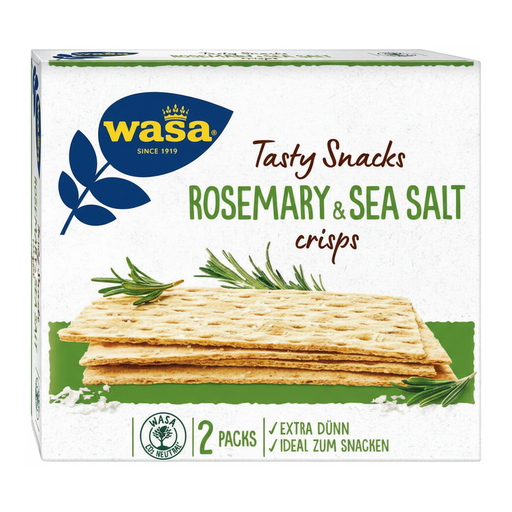
For savoury toppings if you’d like seasoned crispbread with rosemary and sea salt. Compare its salt content with the other ingredients in your snacks, and check the allergen information.
 No image available
For savoury toppings if you’re looking for crispbread with sesame and linseed. To compare fibre, check the nutritional information per 100 g on the packet, and read the ingredients and allergen information.
Digestive biscuits serve a different purpose from crispbread with savoury dips and toppings, but they can work for a deliberately sweet dessert. REWE lists McVitie's Digestive Original as a biscuit and gives its nutritional values per 100 g as 21.3 g fat, 15.1 g sugar and 3.7 g fibre.
Compare the fibre per 100 g in the nutritional information and check the ingredients list too. REWE lists 21 g of fibre per 100 g for Burger Delikatess and 30 g for Burger Ballaststoff; the portion you choose and your toppings are also part of planning your snacks.
No, rye is a grain that contains gluten. If you need to avoid gluten, look for a product that is explicitly labelled as suitable and check the ingredients on the specific packet rather than assuming it’s suitable based on the product category.
Certain allergenic ingredients must be listed on food packaging, as explained by Germany’s Federal Ministry of Agriculture, Food and Home Affairs. Read the ingredients list for the variety you choose and check any voluntary ‘may contain’ statements too; these are not the same as ingredients that have been deliberately added.
Keep it dry and seal it well after opening. For the Burger varieties described by REWE, the storage instruction is ‘Store in a dry place’; it’s best to add wet dips just before serving.