Hosts with a varied mix of guests
If you’re serving crispbread with cheese, dips or spreads, find out before you shop whether any of your guests need to avoid particular ingredients. Check the labelling of the varieties you’ll actually be serving.


For a dinner party, plan how much crispbread you’ll need based on the number of guests and the other food you’re serving. Then choose varieties to suit the toppings and your guests’ dietary requirements. If anyone needs to eat gluten-free, you’ll need a pack explicitly labelled as gluten-free, and should also check the ingredients and allergen information.
If you’re serving crispbread with cheese, dips or spreads, find out before you shop whether any of your guests need to avoid particular ingredients. Check the labelling of the varieties you’ll actually be serving.
When you’re catering for a larger group, the total quantity matters. Compare the net weight of the packs and consider whether crispbread will be a main part of the spread or just an accompaniment.
If you want the crispbread itself to add variety to the platter, you could pair a plain rye variety with a seeded one – as long as its ingredients suit your guests.
First, check any dietary requirements that must be met. Then work out how much you’ll need, and finally choose varieties to go with the toppings. Remember, a ‘family pack’ label is no substitute for checking the net weight.
| Consideration | What to check before buying | Who it matters to |
|---|---|---|
| Dietary requirements | Check the ingredients list and allergen information on the specific pack. If you need a gluten-free option, look for a clear gluten-free label. | If a guest needs to avoid certain ingredients, I want to offer them a suitable option without relying solely on terms such as ‘gluten-free’. This is the main priority for around 42% of consumers. |
| Total quantity | Compare the net weight and, where available, serving information. Work out how many packs you need based on the number of guests and the other food you’re serving. | If I want there to be enough crispbread for several guests, I need to work out the total quantity rather than just choosing a pack with a suitable name. This is the main focus for around 33% of consumers. |
| Flavour and toppings | Decide whether you want to serve a plain rye variety, a seeded one or both, and check that the ingredients in each are suitable for your guests. | If I’m serving a range of toppings, I want to choose crispbread to go with them. This is the priority for around 25% of consumers. |
The gluten-free Wasa Sesame & Sea Salt variety listed by REWE contains sesame; possible traces of milk are also noted. So a gluten-free label won’t answer every question about the ingredients.
Ask guests with known allergies which specific ingredients they need to avoid, then check the ingredients list and any ‘may contain’ warnings on the pack you buy.
The name alone won’t tell you how many packs you’ll need for your guests. Even a single larger pack may not be enough if crispbread is a substantial part of the spread.
Decide what role crispbread will play in the menu, then plan based on the net weight of the packs you choose.
If you don’t buy enough, you may need to make an extra trip at short notice. If you open too many packs, you could be left with leftovers.
Varieties containing poppy seeds, linseeds or sesame have different ingredients from plain rye crispbread, so they won’t necessarily suit every group of guests.
Choose these varieties as an addition, and check their ingredients before serving them to guests with dietary restrictions.
REWE lists several Wasa varieties, including rye crispbread, a poppy seed and linseed variety, and a sesame variety explicitly labelled as gluten-free.
ALDI SÜD sells GOLDÄHREN crispbread in wholegrain and sesame varieties, each weighing 250 g.
The EDEKA24 range includes EDEKA Bio 3 Saaten Knäckebrot, among other products.
These crispbreads could work as a plain base or as a variety with its own distinct ingredients on your dinner party platter. Plan how much you’ll need based on the weight of each pack. If your guests have dietary requirements, check the labelling on the pack you buy.
 Image unavailable
A wholegrain rye variety if you’re looking for a crispbread base for toppings. The pack contains 260 g. Rye crispbread isn’t suitable for a gluten-free diet.
 Image unavailable
A variety with oats and sesame if you’d like to offer another flavour alongside a plain option. The pack contains 230 g. If any guests have allergies, check the ingredients with them beforehand.
 Image unavailable
A sesame and linseed variety for guests who’d like an alternative to plain crispbread. The net weight is 210 g. Check the allergen information on the specific pack.
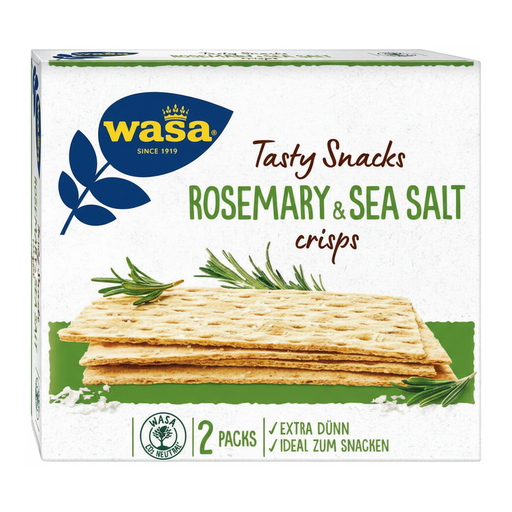 Image unavailable
A round variety with rosemary and sea salt if you’re looking for a seasoned option to go with savoury toppings. The pack contains 190 g, so be sure to factor its weight into your quantity planning.
 Image unavailable
A rye sourdough variety to add more choice to a selection of rye crispbreads. The pack contains 235 g. If any guests need to avoid gluten, choose a product explicitly labelled as gluten-free instead.
No. You can’t tell from the ‘family pack’ label alone. Plan based on the net weight, number of guests and other food you’re serving. Only use serving information for the variety whose pack it appears on.
Choose a pack explicitly labelled as gluten-free, and also check the ingredients and allergen information. For example, the gluten-free Wasa Sesame & Sea Salt variety listed by REWE contains sesame and may contain traces of milk.
Read the ingredients list and any ‘may contain’ warnings on the pack you plan to serve. If a guest has a known allergy, check beforehand which ingredients they need to avoid. The variety name alone won’t tell you.
Follow the storage instructions on the pack and reseal it after serving. If you’ve opened several varieties, you can check and follow the instructions for each one.