Couples with different wholegrain preferences
If you don’t both want crispbread made entirely with wholegrain flour, you could compare a recipe that combines wholegrain and wheat flour. Whether you both enjoy it comes down to personal taste.


If you have different wholegrain preferences when planning dinner for two, crispbread made with wholegrain and wheat flour can be a sensible compromise: REWE lists Wasa Sesame & Wholegrain as containing 49 % wholemeal wheat flour and 39 % wheat flour. If you’d rather prioritise wholegrain or a seed-based option, check the ingredients for the variety you’re considering. If you’re serving guests with allergies, it’s also important to check for sesame and any ‘may contain’ warnings.
If you don’t both want crispbread made entirely with wholegrain flour, you could compare a recipe that combines wholegrain and wheat flour. Whether you both enjoy it comes down to personal taste.
If wholegrain is your priority, compare the ingredients list and the fibre content per 100 g for the varieties you’re considering.
For a sharing platter, consider not only the crispbread itself but also sesame, other declared allergens and how you’ll store it until serving.
First decide what matters most: a compromise on flavour, a wholegrain-focused recipe or a seed-based option to go with your toppings. Then check the information on the specific packet.
| Criterion | What to check | Who is it important for? |
|---|---|---|
| Mixed flour | Compare the ingredients and flour proportions: REWE lists Wasa Sesame & Wholegrain as containing 49 % wholemeal wheat flour and 39 % wheat flour. | If we have different wholegrain preferences, I’d like to serve a recipe that includes both types of flour. For around 44 % of consumers, this compromise comes first. |
| Wholegrain | Compare the wholegrain ingredients and fibre content per 100 g on the packet for each variety. | A clearly wholegrain-focused option matters more to me than a mixed product, even if we don’t all prefer the same recipe. Around 33 % of consumers put wholegrain first when making this choice. |
| Seeds and toppings | Check the ingredients, allergen and ‘may contain’ warnings, and store the crispbread somewhere dry until you’re ready to serve it. | I’m mainly looking for a seed-based option to serve with toppings, while also taking my guests’ needs into account. This is the main consideration for around 23 % of consumers. |
A variety can contain both types of flour: according to REWE, Wasa Sesame & Wholegrain is made, among other things, with 49 % wholemeal wheat flour and 39 % wheat flour. Lebensmittelklarheit also draws attention to this composition.
Compare the declared types and proportions of flour if you’re specifically looking for a mixed product or a more wholegrain-focused variety.
Varieties differ: REWE lists milk ingredients in Wasa Mjölk and sesame in Wasa Sesame & Wholegrain; EDEKA24 says that EDEKA Bio 3 Seeds may contain traces of soya and milk.
Check what your guests need before you shop, and read the ingredients and ‘may contain’ warnings on the packet you buy.
EDEKA24 lists 20.3 g of fat per 100 g for EDEKA Bio 3 Seeds. So looking at the seeds alone won’t tell you everything you need to know about its nutritional content.
Compare the figures for different varieties on the same basis, such as per 100 g, rather than guessing their nutritional values from the name.
Moisture can make it lose its crunch. Verbraucherzentrale recommends keeping crispbread away from moisture and storing it separately from other bread.
Open the packet as close to serving time as possible, and keep any leftovers somewhere dry.
The details below apply to specific varieties, not to a brand’s entire range.
REWE describes both the mixed-flour Sesame & Wholegrain variety and Rustikal, which is made with wholegrain rye.
The Knusperbrot Vollkorn described by REWE contains wholemeal rye flour and wholemeal wheat flour.
The 3 Seeds crispbread described by EDEKA24 contains wholemeal wheat flour, sunflower seeds, sesame and linseeds.
These crispbreads give you a starting point for comparing a mixed-flour recipe with wholegrain- and seed-focused varieties. For dinner, consider both people’s preferences and the information on each packet.
 No image available
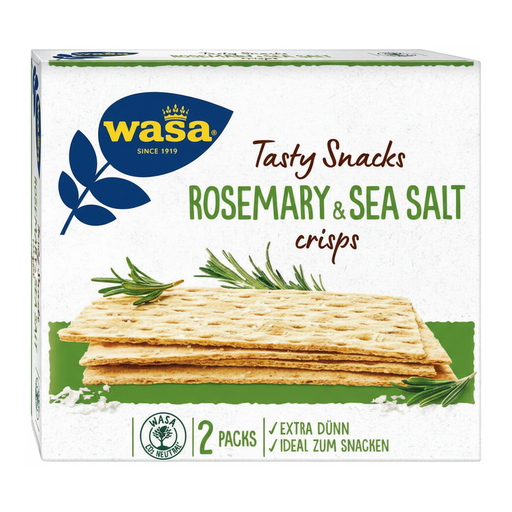
A possible choice for a dinner platter with toppings if you’d like to compare a recipe that combines wholegrain and wheat flour.
This variety is described as flavoured with rosemary and sea salt. Check the packet for allergen information and to compare fibre content.
 No image available
A possible choice for a platter where wholegrain and seeds matter more than a combination of wheat and wholegrain flour.
The variety name lists oats and sesame. If you have allergies, check the information on the specific packet.
 No image available
A seed-based option to serve with toppings if you’re looking for a wholegrain-focused recipe rather than a mixed product.
The variety name lists sesame. If you have allergies, check the ingredients and allergen information on the packet.
 No image available
A possible seed-based option to serve with toppings if you’re not looking for a mixed-flour compromise.
The variety name lists sesame and linseed. Check the packet for fibre content and allergen information.
 No image available
An option if you’d like wholegrain rye on the table and aren’t looking for a mix of wheat and wholegrain flour.
The variety name specifies wholegrain rye. Check the packet information if you’re serving guests with allergies.
Check the ingredients list for the types of flour used. REWE lists Wasa Sesame & Wholegrain as containing 49 % wholemeal wheat flour and 39 % wheat flour; the product name alone doesn’t give you the full picture.
You can’t tell whether it’s suitable from the word ‘crispbread’ alone. The examples described here contain wheat and/or rye, so check your guests’ requirements and read the ingredients and allergen information on the packet you actually buy.
Keep it away from moisture until you’re ready to serve it, and follow the storage instructions on the packet. Verbraucherzentrale also advises storing crispbread separately from other bread.
No. According to the Federal Ministry of Agriculture, Food and Home Affairs, the best-before date is not an automatic throw-away date. Whether the product is still suitable to eat also depends on how it has been stored and its condition; bread with visible mould should be thrown away.