What should you look for when buying?
Gluten- and lactose-free crispbread
A good choice if: you avoid gluten and lactose, and the rest of the labelling on the specific pack is also suitable for your household.
Bear in mind: Wasa states that Gluten and Lactose Free Classic may contain traces of sesame and milk.
Wholegrain rye crispbread
A good choice if: you don’t need to avoid rye or gluten-containing cereals and prefer a short ingredients list.
Bear in mind: Wasa Whole Grain Rye contains rye; REWE states that the 260-g variety may contain traces of sesame.
Seed and multigrain crispbread
A good choice if: the grains and seeds in the variety you choose fit your individual avoidance requirements.
Bear in mind: EDEKA Bio 3 Saaten contains wheat and sesame, among other ingredients; the product information also lists possible traces of soya and milk.
When choosing crispbread for several people, first check the variety against your main dietary requirement. Decide how much to buy only afterwards.
| Criterion |
What to check when buying |
Who it matters most to |
| Specific allergen |
Compare the full ingredients list and highlighted allergens for the exact variety with your avoidance requirements. |
If I need to strictly avoid a particular ingredient, I need to be certain about what’s in the pack. For around 40% of consumers, this check comes first. |
| Possible traces |
Check ‘may contain’ warnings separately; don’t assume cross-contact has been ruled out if no warning appears. |
The ingredients are generally suitable, but possible traces could still affect my decision to buy. Around 30% of consumers put this question first. |
| Pack size |
Compare the net weight, individual packs if applicable, best-before date and storage instructions. |
For several people, I only want to stock up on as much of a suitable variety as I can store sensibly. This is the main concern for around 20% of consumers. |
| Exact product variety |
Check that the ingredients and pack size match the product actually on offer; don’t assume information for other countries applies. |
When shopping, I need to know that the information I’ve found really applies to my pack. For around 10% of consumers, this check takes priority. |
Crispbread at Joybuy
This selection includes rye and seed crispbread in a range of single-pack sizes. When stocking up for a family, check the labelling for each variety first; the weight alone doesn’t make a pack a multipack.
 No image available
Wasa Delicate Crisp Oats & Sesame crispbread, 230 g
For households whose avoidance requirements allow rye, wheat, oats and sesame. The product information gives a weight of 230 g, notes possible traces of milk and recommends storing in a cool, dry place. Check the pack labelling before buying in bulk.
View at Joybuy
 No image available
Wasa Sesame & Flaxseed crispbread, 210 g
For households whose avoidance requirements are compatible with the ingredients in this variety. The product information gives a weight of 210 g and lists 91% wholegrain rye flour and 5.3% linseed, as well as gluten-containing cereals and possible traces of milk. Store in a cool, dry place.
View at Joybuy
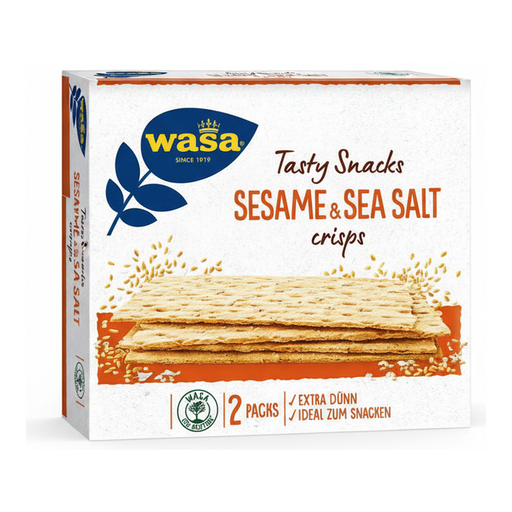 No image available
Wasa Round Sesame & Sea Salt crispbread, 190 g
A 190-g variety for households that don’t need to avoid sesame or the gluten-containing cereals listed. The product information lists wheat and barley, as well as possible traces of milk; always check the labelling on the specific pack.
View at Joybuy
 No image available
Wasa Whole Grain Rye crispbread, 260 g
For households that don’t need to avoid rye or gluten and are considering a 260-g pack. The listed ingredients are wholegrain rye flour, yeast and salt. Joybuy and REWE give different information about possible traces of milk; if you have a milk allergy, check the labelling on the specific pack.
View at Joybuy
 No image available
Alnatura Organic Sesame Crispbread, 250 g
For households that don’t need to avoid rye or sesame. The product information gives a weight of 250 g and lists 84% wholegrain rye flour and 10% sesame, with storage in a dry place. Check the pack for any other ingredients relevant to you before buying.
View at Joybuy
Frequently asked questions
How can I identify allergens that must be declared on packaged crispbread?
They must be highlighted in the ingredients list. This is required under the EU Food Information Regulation for the allergens it covers; when shopping, the list on the specific pack is what matters.
Is gluten-free crispbread suitable for every food allergy?
No. ‘Gluten-free’ doesn’t tell you whether other ingredients that matter to you or possible traces are present. For example, Wasa states that Gluten and Lactose Free Classic may contain traces of sesame and milk.
Does the absence of a trace warning mean there’s no risk of cross-contact?
No. Lebensmittelklarheit explains that additional trace warnings aren’t covered by consistent legal requirements. If possible cross-contact is an important factor in your decision, you should check the information for the specific variety.
How should I store a larger supply of crispbread?
Follow the instructions on the pack you buy. REWE recommends storing Wasa Whole Grain Rye in a dry place away from light. Once opened, seal the pack as instructed and keep it clearly identified with its variety.
Can I use information about Ryvita from a UK website for a pack sold in Germany?
No. The ingredients and warnings for the Ryvita variety shown on a UK website don’t confirm the labelling on a pack sold in Germany. Before buying, check the information for the variety you’ve actually chosen.


