Compare sugar values
You want to compare the ‘of which sugars’ value per 100 g across different crispbreads, without confusing a marketing claim with the actual figure in the nutrition table.


When comparing crispbreads, start by checking ‘of which sugars’ per 100 g rather than relying on claims such as ‘less sugar’. The GUT&GÜNSTIG wholegrain and sesame varieties listed by EDEKA contain 2.9 g and 2.6 g of sugar per 100 g respectively; REWE lists 1.5 g for Burger high-fibre crispbread. The right choice also depends on the ingredients, fibre content and allergens.
You want to compare the ‘of which sugars’ value per 100 g across different crispbreads, without confusing a marketing claim with the actual figure in the nutrition table.
You’re looking for a crispbread for everyday use and want to consider pack size, ingredients and sugar content together. A supermarket own-brand name alone won’t answer these questions.
You also want to compare fibre content, or you need to check the labelling on the specific pack for gluten-containing cereals, sesame and possible traces.
Start by comparing the sugar value using the same measure, then check whether the recipe and pack size suit your needs.
| Criterion | What to check | Who it matters to |
|---|---|---|
| Sugar content | Compare ‘of which sugars’ per 100 g across similar crispbreads; don’t mistake a reduction claim for an absolute value. | If I’m choosing varieties by their sugar content, I need to compare them using the same measure rather than relying on a claim on the front of the pack. This is the main consideration for around 45% of consumers. |
| Everyday product and pack | Check the pack size, ingredients list and sugar content of the specific variety. | For everyday use, I want a suitable pack size and a recipe with ingredients I can understand. Around 33% of consumers prioritise choosing this kind of everyday staple. |
| Fibre and allergens | Compare fibre, fat and salt per 100 g; check the ingredients and any ‘may contain’ information on the current pack. | If I need to avoid certain ingredients or want to compare fibre content too, the sugar value alone isn’t enough. This is the most important consideration for around 22% of consumers. |
The Verbraucherzentrale (German consumer advice centre) points out that even 30% less sugar than a comparison product can still mean a high sugar content.
Also check ‘of which sugars’ per 100 g and compare the figure with a similar type of crispbread.
For GUT&GÜNSTIG sesame crispbread, EDEKA lists 2.6 g of sugar and 7.5 g of fat per 100 g; the variety contains sesame. For Burger high-fibre crispbread, REWE lists 1.5 g of sugar and 30 g of fibre per 100 g, as well as several cereal and seed ingredients.
Decide which information matters to you in addition to sugar, and check it for each specific variety.
Supermarket own brands and other brands offer a range of varieties. The brand name alone doesn’t tell you the sugar content or ingredients of a particular crispbread.
Compare the nutrition information and ingredients lists on the packs you’re choosing between.
Depending on the variety, the crispbreads mentioned here may contain gluten-containing cereals or sesame, or carry warnings about possible traces. EDEKA notes that the information on the packaging may differ from what’s listed online.
If you have an allergy or coeliac disease, check the current packaging before eating the product. If the information is unclear, don’t assume the variety is suitable.
EDEKA own brand, with wholegrain and sesame crispbread among the products considered here.
A crispbread brand with Delikatess and high-fibre varieties among those considered here.
A brand with a range of crispbreads, including wholegrain rye and seed varieties.
REWE’s own brand, which you can include when comparing specific crispbread varieties.
These Wasa varieties include different rye, seed and seasoned options to compare. Choose based on the pack size, and check the sugar content, other nutritional values and allergens for each variety.
 No image available
A wholegrain rye option to compare with other crispbreads of this type. Check the sugar content and allergen information on the current pack.
 No image available
A rye variety made with sourdough, for comparing different recipes. Check the nutrition information and allergen details on the specific pack.
 No image available
A variety described as containing sesame and flaxseed. If sesame is a concern for you, check the ingredients and any ‘may contain’ information on the current pack.
 No image available
An oat and sesame variety to consider if you want to compare fibre as well as sugar. Check the values per 100 g and the allergen information on the pack.
 No image available
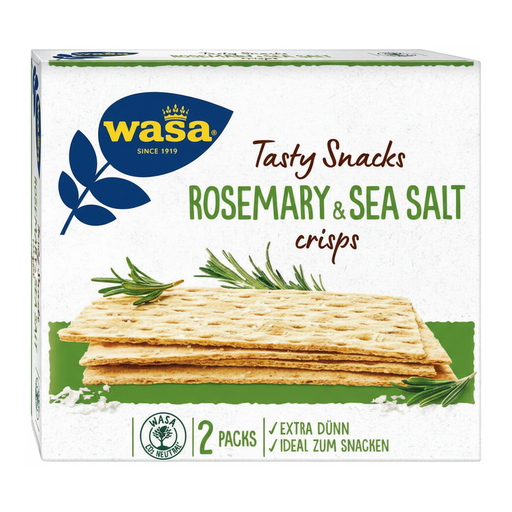
A seasoned, round option to compare with plain crispbread. As well as ‘of which sugars’, check the salt content per 100 g.
No. ‘Less sugar’ describes a comparison, whereas ‘of which sugars’ in the nutrition table gives the value for the specific product. The Verbraucherzentrale (German consumer advice centre) points out that a product can still contain a lot of sugar even if it has 30% less; so compare the values per 100 g.
Check the ingredients and allergen information on the current pack before deciding whether a variety is suitable. Depending on the product, the varieties considered here contain sesame or gluten-containing cereals; warnings about possible traces may also be relevant.
Follow the storage instructions on the pack. The Burger products considered here should be stored in a dry place. After opening, a tightly sealed container or a resealable original pack can help, if the pack is designed for this.
Not necessarily: EDEKA notes on the product pages considered here that some varieties may not be available in every store. Check that the variety you want is available at your chosen store, and read its current packaging information.