Parents who prioritise wholegrains
For a school lunch, you’re looking for a crispbread base where the wholegrain label and fibre content matter more than special seasoning.


Wholegrain rye crispbread can be a good base for a school lunchbox if wholegrains are a priority and your child can tolerate rye. With sesame varieties, taste and allergen labelling matter too. If a gluten-free diet is necessary, only crispbread labelled as gluten-free is suitable. You can only tell whether the slice shape and how easily it breaks suit your lunchbox by checking the specific product.
For a school lunch, you’re looking for a crispbread base where the wholegrain label and fibre content matter more than special seasoning.
The ingredients and allergen information on the specific pack are what count. A gluten-free label alone doesn’t tell you whether the product also meets other allergen requirements.
You’re looking for a slice shape and flavour your child will enjoy with the planned topping, and that’s easy to manage in a lunchbox.
When choosing crispbread for a school lunchbox, check any essential allergen requirements first. Then use the ingredients list and nutrition information, and consider the slice shape.
| Criteria | What to check | Who it matters to |
|---|---|---|
| Wholegrains | Look for the words “wholegrain” and compare fibre content on the same basis: per 100 g. | If wholegrains are a priority for a school lunch, I don’t want to rely on a dark colour alone. Around 36% of consumers would make wholegrains their most important purchase criterion. |
| Allergens and gluten | Check the ingredients, allergen information and may-contain statements on the pack. If a gluten-free diet is necessary, look for an explicit gluten-free label. | If there’s a specific dietary requirement, the individual variety must suit your child, not just the brand. Allergen or gluten requirements would be the top priority for around 29% of consumers. |
| Flavour and lunchbox suitability | Consider the slice shape alongside the planned topping; pack moist ingredients separately if needed. | If your child doesn’t like stronger flavours or the crispbread goes soft before lunchtime, the right ingredients list alone won’t help much. Practical suitability would come first for around 21% of consumers. |
| Comparing varieties | When switching varieties, compare the ingredients, nutrition information, pack size and availability in your local shops. | If you want to buy the same variety regularly for the school week, you’ll need a suitable alternative in case it isn’t available in your local shops. Around 14% of consumers would start by comparing varieties. |
Colour alone doesn’t prove that crispbread is made from wholegrains. The German Nutrition Society points to the need for an explicit wholegrain label.
Check the product description and ingredients list. To compare fibre content, use the nutrition information per 100 g.
A gluten-free variety may contain other ingredients that matter: Wasa Sesame & Sea Salt, listed by REWE, contains sesame.
If your child has an allergy, read the ingredients and may-contain statements on every specific pack, and follow their individual dietary requirements.
If a moist topping sits directly on the crispbread for a long time, it may lose the crunch you want by lunchtime.
Pack moist ingredients separately or add the topping just before eating.
Products from well-known brands and supermarket own brands that look similar may differ in their ingredients, nutrition information and allergen details.
When switching varieties, compare the specific packs, especially if gluten or other allergens are a deciding factor.
Among the varieties listed by REWE, Wasa offers both wholegrain rye crispbread and sesame varieties.
Finn Crisp is a good example of wholegrain rye crispbread as a base for a school lunch.
Ingredients and fibre content are the main points to compare when considering Burger Fibre Crispbread.
The EDEKA own-brand wholegrain crispbread is another variety to consider when comparing ingredients.
ALDI SÜD lists Goldähren Wholegrain Crispbread in a 250-g pack.
These varieties offer different options for a school lunchbox: wholegrain rye, sesame, and a version seasoned with garlic and sea salt. Before choosing, check which ingredients your child can tolerate, and whether the flavour and slice shape suit the planned lunch.
 No image available
An option if oats and sesame work with the flavours you have planned for lunch. If your child has a sesame allergy, pay particular attention to the ingredients and allergen information on the specific pack. Check that the slice shape and how easily it breaks suit your lunchbox too.
 No image available
A wholegrain rye option for your child’s lunchbox, if they can tolerate rye. For the corresponding 260-g Wasa Wholegrain Rye variety, REWE lists 20 g of fibre per 100 g; the information on the specific pack is what matters when making your choice.
 No image available
A sesame variety for children who enjoy this flavour in their school lunch. If your child has a relevant allergy, check the pack labelling and make sure the slice shape works for your lunchbox.
 No image available
A rye sourdough option if its flavour works with your planned topping. Rye contains gluten; if fibre is a priority, compare the nutrition information per 100 g on the pack.
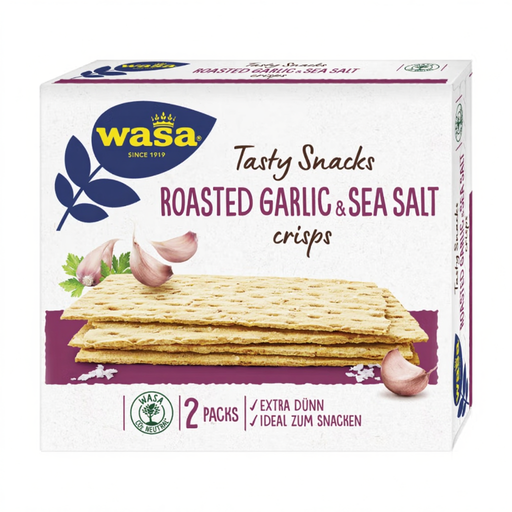 No image available
This variety, described as roasted garlic and sea salt, is only suitable if your child likes those flavours. Before packing it, check that the round shape fits in your lunchbox.
Crispbread can provide the grain element of a school breakfast, but it doesn’t automatically replace the other parts of the meal. The Federal Centre for Nutrition recommends that a primary-school breakfast also includes a drink, fruit or vegetables, and milk or a dairy product.
Look for the word “wholegrain” and read the ingredients list rather than assuming that a dark colour means the product is wholegrain. The German Nutrition Society specifically recommends looking for a wholegrain label.
No, rye contains gluten. If a gluten-free diet is necessary, choose only a variety explicitly labelled as gluten-free, and also check the other ingredients and allergen information on the pack.
Pack moist toppings separately from the crispbread and, if possible, add them just before eating. The Federal Centre for Nutrition recommends using separate compartments for lunchbox items. For an opened pack, follow the storage instructions on the label.
Yes. If your child has an allergy, check the labelling on the specific pack you’re using, especially if you switch varieties or brands. The Federation of German Consumer Organisations recommends checking the ingredients lists of packaged foods when looking for allergens.