If you’d like to swap sweet biscuits or pastries for crispbread with your coffee now and then, start with a plain rye or wholegrain variety and compare its sugar content per 100 g with that of your usual choice. Whether your whole coffee break contains less sugar also depends on the topping. A claim such as ‘reduced sugar’ is no substitute for checking the nutrition information and ingredients.
Who might enjoy crispbread with coffee?
People keeping an eye on sugar with their coffee
If you’d like to replace biscuits or other sweet bakes from time to time, compare the crispbread’s sugar content per 100 g with that of your usual choice. Lebensmittelklarheit points out that ‘reduced sugar’ is a comparative claim – it doesn’t simply mean that a product has a particularly low sugar content.
Fans of savoury wholegrain crispbread
If you prefer something savoury with your coffee, rye crispbread with a non-sweet topping might suit your taste. Wasa gives the sugar content of its Whole Grain Rye as 1.5 g and its fibre content as 20 g per 100 g. You may need to check the sugar content of the topping separately.
People comparing supermarket own-label options
When choosing between branded and own-label varieties, compare the pack size, ingredients and nutrition information for the specific products. The sugar contents listed by ALDI SÜD differ between GOLDÄHREN Wholegrain and GUT BIO Three Seed. The information on the pack may also vary when suppliers change.
What should you look for when buying?
When choosing crispbread to enjoy with coffee, start by checking the specific pack. Then consider what you’d like to eat with it.
| What matters |
What to check when buying |
Who it matters most to |
| Sugar content |
Compare the ‘of which sugars’ figure per 100 g on the pack. For ‘reduced sugar’ claims, also check which product it’s being compared with. |
If I want to replace biscuits or pastries, I need to be able to compare the sugar content of the specific variety with my usual choice. This is a priority for around 37% of shoppers. |
| Ingredients and allergens |
Check the types of grain, ingredients list and allergen or ‘may contain’ information on the current pack. |
Rye or a ‘may contain’ warning could limit my choice of variety. That’s why around 27% of shoppers prioritise checking whether the ingredient information meets their needs. |
| Toppings and flavour |
Choose your crispbread and planned topping together. If you’re having a sweet spread, check its nutrition information too. |
I’m looking for something crunchy to enjoy with coffee and want to choose whether the topping is savoury or sweet. This combination is a priority for around 18% of shoppers. |
| Comparing varieties |
Compare pack sizes and nutrition information for different varieties on the same 100 g basis. |
If I’m considering several branded and own-label varieties, I need comparable information for the pack I’m actually buying. This comparison is the most important consideration for around 18% of shoppers. |
Common comparison pitfalls
-
Assuming ‘reduced sugar’ means low in sugar
‘Reduced sugar’ describes a comparison with a food of the same type. According to Lebensmittelklarheit, the claim requires at least 30% less sugar than the comparison product. On its own, it doesn’t tell you how much sugar the crispbread contains per 100 g.
Check the ‘of which sugars’ line in the nutrition information and find out what a reduced-sugar claim is referring to.
-
Ignoring the topping when comparing sugar content
The crispbread’s nutrition information doesn’t cover a finished portion with toppings. Jam, honey or a sweet spread needs to be considered separately.
Choose your crispbread and topping together. If you’re having a sweet spread, check its nutrition information too.
-
Assuming ‘organic’ or ‘three seed’ means less sugar
ALDI SÜD lists 3.4 g of sugar per 100 g for GUT BIO Three Seed, compared with 1.1 g per 100 g for GOLDÄHREN Wholegrain. The variety name alone won’t answer your questions about sugar.
Compare the nutrition information for the specific varieties on the same 100 g basis.
-
Relying on online information instead of the current pack
ALDI SÜD notes that the nutrition information for the own-label varieties mentioned may vary depending on the supplier.
Before buying, check the ingredients, allergens and nutrition information on the pack you’re actually choosing.
Brands and ranges to consider
Wasa (Wasabröd)
Rye and wholegrain crispbread, where the nutrition information for each variety matters more than the brand name.
- Wasa gives the sugar content of its Whole Grain Rye as 1.5 g and its fibre content as 20 g per 100 g. EDEKA24 lists 0.3 g of sugar per 100 g for Wasa Sourdough Rye.
- EDEKA24 notes that Wasa Sourdough Rye may contain traces of sesame and milk. Check the information on the pack you choose.
GOLDÄHREN (ALDI SÜD)
An own-label range that includes a wholegrain crispbread for comparing individual varieties.
- ALDI SÜD gives the sugar content of GOLDÄHREN Wholegrain as 1.1 g and its fibre content as 15.3 g per 100 g.
- ALDI SÜD notes that nutrition information may vary when suppliers change. The information on the specific pack is the one to go by.
GUT BIO (ALDI SÜD)
Organic crispbread, including a three-seed variety for shoppers who want to take seed ingredients into account.
- For its Organic Crispy Crispbread Three Seed, ALDI SÜD lists 3.4 g of sugar, 12 g of fibre and 14 g of protein per 100 g.
- The three-seed name doesn’t mean it will have less sugar than other varieties. Nutrition information may vary depending on the supplier here too.
Ryvita
Rye crispbread as a reference point for shoppers comparing the ingredients lists of individual products.
- On its UK product page, Ryvita lists wholemeal rye flour, rye flour and salt as ingredients in Original Crispbread.
- Don’t assume the information on the UK product page also applies to a pack intended for the German market.
EDEKA Bio
Organic crispbread in the EDEKA24 range, offering another variety to compare within the category.
- EDEKA24 lists EDEKA Bio 3 Seed Crispbread as a 200 g product.
- If you’re choosing with sugar in mind, the ingredients and sugar content on the specific pack are what matter.
Crispbread on Joybuy
This range includes plain rye varieties as well as options with seeds or savoury seasoning. For your coffee break, compare the current nutrition information and your planned topping, as well as choosing a flavour you’ll enjoy.
 No image available
Wasa Sesame & Flaxseed crispbread 210 g
A variety with seeds in the name, if you’re considering crispbread instead of sweet biscuits or pastries with your coffee. Check the ingredients list carefully for this option: sesame is named in the product title, but the other product information doesn’t make clear whether it’s an ingredient or a possible trace. Also check the sugar content on the pack.
View on Joybuy
 No image available
Wasa Sourdough Rye crispbread 235 g
A sourdough rye variety if you’re looking for a savoury base to enjoy with your coffee. Rye contains gluten, so check the current allergen and ‘may contain’ information too. Check the sugar content per 100 g on the pack you choose.
View on Joybuy
 No image available
Wasa Whole Grain Rye crispbread 260 g
A wholegrain rye variety for anyone looking for a plain base to pair with a topping of their choice. Compare the nutrition information on the specific 260 g pack and remember that rye contains gluten when choosing ingredients.
View on Joybuy
 No image available
Wasa Delicate Crisp Oats & Sesame crispbread 230 g
An oat and sesame option if these ingredients are important to you when choosing a variety. The name alone doesn’t tell you how much sugar it contains, so check the nutrition information per 100 g and the current allergen information.
View on Joybuy
 No image available
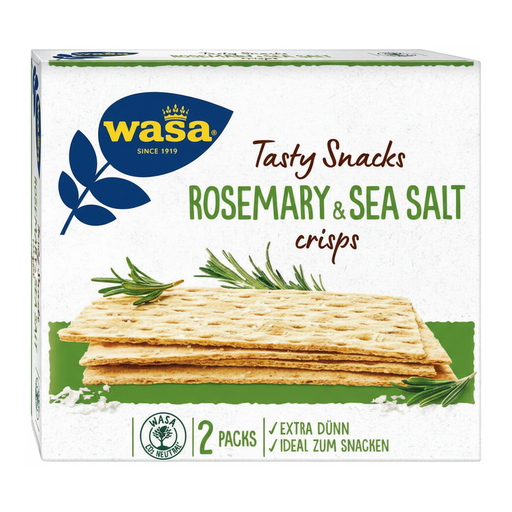
Wasa Round Rosemary & Sea Salt crispbread 190 g
A variety seasoned with rosemary and sea salt, if you prefer something savoury with your coffee. For a sugar comparison, use the figure per 100 g on the specific pack. Also check the ingredients and allergen information.
View on Joybuy
Frequently asked questions
Does ‘reduced sugar’ mean that crispbread is also ‘low in sugar’?
No. ‘Reduced sugar’ is a comparative claim and doesn’t tell you the absolute sugar content on its own. Lebensmittelklarheit says it means at least 30% less sugar than a food of the same type. The sugar content of the variety you choose is shown in the nutrition information per 100 g.
Does ‘no added sugar’ mean that no sweeteners are included?
No, you can’t assume that from ‘no added sugar’. If sweeteners are a factor in your choice, check the ingredients list on the specific pack.
Is rye crispbread gluten-free?
No, rye contains gluten. If you need to avoid gluten, don’t rely on the general term ‘crispbread’ alone. Check the ingredients and look for an explicit gluten-free label on the specific pack.
How should I store crispbread once opened?
Follow the storage instructions on the pack. For Wasa Sourdough Rye, EDEKA24 recommends storing it in a dry place away from light.


