Families keeping an eye on sugar
If you’re buying crispbread for several people, compare the ‘of which sugars’ figures per 100 g and the ingredients lists of similar varieties. A ‘less sugar’ claim is no substitute for checking these details.


When stocking up for the family, the stated sugar content per 100 g is a more useful way to compare similar types of crispbread than a prominent ‘less sugar’ claim. Then check the ingredients, wholegrain claims, salt and allergens. If you’re buying in larger quantities, also consider the pack size and how much your household will actually use.
If you’re buying crispbread for several people, compare the ‘of which sugars’ figures per 100 g and the ingredients lists of similar varieties. A ‘less sugar’ claim is no substitute for checking these details.
Check the wholegrain description, ingredients list and fibre content for the specific variety. Salt content and pack size may also affect your choice.
If anyone in your household needs to avoid certain grains or other allergens, check the information on the individual pack. The word ‘crispbread’ alone won’t tell you what it contains.
Start by comparing the nutrition information for similar types of crispbread. Lebensmittelklarheit explains that a sugar-reduction claim describes a comparison; it doesn’t, by itself, mean the product has a low absolute sugar content.
| What matters | What to check when buying | Who it matters to |
|---|---|---|
| Sugar content | Compare ‘of which sugars’ per 100 g across similar types of crispbread; if a product claims ‘less sugar’, check which product it is being compared with. | I want to shop for several people without relying solely on the front of the pack when choosing a lower-sugar option. Around 33 % of consumers put sugar content first. |
| Wholegrain and fibre | Check the wholegrain description against the ingredients list and, where shown, compare fibre per 100 g. | I’m specifically looking for a wholegrain variety for my pantry, rather than judging by its dark colour; around 25 % of consumers put this first. |
| Pack size and stocking up | Consider the pack weight, how quickly you expect to use it and the storage advice for your chosen variety. | If I’m buying several packs for the family, I want the quantity to match what we’ll actually use. Stock planning is a priority for around 25 % of consumers. |
| Allergens and ingredients | Read the ingredients, highlighted allergens and any ‘may contain’ warnings on the specific pack. | If anyone in my household needs to avoid certain ingredients, the labelling comes before flavour or variety; around 17 % of consumers put this check first. |
A comparison with another product doesn’t tell you how much sugar the crispbread actually contains per 100 g. It also doesn’t reveal its energy content.
Read the nutrition information and, if the product makes a comparative claim, check which product it is being compared with.
Colour alone doesn’t show whether a crispbread variety is made with wholegrain flour.
Look for a wholegrain description and check the ingredients listed.
Gluten-free crispbread still has its own sugar and salt content, as well as ingredients that may matter to some households.
Check the gluten-free labelling if your household needs it, then compare sugar, salt and allergens separately.
Wasa offers a range of crispbreads, including wholegrain, rye and explicitly labelled gluten-free varieties.
EDEKA24 describes a 250-g pack of wholegrain rye crispbread made with wholegrain rye flour, water and sea salt.
On its UK website, Ryvita describes its Original Crispbread as rye crispbread.
This selection includes three crispbread varieties with different ingredients, suitable for stocking up the family pantry. Check the information on each pack before choosing one variety or buying several packs.
 No image available
A variety for households looking to include oats and sesame in their crispbread selection. Compare the sugar content per 100 g and check the allergen information on the pack.
 No image available
If sesame is an option when choosing a variety, check the ingredients and nutrition information on the specific pack before stocking up. The stated pack size is 250 g.
 No image available
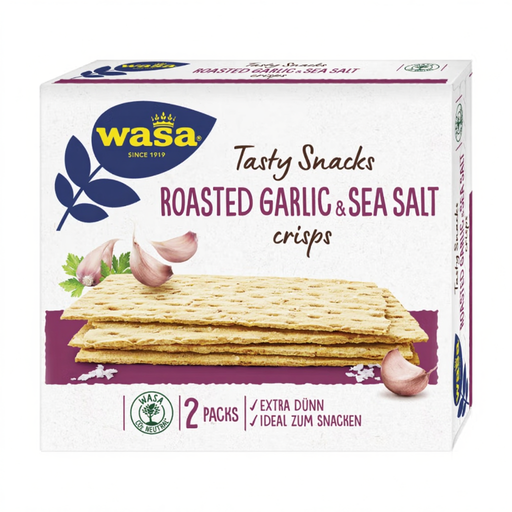
This garlic and sea salt variety may suit households looking for a savoury, seasoned option. Alongside the sugar content, pay particular attention to the salt and allergen information on the 190-g pack.
It describes a reduction compared with a similar food; it doesn’t automatically mean the product has a low sugar content. Lebensmittelklarheit therefore recommends checking ‘of which sugars’ per 100 g too. It’s also important to compare like-for-like crispbreads.
No. Naturally occurring sugars may still be present. Check the ‘of which sugars’ figure on the pack for the actual amount.
Check the ingredients list and allergen information on the specific pack. Under European labelling rules, allergens are highlighted in the ingredients list. For rye or seed varieties, check which cereals and ingredients are named.
Follow the storage advice on your chosen pack, and keep opened crispbread dry and in a tightly sealed container. EDEKA24 advises storing its organic wholegrain rye crispbread in a cool, dry place.