People comparing sugar content
You’re after something crunchy with your afternoon coffee and want to check the sugar content on the label. It helps to distinguish between sugar, total carbohydrates and energy.


For an afternoon coffee break, it’s worth choosing crispbread based on its sugar content per 100 g, how easy it is for you to chew and what you plan to put on it – rather than relying on the words ‘reduced sugar’ alone. Plain rye crispbread may be a good option if you’re comfortable chewing firm slices. With seeded varieties, it’s also worth checking the fat, energy and allergen information.
You’re after something crunchy with your afternoon coffee and want to check the sugar content on the label. It helps to distinguish between sugar, total carbohydrates and energy.
For you, the key question is whether a firm, dry slice is comfortable to chew. The German Nutrition Society lists chewing ability as something that can change with age, although this isn’t the case for everyone.
You use crispbread as a base for sweet or savoury toppings and look beyond the sugar content to ingredients, allergens, fat, salt and energy.
Start by comparing the nutrition information for similar crispbreads. Whether a variety works with your afternoon coffee also depends on its texture and ingredients.
| What to check | What to look at when buying | Who it matters most to |
|---|---|---|
| Sugar content | Compare sugar per 100 g for similar crispbreads. Use the per-slice figure if it’s shown on the pack. Check carbohydrates and energy separately. | If a low sugar content matters to me, I want to know what’s actually in each slice. Around 40% of consumers put this comparison first. |
| Texture and ease of chewing | Check whether firm, dry slices are comfortable for you to chew. If you have difficulty chewing or swallowing, seek professional advice about whether it’s suitable. | A very crunchy slice isn’t right for me if I find chewing difficult. That’s why texture is the main consideration for around 30% of consumers. |
| Ingredients and toppings | Check the ingredients and allergens on the specific pack. For seeded varieties, also compare fat, energy and salt per 100 g. | If I’m adding toppings to my crispbread or need to avoid certain ingredients, there’s more to consider than sugar alone. Around 30% of consumers prioritise these needs. |
A claim that a product contains less sugar doesn’t automatically mean it has fewer total carbohydrates or less energy. Lebensmittelklarheit explains the difference using a comparative sugar claim as an example.
Compare sugar, carbohydrates and energy using the same basis for each. For a coffee break, it can also be useful to check the amount per slice.
EDEKA Bio 3 Saaten Knäckebrot lists 1.4 g of sugar, but also 20.3 g of fat per 100 g. REWE Bio Naturland Vollkorn Knusperknäcke contains sesame and lists 19.5 g of fat per 100 g. These figures apply to these specific products.
For seeded varieties, check the fat, energy, salt and allergen information as well as the sugar content.
Wasa describes its wholegrain rye crispbread as extra crunchy. The German Nutrition Society says that chewing ability can change with age, but whether a slice like this is suitable varies from person to person.
If you have difficulty chewing or swallowing, check whether it’s suitable for you rather than choosing crispbread based on its nutritional values alone.
ALDI SÜD says that its GOLDÄHREN Vollkornknäckebrot may come from different suppliers, so the nutrition information can vary.
Always check the pack you’re actually buying for sugar, salt, ingredients and allergens.
Rye crispbread, with sourdough and seeded varieties also available.
Rye crispbread that may be worth comparing, if the specific pack is available.
Wholegrain seeded crispbread as an alternative to plain rye crispbread.
Three-seed crispbread made with wholegrain wheat and rye.
An own-label wholegrain crispbread option.
These Wasa products include rye crispbread, seeded varieties and a seasoned wheat variety. When choosing crispbread for an afternoon coffee break, check the sugar content on the pack, the ingredients and how easy it is for you to chew.
 No image available
A plain base for toppings, if firm, crunchy slices are comfortable for you to chew.
Wasa lists 1.5 g of sugar and 20 g of fibre per 100 g for Vollkorn Roggen. Check the pack for the figures for your portion.
 No image available
A seeded option if the ingredients matter just as much as the sugar content.
Compare the nutrition information and, if you have a sesame allergy, check the ingredients and allergen advice on the pack.
 No image available
A rye option if you’re considering sourdough crispbread as a base for your toppings.
Compare the sugar content per 100 g on the pack and check that the firm texture suits you.
 No image available
An oat and sesame variety if the ingredients matter as much as the sugar content.
Before buying, check the nutrition information and, if you have a sesame allergy, the allergen advice on the specific pack.
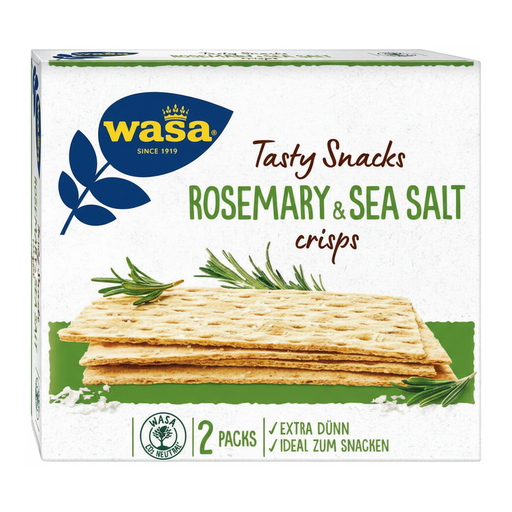 No image available
A savoury option if rosemary and sea salt suit the toppings you have in mind.
As well as the sugar content, check the salt on the pack. The seasoning alone doesn’t tell you anything about the nutritional values.
No. A claim about having less sugar relates to sugar; it doesn’t automatically mean the product contains fewer total carbohydrates. Lebensmittelklarheit explains the difference using a comparative sugar claim as an example. When choosing crispbread, check both figures separately in the nutrition table.
No. The sugar content alone doesn’t tell you whether a firm slice is easy to chew. The German Nutrition Society points out that chewing ability can change with age. If you have difficulty chewing or swallowing, check whether it’s suitable for you.
Store it according to the instructions on the specific pack. REWE recommends storing Wasa Vollkorn Roggen in a dry place away from light.