Shoppers focused on fibre
You want to enjoy crispbread regularly at teatime and compare wholegrain and rye options by their fibre content per 100 g, rather than by their colour.


If you want to compare fibre content for teatime, wholegrain rye crispbread with clearly stated nutritional information is a sensible place to start – but it’s no guarantee of a particular effect on digestion. Check the ingredients, salt and allergens too, and choose an option whose flavour and portion size suit your toppings and what you personally find comfortable to eat.
You want to enjoy crispbread regularly at teatime and compare wholegrain and rye options by their fibre content per 100 g, rather than by their colour.
You’re looking for a crispbread base for spreads or cheese and want to check the grains, salt and allergens listed on the packet.
Your main consideration is whether the flavour of rye and the crisp texture work with your sweet or savoury toppings and the portion you have in mind.
When choosing crispbread for teatime, start by comparing the nutritional information per 100 g and the ingredients. Then decide which grain and texture will work best with your toppings.
| Criteria | What to check | Who it matters to |
|---|---|---|
| Fibre | Compare the fibre content per 100 g and take account of the portion you’ll actually eat. A term such as ‘digestive’ is no substitute for nutritional information. | If fibre is my main priority, I want to compare crispbreads using their nutritional information without assuming they’ll have an effect on digestion. Around 50% of shoppers put this concern first when choosing for teatime. |
| Ingredients and allergens | Read the ingredients list and allergen information on the specific packet, paying particular attention to the grains used. | When choosing a simple crispbread base for spreads, I want to know which ingredients and relevant allergens it contains. For around 30% of shoppers, this clarity comes first. |
| Flavour and texture | Check whether the variety and its ingredients will work with sweet or savoury toppings. For seasoned varieties, also check the salt content per 100 g. | For teatime, I want the texture of the crispbread to complement the topping without its own flavour overpowering it. This is the most important reason to buy for around 20% of shoppers. |
Colour alone doesn’t tell you which flour a crispbread contains. The product name and ingredients list are more useful for finding out.
Look for the term ‘wholegrain’ and check which flour or meal is listed among the ingredients.
The fibre content tells you about the nutritional value, not how well you’ll personally tolerate the product or how it will affect your digestion. The type of grain matters too.
Compare fibre alongside the ingredients, allergens and the portion you plan to eat.
Wholegrain crispbreads can vary in their other ingredients and salt content. For example, REWE lists rye wholegrain flour and sea salt as ingredients in Linea Natura Bio Roggen Vollkorn Knäcke, with 1.4 g of salt per 100 g.
Compare the ingredients list and nutritional information per 100 g, especially if your topping is already strongly flavoured or salty.
EDEKA notes that information on its GUT&GÜNSTIG Knäckebrot product page may differ from the packaging. ALDI SÜD says that GOLDÄHREN Vollkornknäckebrot may come from different suppliers, so its nutritional values can vary.
Before buying, check the ingredients, allergens and nutritional information on the specific packet.
REWE lists options including Wasa Vollkorn Roggen and Wasa Roggen traditionell.
Ryvita Dark Rye is a rye option for shoppers looking for a short ingredients list.
The wholegrain crispbread from this EDEKA own-brand range is a rye option.
ALDI SÜD sells several products under the GOLDÄHREN name, including wholegrain crispbread and a sesame variety.
Linea Natura Bio Roggen Vollkorn Knäcke is a rye option with a simple list of ingredients.
This selection includes crispbreads made with rye or seeds, as well as savoury flavours. Check the information on the specific packet to find an option that suits your toppings and ingredient requirements.
 No image available
A wholegrain rye option if you want to compare grains and nutritional values for teatime. If you have a rye allergy or follow a gluten-free diet, check the labelling and choose a suitable alternative.
 No image available
An oat and sesame option if you’re looking for a seeded crispbread for teatime. If you have a sesame allergy, it’s particularly important to check the ingredients and allergen information on the specific packet.
 No image available
A sesame crispbread for shoppers looking for a seeded option to go with their teatime toppings. Before buying, compare the ingredients, allergens and salt content on the packet.
 No image available
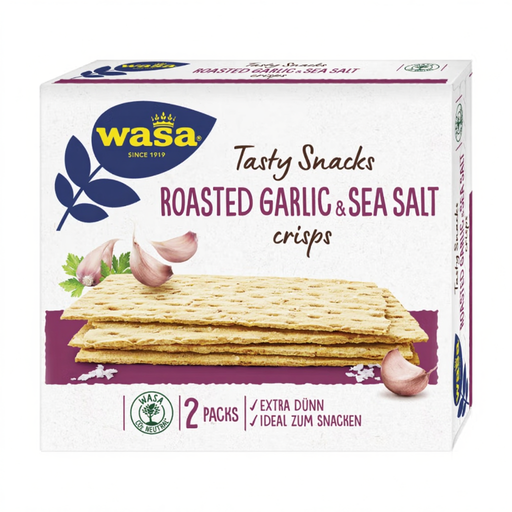
A crispbread seasoned with roasted garlic and sea salt, ideal for savoury teatime toppings. If you’re comparing salt content, check the nutritional information per 100 g on the packet.
 No image available
An option with sesame and flaxseed if you prefer seeds with savoury toppings. To compare fibre content, check the amount per 100 g on the specific packet, and look out for allergen information too.
No, you can’t infer an effect on digestion from the word alone. The ingredients, fibre content per 100 g, portion size and how well you personally tolerate it are more useful when choosing.
Compare the figures per 100 g and take account of how much crispbread you actually eat. REWE lists 20 g of fibre per 100 g for Wasa Vollkorn Roggen; that doesn’t mean there’s one ideal portion for everyone at teatime.
No, rye is a gluten-containing grain. If you need to eat gluten-free, choose an alternative that is clearly labelled as such and check the ingredients and allergen information on the specific packet.
Store it in a dry place and follow the instructions on the packet. For Leicht&Cross Vollkorn, REWE recommends keeping it somewhere dry and eating it within a few days of opening. For the Wasa rye variety listed, REWE recommends storing it somewhere dry and away from light.