A cup dishwasher for limited space
If you mainly wash a few cups, compare the appliance’s width and depth, as well as the space needed to open the door, with the room available on your worktop.


If you only have a few cups to wash and limited worktop space, first check the appliance dimensions, door clearance and whether your cups will fit in the basket of a compact countertop model. A tank can replace a fixed water supply, but not the need for a suitable drain; Bomann lists this feature for the TSG 5702. If you regularly have other dishes to wash as well, a larger countertop dishwasher could be a good fit. A freestanding 45-cm model keeps your worktop clear, provided you have a suitable space for it. Place settings don’t tell you exactly how many cups an appliance can hold.
If you mainly wash a few cups, compare the appliance’s width and depth, as well as the space needed to open the door, with the room available on your worktop.
A model with a tank can be an alternative to a fixed water supply. Even when using the tank, you’ll still need a suitable way to drain the wastewater.
If you often wash cups alongside plates and cutlery, check the basket layout and capacity. Consider whether a larger countertop dishwasher or a freestanding model is better suited to the space available.
When it comes to cups, the external dimensions aren’t the only consideration. Door clearance, drainage and the shape of the interior basket must also suit the space available and the items you plan to wash.
A good fit if: you only have a few cups to wash and there’s no fixed water supply at the appliance’s location.
Consider: filling the tank and draining wastewater need to work for your routine and the space available.
A good fit if: you regularly wash cups and other dishes together, and have both a water supply and a drain.
Consider: an appliance that’s 55 cm wide takes up more worktop space, and the basket still needs to suit your cups.
A good fit if: you have a suitable spot on the floor or under the worktop, along with the necessary connections.
Consider: the height, depth and door clearance also need to fit. According to the German Environment Agency, narrower models may use more electricity and water per unit than larger types.
| Priority | What to check when buying | Who is this especially important to? |
|---|---|---|
| Space and cup fit | Measure the width, depth, height and door clearance; check the basket against your largest cups, including their handles. | If I only wash a few cups, I want to know whether the appliance will fit on my worktop and whether my cups will fit in the basket. Around 36% of consumers prioritise space and cup fit. |
| Water supply and drainage | Check whether the specific model uses a tank or a connection, and how the hoses and drain will work at the planned location. | If there’s no fixed water supply where I want to put the appliance, I want to find out in advance how tank filling and wastewater drainage work. Around 29% of consumers put water supply and drainage first. |
| Capacity for a mixed load | Consider how cups, handles and other dishes will fit in the basket; don’t convert place settings into a number of cups. | If I regularly wash cups with plates and cutlery, I need an appliance that can handle a suitable mixed load. Around 21% of consumers prioritise capacity for cups and other dishes. |
| Energy use and noise | Compare kWh per 100 Eco cycles, litres per Eco cycle, programme duration and noise level on a like-for-like basis. | Once I’ve checked the space and connections, I want to compare the energy use and noise levels of similar appliances. Around 14% of consumers pay particular attention to energy use and noise. |
The consumer advice centre recommends using the Eco programme figures when comparing appliances. These figures are based on the relevant labelling requirements and don’t tell you what every small load of cups will cost.
For the Bomann TSG 5702, the manufacturer lists an integrated tank and a drain hose. Using the tank doesn’t remove the need for a suitable way to drain wastewater.
Before buying, check the instructions to find out how the drain should be set up at your chosen location.
The capacity figure refers to place settings, not whether your cups will fit. Their height and handles, as well as the basket design, determine what you can actually load.
Measure your tallest and widest cups, then check them against the interior basket and any cup holders.
The height and depth, along with the space needed to open the door, can also determine whether the appliance will fit where you plan to put it.
Check the width, depth, height, door clearance and hose route together. If you have a suitable space, consider a freestanding 45-cm model too.
Electricity and water consumption figures are based on the stated programme and testing method. They can’t automatically be applied to other programmes or every small load.
Compare appliances using the same Eco figures, and consider how often you’re likely to run a suitable load in the appliance you choose.
The models listed include a compact tank model and a wider countertop dishwasher.
The countertop models listed differ in width and stated capacity.
For the DWT30 (MD370022), MEDION lists several ways to supply water.
A freestanding 45-cm model could be an option if you don’t plan to put the appliance on the worktop.
The following Joybuy products are listed as countertop or mini dishwashers. Compare their stated features with your cup load, the space available and your connection options.
 No image available
Listed as a compact countertop model for cups and a small amount of other tableware.
The product title lists 3 place settings, 7 programmes and operation with or without a water connection.
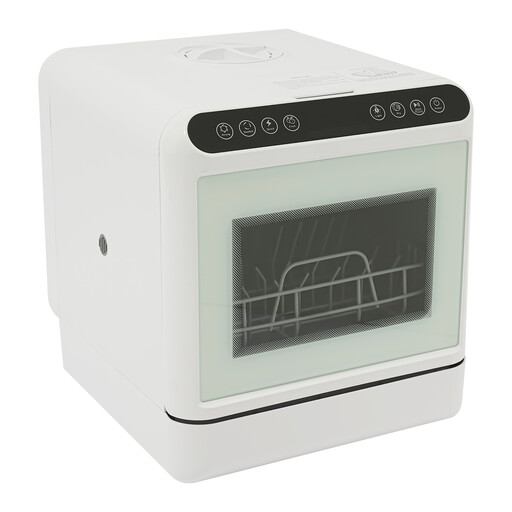 No image available
A countertop option listed as compact, if you’re looking for an appliance to sit on your worktop.
The product title lists an integrated 1.32-gallon water tank.
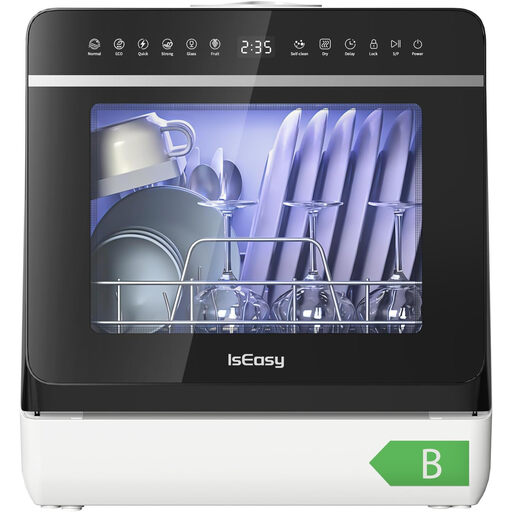 No image available
For a location where you don’t plan to use a fixed water supply; the product title lists a water tank.
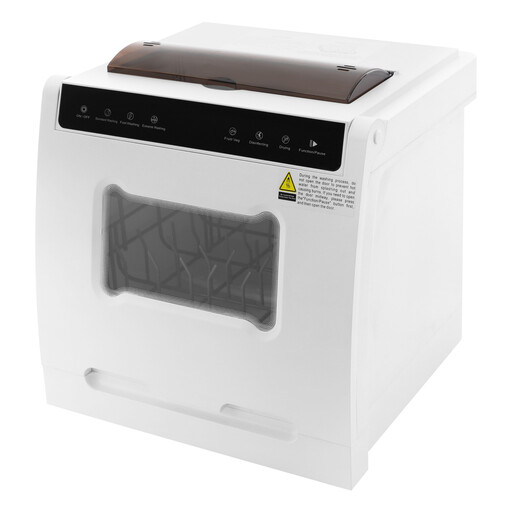 No image available
Listed as a mini countertop model; its description can help if you’re looking for an appliance to sit on your worktop.
The product title lists 72 °C and 6 wash modes.
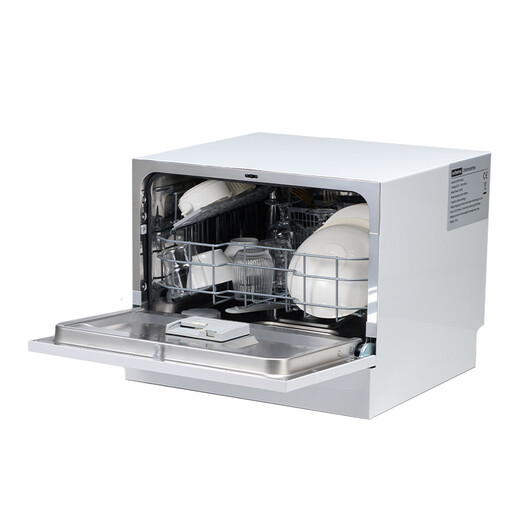 No image available
The product title lists a countertop model with capacity for 6 standard place settings, if you plan to wash other dishes as well as cups.
A 30-minute quick wash and 8 functions are also listed.
No. The symbol indicates that an item is suitable for contact with food, not that it can be washed in a dishwasher. Check the care instructions for your cup.
On the Bomann TSG 5702, the integrated tank replaces a fixed water supply, not a drain: the manufacturer lists a drain hose. Check the instructions to find out how it should be set up where you plan to put the appliance.
Compare the figures on the same basis, such as kWh per 100 Eco cycles and litres per Eco cycle. To estimate your own costs, you’ll also need to factor in how often you use the dishwasher and your electricity and water tariffs.
Measure the width, depth and height of the space, as well as the clearance needed for the door when open. Also compare the height and width of your largest cups, including their handles, with the interior basket of the specific model.
Check the current EU energy label for the specific dishwasher. The European Union notes that the former plus classes for dishwashers have not been used since 2021; online listings must display the labelling information for the relevant product.