If the window light is bright enough and only the shadow side is too dark, a white card reflector is often all you need to start with. An LED panel is more worthwhile if you want to control brightness and when you shoot, time after time. For several cupcakes, a larger dimmable panel with suitable diffusion is more practical, while a small battery-powered light is better suited to individual subjects and compact set-ups.
Which type of light is right for you?
Photographers dealing with deep shadows
If you shoot by a window and want to bring out the texture of icing or decorations, a white reflector opposite the window can brighten the shadows. Adobe and Nikon describe window light and reflectors as options for food photography.
Bakers taking photos regularly
If you’re photographing several cupcakes or shooting at different times, a dimmable panel can help you adjust the extra light on your set. Adobe describes artificial light as a way to rely less on the weather and time of day.
Photographers with a small or mobile set-up
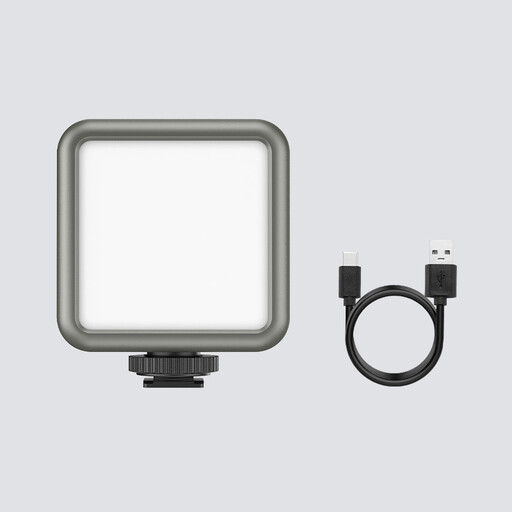
For individual cupcakes, close-up details or changing locations, a small battery-powered light may be easier to fit in than a large panel. Ulanzi describes the VL49 as a mini LED light.
What should you look for when buying?
Window light with a reflector
Best if: Your cupcakes are already getting enough light and you only want to brighten the shadow side.
Trade-off: You won’t need an additional power supply, but you’ll still depend on the window light and how it changes.
Larger bi-colour panel
Best if: You regularly photograph several decorated cupcakes and want to adjust the brightness and colour temperature.
Trade-off: Allow space to set it up and, if needed, budget for a stand. Check the diffuser and power supply for the specific version.
Small battery-powered panel
Best if: A single cupcake or detail needs extra light in a compact space and portability is your priority.
Trade-off: Its small light-emitting surface is less suited to a wide arrangement; according to Ulanzi, the white Ulanzi VL49 has a fixed colour temperature.
| Buying priority |
What to look for |
Who is it important to? |
| Soft shadows |
First, try a white card opposite the window. With a panel, consider the size of the light-emitting surface, a suitable diffuser and where to position it beside your set. |
If I want to show off icing and decorations without letting the shadow side get too dark, I look for gentle fill light first. Around 36% of consumers put soft shadows and visible details at the top of their list. |
| True-to-life decoration colours |
Check the colour temperature range of the exact model and assess the colours under the light you’ll use, with a neutral reference. |
If window and artificial light are both falling on cream and sprinkles, I want to be able to check the white balance in the finished set-up. Colour accuracy is the top buying priority for around 29% of consumers. |
| Adjustable brightness |
Compare dimming and lux figures only alongside the measurement distance. Also check the power adapter, compatible batteries and what’s included with your chosen version. |
For repeat shoots, I want to be able to adjust the extra light to suit changing conditions. Around 21% of consumers prioritise adjustable brightness. |
| Compact mobile set-up |
Check the mounting options, the size of the area you want to shoot and the battery life at the brightness you need. |
When I photograph individual cupcakes in different locations, a compact battery-powered light matters more to me than a large light-emitting surface. Portability comes first for around 14% of consumers. |
Avoid common buying mistakes
-
Expecting a pocket-sized panel to light an entire cupcake arrangement
A small battery-powered light such as the Ulanzi VL49 has a different-sized light-emitting surface from a larger panel. For an arrangement, the size of the area you’re shooting and how you position the light are important considerations.
Before you buy, decide how many cupcakes you want in the shot at once and how much space you have beside your set.
-
Assuming similarly named VL49 versions are identical
According to the manufacturer, the white Ulanzi VL49 has a fixed colour temperature, while the VL49 RGB offers an adjustable colour temperature range and RGB light.
Compare the full model name and listed features, not just “VL49” or the product image.
-
Assuming a stand and batteries are included
According to the manufacturer, the Neewer NL660 comes with a stand only in the “NL660 with Stand” version; NP-F batteries are not included.
Check the accessories and power supply for the exact version you’re planning to order.
-
Treating CRI or lux figures as a guarantee of natural colours
Manufacturers’ figures describe the light under the conditions specified, not the results you’ll get with your window light and camera white balance.
Compare lux figures only when the measurement distance is known, and check the colours with a test shot of your actual set-up.
Key brands at a glance
Godox
The P260C Pro is a larger bi-colour panel for a cupcake set-up where you want to adjust the light.
- Godox lists a colour temperature range of 2800–6500 K, 45 W input power and average CRI and TLCI ratings of at least 98 for this model. According to the manufacturer, it comes with a diffuser and several power options.
- These are manufacturer figures, not colour measurements taken on your own set; the panel also needs more room to set up than a pocket light.
Neewer
The NL660 is designed for shoots where a dimmable bi-colour panel powered by mains or compatible NP-F batteries is a good fit.
- Neewer lists a colour temperature range of 3200–5600 K, a CRI of at least 96 and a white diffuser.
- According to the manufacturer, a stand is included only with the “NL660 with Stand” version; NP-F batteries are not included. The stated brightness is not a measurement of your own set-up.
amaran
The P60x is a bi-colour panel supplied with a softbox and grid for more controlled continuous lighting.
- The manufacturer lists a colour temperature range of 3200–6500 K, a CRI of at least 95 and 5070 lx at 1 m and 5600 K.
- The lux figure applies to the stated measurement conditions; it is not a measurement of your own cupcake set-up.
Ulanzi
The white VL49 is a small battery-powered light for individual subjects and details, rather than a large cupcake set-up.
- For the white VL49, Ulanzi lists fixed white light at 5500 ± 200 K and a 2000 mAh battery capacity.
- The separately available VL49 RGB has different features and an adjustable colour temperature range. Don’t assume the similarly named versions are the same.
Suitable products at Joybuy
This selection is suited to a portable LED light for individual subjects, macro photography and product photos.
 No image available
Ulanzi VL49 RGB LED light, 2000 mAh, 2500–9500 K
This compact light is well suited to mobile macro and product photography when you want an adjustable colour temperature and dimmable fill light.
The product title lists a 2000 mAh battery and a colour temperature range of 2500–9500 K.
View at Joybuy
Frequently asked questions
How do I get started with a single LED panel by the window?
First, use a white card to see if you can brighten the shadow side enough. If you also use a panel, position it so you can check its effect on the cream and decorations through your viewfinder. Depending on the light and set-up, diffusion may be another option.
Why do cream or sprinkles look different even with a bi-colour panel?
Setting a Kelvin value alone won’t determine the colour in your photo if the window and panel are lighting the scene together. Take a photo of your finished set-up with a neutral reference and check the white balance.
What else might I need besides the panel?
It depends on the model and version. According to the manufacturer, a stand is listed only for the stand version of the Neewer NL660, and compatible NP-F batteries are not included. For the amaran P60x, the manufacturer lists a softbox and grid as included. Check what comes with the specific offer.
What rules apply to buying and disposing of these products in Germany?
Electrical products are subject to the relevant EU requirements. According to the European Commission, the manufacturer is responsible for conformity and affixing the CE marking. This means the CE mark is not an independently awarded quality seal. According to the German Environment Agency, old electrical appliances must not be disposed of with household waste. Consumer advice organisation Verbraucherzentrale states that online orders generally come with a 14-day right to cancel from the date you receive the goods.


