
Lieferung heute & morgen

Qualitätsgarantie

Willkommens-Angebote freischalten: KOSTENLOSE Lieferung | Bis zu 80 % RABATT | Kostenlose 30-Tage-JoyPlus-Testphase
App herunterladen
Retrofitting ambient lighting in your car is a popular way to add a personal touch to the vehicle's interior. The market offers a plethora of aftermarket kits, but the quality differences are significant. Before you make a decision, it's crucial to understand the common pitfalls that often lead to disappointment and unnecessary expense.
Many budget-friendly kits lure customers with impressive promises, only to reveal their weaknesses after installation. The most common problems include:
Understanding the basic technical parameters will help you avoid these problems and choose a product that will serve its purpose for years to come.
To make an informed decision, you should focus on three essential technical features. These determine the quality, functionality, and longevity of your new LED interior car lighting.
The method of light transmission is critical for a homogeneous appearance.
The control options define the user experience. Almost all systems offer interior lighting with an app, but the technology behind it varies.
The scope of delivery and the system's structure are crucial for a clean installation. Look for designations like "10-in-1" or "18-in-1." These indicate how many separate light sources and controllers are included in the set. A modular system with a main controller (for the dashboard and centre console) and several sub-controllers (for doors and footwells) significantly simplifies wiring, as not all cables need to be routed to the centre console. This reduces installation effort and ensures a tidy result.
Based on the quality criteria mentioned, we have identified several products suitable for different user profiles and vehicles.
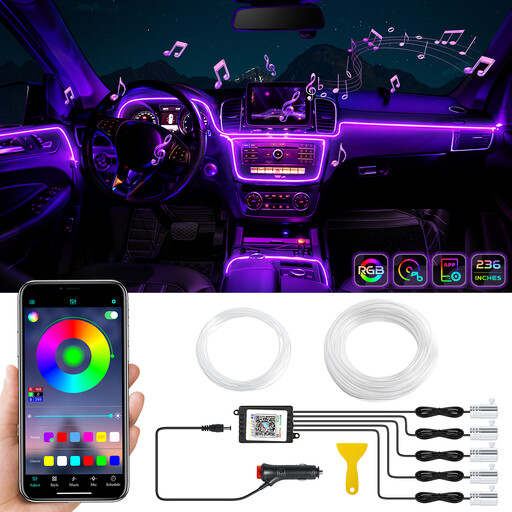
Why This Fits Their Persona: Ideal for users seeking a simple and cost-effective solution primarily for dashboard illumination. The kit is streamlined to the essentials but still offers modern Dreamcolor effects and app control. Powering it via the car's charger port makes installation exceptionally straightforward.
The acrylic technology ensures even illumination along the dashboard. The simple plug-and-play installation prevents cable clutter.
Dreamcolor effects for dynamic lighting. Easy installation via the 12V port without interfering with the vehicle's electronics.

Why This Fits Their Persona: Perfect for tuning fans who want a comprehensive, high-quality solution for the entire interior. The 18-in-1 set covers the dashboard, centre console, all four doors (handles and storage bins), and the footwell, offering maximum design freedom.
The modular design with a main controller and four sub-controllers prevents cable clutter. The high LED count (600) and acrylic strips guarantee bright, even illumination throughout the vehicle.
Dual-Zone Control allows for different colours and modes in various areas. A comprehensive 18-in-1 kit for a complete interior transformation.
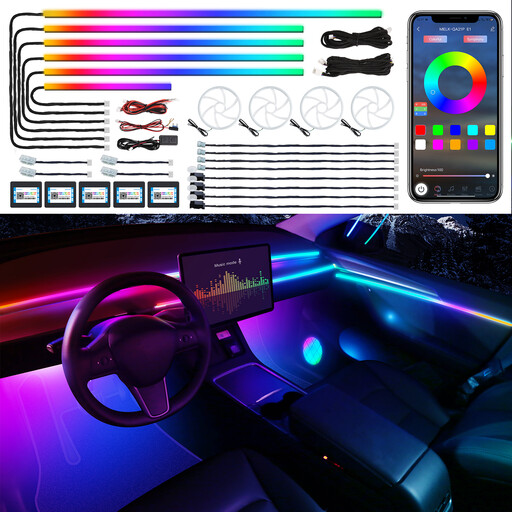
Why This Fits Their Persona: For the discerning DIYer who refuses to compromise. This 22-in-1 set offers the maximum upgrade level, including additional lighting elements for the door speakers (Door Horn Light) to illuminate every corner of the interior.
It offers the same reliable modular architecture and high-quality acrylic lighting technology as the 18-in-1 set but expands it with even more components for seamless integration.
Maximum kit contents, including lighting for door speakers. The music-activated LED car function syncs all light effects to the beat of the music.
We have compiled a complete, up-to-date list of products that fully meet these strict selection criteria and UK safety regulations.
1. How complicated is the installation of aftermarket kits really? Most modern kits are designed for DIY installation. The acrylic or fibre optic strips are not glued but inserted into the gaps between the trim panels of the dashboard and doors using a thin plastic lip. An included pry tool helps to gently open these gaps. Power is often supplied via a 12V plug or by connecting to the cigarette lighter's power supply, which minimises interference with the vehicle's on-board electronics.
2. Does ambient lighting affect the car battery? LEDs are extremely energy-efficient. The power consumption of an RGB interior lighting system is minimal during operation and poses no strain on a healthy car battery. Most systems operate on a 12V supply and are equipped with short-circuit protection. Many control units also have a memory function that remembers the last setting but consumes almost no power when idle.
3. What is the difference between RGB and Dreamcolor (RGB-IC)? This is a crucial point for the visual impact.