
Lieferung heute & morgen

Qualitätsgarantie

Willkommens-Angebote freischalten: KOSTENLOSE Lieferung | Bis zu 80 % RABATT | Kostenlose 30-Tage-JoyPlus-Testphase
App herunterladen
As a Joybuy Product Recommendation Officer, I see daily how the right choice of creative tools can mean the difference between a successful project and pure frustration. Especially with cutting dies for card making or scrapbooking, the vast selection of designs and manufacturers can be overwhelming. Many crafters invest in dies that ultimately deliver messy results or don't fit their existing equipment. This guide will help you navigate the common pitfalls and find the perfect cutting dies for your DIY cards and paper projects.
Before we dive into the important features, let's look at the three most common issues that lead to disappointment:
A fundamental understanding of the key product features is the secret to avoiding these problems.
Focus on the following three objective criteria in your decision-making process to ensure the longevity and functionality of your cutting dies.
The material is the most critical factor for a die's sharpness and durability. Look for products explicitly made from carbon steel. This material offers high hardness and edge retention, meaning the edges stay sharp even after frequent use. Metal dies of this grade guarantee precise, clean cuts through various paper weights and even thin cardstock or felt.
Every die-cutting machine requires a specific stack of plates, known as a "sandwich," to apply the correct pressure to the die. The thickness of the die must be compatible with this system. Before purchasing, check the product description for notes on compatibility with common machine types. Universal, thin metal dies (known as "wafer-thin dies") are generally compatible with most standard machines. For thicker dies, such as those often used for embossing folders, a thorough check of the machine's manual is essential.
An intricate design can only succeed if the paper has the right properties. The paper weight, measured in grams per square meter (GSM), is crucial here.
For paper crafting, the rule of thumb is: the more complex the die, the higher the paper's GSM should be.
Based on the criteria above, we have curated a few products for different user profiles.
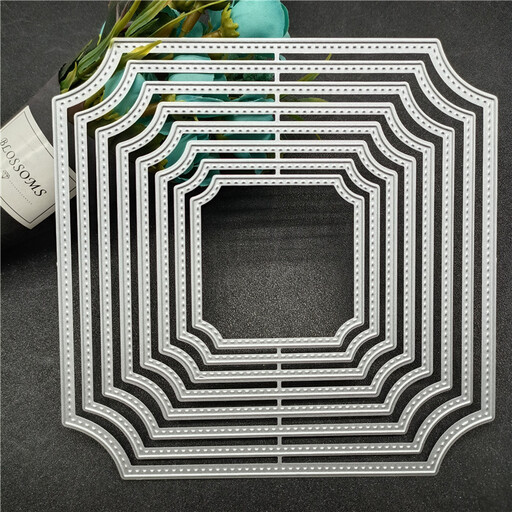
Why it fits this profile: This set offers eight nesting frame shapes. It's ideal for beginners as it provides great versatility for designing cards, gift tags, and scrapbook layouts without committing to a single, specific design.
The clean, geometric shapes are less prone to the cutting errors that can occur with complex designs. They are excellent for experimenting with different types of paper.
The set allows for layering different frame sizes and colours, which instantly adds a professional depth to projects.
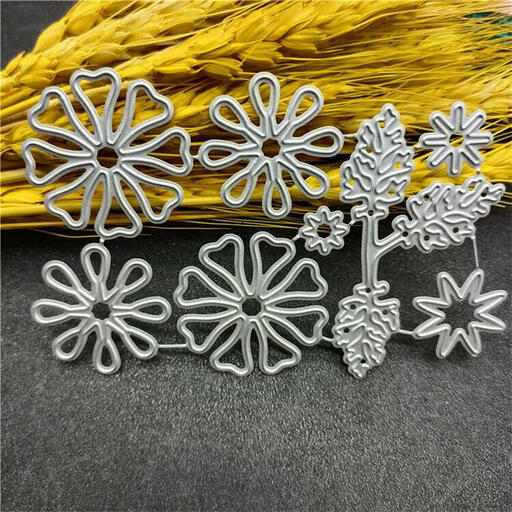
Why it fits this profile: For crafters looking to add a striking, detailed element to their **card-making dies**. The symmetrical, almost snowflake-like floral design is an eye-catcher for any greeting card.
Although the design is intricate, its symmetrical structure provides stability during the cutting process. Using a higher-GSM paper (e.g., 220 GSM) minimises the risk of tearing.
The design not only cuts the outer shape but also fine inner patterns, creating an elaborate embossed and cut effect in a single pass.
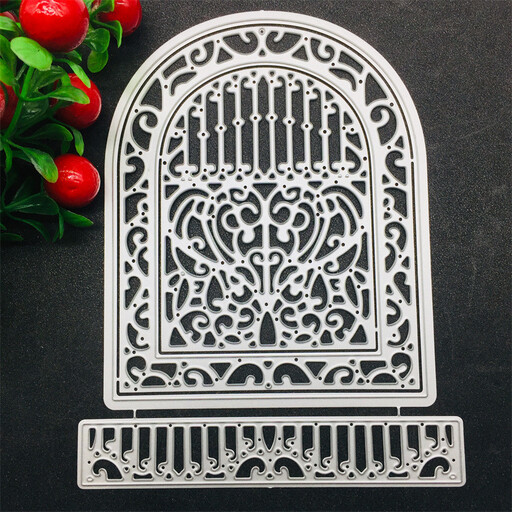
Why it fits this profile: Perfect for creating invitation cards or interactive scrapbook pages. This die creates a complete window or door frame that serves as a central design element or a "peek-a-boo" window to a scene behind it.
The large, sturdy frame construction ensures even pressure and a clean cut. The risk of small pieces getting stuck is significantly lower here than with more fragmented patterns.
This die offers high creative value by providing a complete architectural element for three-dimensional cards or elaborate layouts.
There is a wide range of designs available, especially for floral motifs. Discover our entire collection, which is curated based on the quality criteria mentioned.
For most metal dies, a smooth cardstock with a weight between 160 GSM and 240 GSM is a great choice. For very intricate designs, you should use paper with at least 200 GSM to achieve clean results and prevent tearing.
After use, small paper scraps may remain in the die. These can be best removed with a pointed tool (e.g., a needle or a specialised "pick tool") or a fine brush. Store your dies flat and dry, ideally on magnetic sheets or in special storage pockets, to protect them from bending and moisture.
No, not necessarily. Most thin metal dies ("wafer-thin dies") are compatible with the most common manual die-cutting machines. However, it is advisable to know the maximum width your machine can handle and to check it against the die's dimensions. Information on compatibility can often be found in the product description or on the packaging.