
Lieferung heute & morgen

Qualitätsgarantie

Willkommens-Angebote freischalten: KOSTENLOSE Lieferung | Bis zu 80 % RABATT | Kostenlose 30-Tage-JoyPlus-Testphase
App herunterladen
A suitable cutlery holder for the kitchen should keep your cutlery neatly organised, take up minimal space, and be easy to clean without much effort. In practice, however, it's not just the material and design that can lead to a poor purchase. Often, the dimensions don't fit the drawer, water can't drain from open holders, or the compartments are awkwardly divided for the cutlery you own.
This guide highlights which features matter before you buy, and which cutlery organiser suits different households.
A cutlery tray for a drawer doesn't just need to fit into the compartment. The internal dimensions, the height, and the available clearance above the insert are also crucial. Drawers with narrow side walls or an inner frame often offer less usable width than you might expect from the outside.
So, before you buy, you should measure:
A cutlery stand next to the sink is handy when you want cutlery within easy reach straight after washing. A spout or a removable drip tray makes dealing with residual water easier. However, this function doesn't replace regular emptying and cleaning. Otherwise, standing water can collect in the catchment area.
With a cutlery drainer, you should therefore check whether water can drain away effectively and whether the underside is accessible.
"Stainless steel" or "wood" alone tell you little about daily suitability. With a stainless steel cutlery holder, for example, the specific finish, ventilation, and cleaning method are important. With a wooden cutlery holder, a dry placement and distance from heat sources are key.
Plastic isn't automatically inferior either. ABS or PET can be easy to clean and dimensionally stable, provided the manufacturer provides care and temperature instructions.
For a tidy, understated kitchen organisation, a flat cutlery tray with compartments is ideal. An insert with five or six sections can separate knives, forks, tablespoons, teaspoons, and larger kitchen utensils. It's important that the compartments suit the quantity and length of your cutlery.
On the worktop, vertical cutlery stands offer quicker access. They take up less depth space but need sufficient height and a stable base.
A high number of compartments isn't automatically useful. Narrow compartments can be fine for standard cutlery, while ladles, wooden spoons, or larger knives need more room. Also check whether small items can be collected in a separate section.
A kitchen utensil holder with several open sections is suitable for mixed utensils. A flat cutlery tray, on the other hand, is usually more organised if you're mainly storing classic eating cutlery.
For models placed by the sink, smooth surfaces, ventilation holes, and a removable base are practical features. For drawer inserts, hand washing should be possible if dishwasher suitability isn't stated. Non-slip surfaces help prevent cutlery from shifting when opening and closing the drawer, but they don't replace a precise fit.
Also pay attention to:
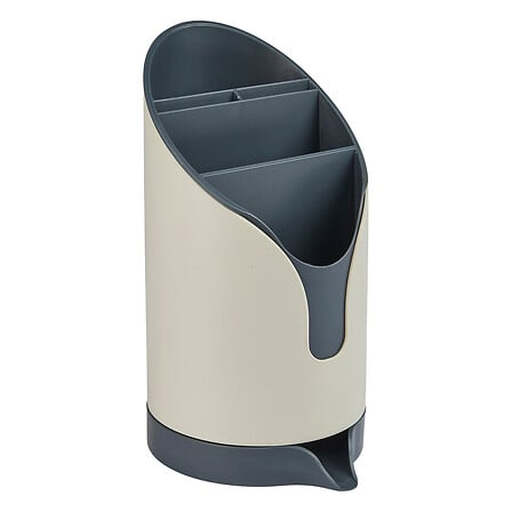
Why this product fits the profile: This compact holder made from ABS plastic is designed for the worktop and requires no assembly. At 12.8 × 11 × 20.2 cm, it can be placed next to the sink or against a free wall space.
The integrated spout is designed for water drainage. Several sections separate large utensils, knives, and smaller cutlery; the front section can also serve as a sponge holder.
ABS plastic with a smooth design; integrated water drainage; clean with mild soap and water.
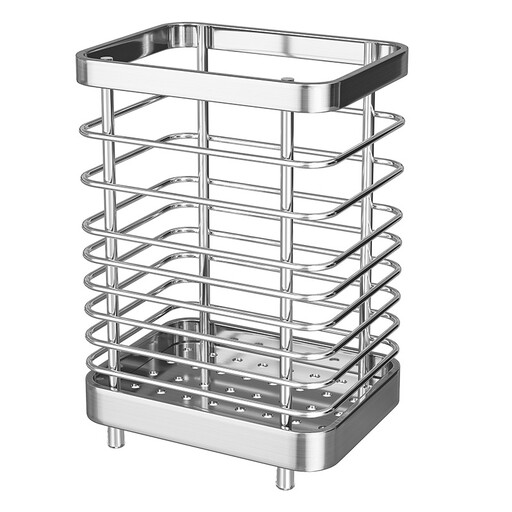
Why this product fits the profile: This holder made from 304 stainless steel is designed for long-term use on the worktop. Its slim dimensions of 10 × 15 × 7.5 cm make it suitable for areas next to the sink or window.
The open construction features ventilation holes on four sides. A removable drip tray provides easy access to the water and dirt area.
304 stainless steel; removable drip tray; raised rubber feet to protect the work surface.
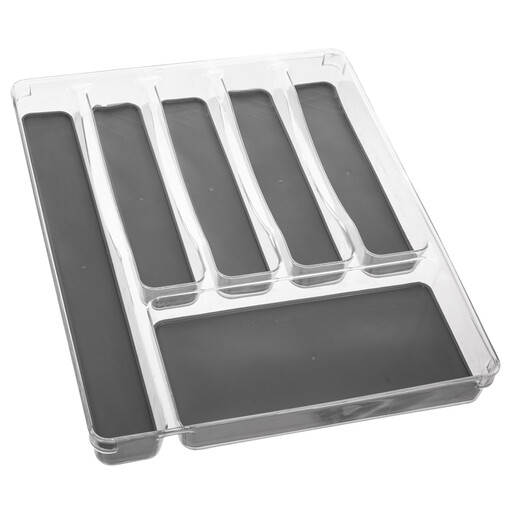
Why this product fits the profile: Six separate sections are ideal for households with different types of cutlery or additional kitchen accessories. This model is designed as a space-saving solution for a kitchen drawer.
The fixed compartment layout reduces mixing of different cutlery types. The non-slip surface limits shifting when opening the drawer, but does not fully secure the insert.
Six compartments; dimensions 32.7 × 23.5 × 4.6 cm; PET construction; no assembly required.
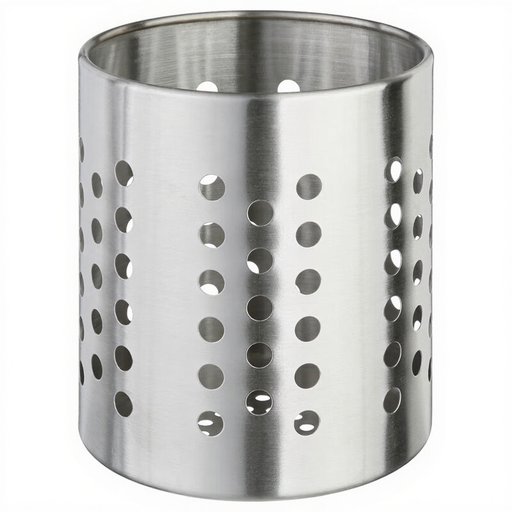
Why this product fits the profile: The compact, open design is ideal for households that want to keep cutlery within easy reach on the worktop. With an 11.5 cm diameter and 13.8 cm height, this holder takes up relatively little surface space.
The dimensions are clearly stated, making it easy to plan where to place it. Thanks to the open design, the contents remain visible and can be easily removed for cleaning.
Stainless steel construction; compact format; lightweight at 0.15 kg.
We've put together a complete, regularly updated list of products that fully meet these strict selection criteria and the safety regulations in force in the EU.
The lifespan depends not only on the material but also on the environment and how you care for it. Some practical basic rules apply to all types:
Measure the usable internal area of the drawer and compare it with the external dimensions of the insert. You should also consider the height so that the drawer can close fully. For a model with five compartments, for example, dimensions of 32.7 × 23.5 × 4.6 cm are given.
That depends on your kitchen routine. A drawer insert protects the contents from visible worktop clutter and is ideal for organised eating cutlery. A cutlery stand is useful when utensils are needed frequently or need to dry openly after washing.
Empty the drip tray regularly, remove it – if possible – and clean the holder and base with mild washing-up liquid. Then let all parts dry completely. This way, your cutlery storage stays clean with manageable effort.