
Lieferung heute & morgen

Qualitätsgarantie

Willkommens-Angebote freischalten: KOSTENLOSE Lieferung | Bis zu 80 % RABATT | Kostenlose 30-Tage-JoyPlus-Testphase
App herunterladen
A cutlery organiser keeps knives, forks, spoons and small kitchen utensils neatly stored. In practice, however, many models do not fit the intended drawer, shift when it is opened or are awkward to clean. If you focus only on the number of compartments or an attractive wood finish, you may overlook important details.
This buying guide explains which dimensions, materials and design features really matter when choosing a cutlery tray. You will then find a selection of products for different households and usage scenarios.
A cutlery tray can look compact in product photos and still fail to fit in your existing drawer. The key factors are the organiser’s length, width and height, as well as the drawer’s internal dimensions. Rails or stops may also reduce the available space.
Before buying, measure:
For example, a model measuring 32.7 × 23.5 × 4.6 cm requires enough clearance in all three directions.
A cutlery tray with compartments is only practical if the compartments suit the amount of cutlery you have. Sections that are too narrow can be inconvenient for large kitchen knives or serving cutlery. A system with lots of very small compartments can also result in individual sections becoming overloaded.
So check whether the layout suits your household:
An anti-slip surface can help prevent the cutlery from moving around when the drawer is opened and closed. However, it does not necessarily hold the entire organiser in place. On smooth drawer bases, the model should stand firmly and evenly.
Cleaning is also important. PET or plastic models may be cleaned with a damp cloth or by hand. With bamboo and wood-based materials, prolonged contact with water should be avoided. Always check the product information directly for details about dishwasher suitability.
A cutlery drawer organiser should not be wedged tightly into place or knock against the drawer sides every time it moves. A small gap between the organiser and the drawer can be useful. If the gap is too large, however, the insert will shift more easily.
Different criteria apply to worktop use: a cutlery holder should not wobble and should have a sufficiently wide base. Round or tall containers take up less drawer space, but they do use worktop space beside the hob or sink.
The compartments should be long enough for the cutlery you already own. With a five-section model, for example, you could separate forks, knives, tablespoons, teaspoons and use the larger section for miscellaneous items. For a household with lots of cooking utensils, a larger, separate kitchen utensil storage solution may be more suitable.
If a product includes specific material or safety information, read these instructions in full. For the 5-Compartment Cutlery Holder TS PET, for example, the instructions specify hand washing and protection from intense heat or prolonged direct sunlight.
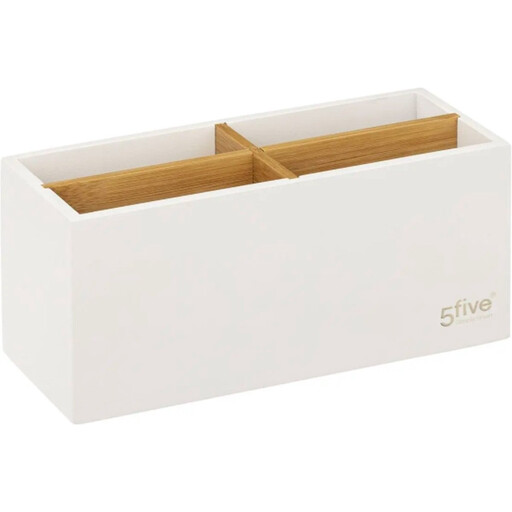
Why this product suits the profile: The compact design with four compartments is suitable for smaller amounts of cutlery and can stand freely on a level surface. The stated dimensions of 21 × 8 × 9 cm make it easier to check compatibility before buying.
The clearly stated external dimensions help you avoid choosing a solution that is too large for a narrow drawer or worktop. The removable bamboo divider allows for a flexible layout.
Four compartments; bamboo and MDF as the stated materials; freestanding use with no assembly required.

Why this product suits the profile: This model offers five separate sections and a stated anti-slip surface. Measuring 32.7 × 23.5 × 4.6 cm, it is intended for standard drawers of a suitable size.
The compartment layout helps keep different types of cutlery separate. The product information also explicitly states that the surface stabilises the contents but does not attach the insert to the drawer itself.
Five compartments; PET construction; no assembly required. Hand wash with a mild cleaning product.
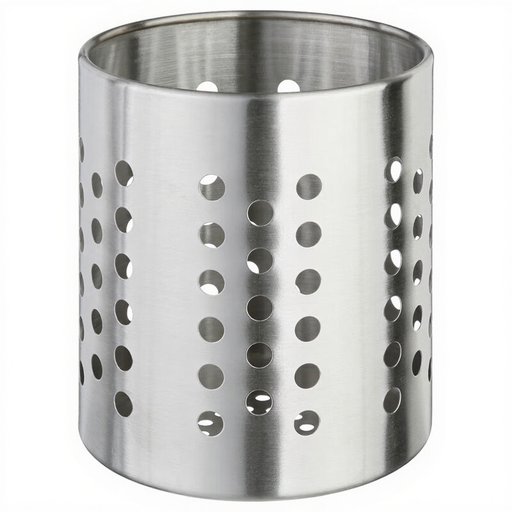
Why this product suits the profile: This freestanding cutlery holder is suitable for households that want to keep knives and cutlery close to hand on the worktop. Its diameter of 11.5 cm and height of 13.8 cm make it easier to plan the available space.
The dimensions make it clear that this is not a flat drawer insert. This helps prevent ordering the wrong product because of incorrect expectations about its design.
Stainless steel as the stated material; low product weight of 0.150 kg; suitable for use on worktops or shelves.
We have put together a complete, regularly updated list of products that fully meet these strict selection criteria and the safety regulations applicable in the EU.
Organise cutlery by frequency of use and size. Knives should be placed or stored so that the blade is not freely accessible. Heavy serving spoons should not be put in a narrow teaspoon compartment. With bamboo or MDF models, drying them immediately after cleaning is recommended.
An organiser will last longer if you do not overload the compartments or place it near hobs or other strong heat sources. If you notice cracks, sharp edges, rust or deformation, assess whether it is still safe to use.
The usable internal dimensions of the drawer are crucial. Compare the insert’s length, width and height with the product dimensions, and allow for rails, stops and a small amount of movement.
For a small household, two to four compartments may be sufficient. Five or six sections are useful if you want to keep forks, knives, spoons, teaspoons and larger kitchen utensils separate.
Always follow the care instructions for the specific material. PET models, for example, may be intended for hand washing, while bamboo and MDF should only be cleaned with a slightly damp cloth and dried afterwards.