
Lieferung heute & morgen

Qualitätsgarantie

Willkommens-Angebote freischalten: KOSTENLOSE Lieferung | Bis zu 80 % RABATT | Kostenlose 30-Tage-JoyPlus-Testphase
App herunterladen
A cluttered cutlery drawer wastes time in your daily routine. At the same time, a poorly chosen cutlery tray can quickly become a bad buy: it doesn't fit the drawer, slides to the back when you open it, or offers too few compartments for kitchen tools. If you're looking for a cutlery organiser for the kitchen, you shouldn't just focus on colour and appearance.
The external dimensions of a cutlery tray must be smaller than the internal dimensions of the drawer. What matters isn't just length and width, but also height. Drawer runners, internal shelves or a protruding rim can further reduce the available space.
Measure the usable interior at several points. For narrow or unusually shaped drawers, a rigid cutlery drawer insert may be unsuitable, whereas a model with adjustable compartments offers more flexibility.
A non-slip surface can prevent your cutlery from needing to be rearranged every time you move the drawer. However, it doesn't necessarily fix the entire cutlery tray in place inside the drawer. On smooth surfaces or with very lightweight materials, the insert can still shift.
So check whether the organiser sits wide enough, has anti-slip surfaces, or is held stable by its shape. A well-fitted choice is usually more important than any marketing promise about non-slip properties.
Wood, bamboo, PET, steel and sheet metal all differ when it comes to moisture, cleaning and durability. A utensil holder made of wood should not stay wet for long periods. PET inserts can be easy to care for, but may not be dishwasher-safe. With metal models, you need to dry-clean them to prevent rust spots from forming.
Also look out for rounded or neatly finished edges. Particularly with cutlery holders on the worktop, sharp metal parts can pose a practical safety issue.
For a standard drawer, compact models with a clear compartment layout are often sufficient. A typical drawer divider separates knives, forks, tablespoons and teaspoons. Additional compartments are ideal for kitchen tools, chopsticks or serving cutlery.
Check:
The Bamboo Cutlery Tray, for example, measures 34 × 25 × 4.5 cm and has five separate compartments. The 5-Compartment Cutlery Holder TS PET is slightly more compact at 32.7 × 23.5 × 4.6 cm.
Bamboo and wood bring a natural look to the kitchen, but should be cleaned with a damp cloth and then dried. Prolonged soaking can warp the material. PET is lightweight and resistant to brief contact with moisture; however, according to the product information, the PET model mentioned is not suitable for cleaning in the dishwasher.
With steel and wood combinations, the care of the wood deserves special attention. A kitchen utensil holder for the worktop should be kept dry, stable, and not placed directly next to a heat source.
A cutlery tray makes use of the existing storage space in a drawer. This keeps the worktop clear and protects the cutlery from visible kitchen chaos. A freestanding cutlery holder, on the other hand, makes sense when frequently used cooking spoons, spatulas or ladles need to be within easy reach.
The choice therefore depends on your daily routine:

Why this product fits the profile: This compact insert offers five fixed sections and is designed for a tidy cutlery drawer.
The stated dimensions of 32.7 × 23.5 × 4.6 cm make it easy to check before buying. The non-slip surface reduces cutlery shifting.
Five compartments, PET construction, no assembly required. Clean by hand with a mild detergent.
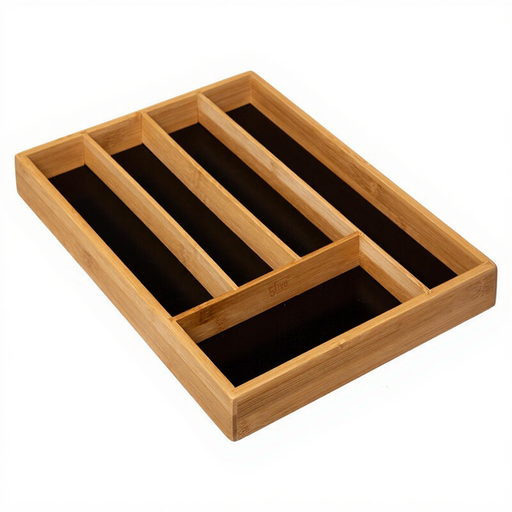
Why this product fits the profile: The bamboo and the combination of natural and black finishes combine clear organisation with a restrained kitchen design.
The specific size of 34 × 25 × 4.5 cm helps with drawer planning. The care instructions recommend wiping with a damp cloth and drying immediately.
Five separate compartments, 0.6 kg weight and a footprint suitable for many standard drawers.
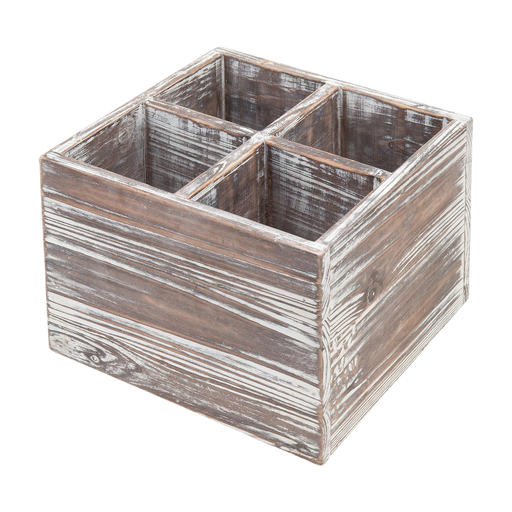
Why this product fits the profile: This freestanding holder is aimed at households that want to keep cooking spoons, spatulas or ladles right next to the worktop.
Four separate compartments prevent mixing utensils of different sizes in one space. The dimensions of 9.4 × 9.4 × 7.1 inches should be checked against your intended spot beforehand.
Four compartments and a rustic wood finish. The holder is designed for use on the worktop.
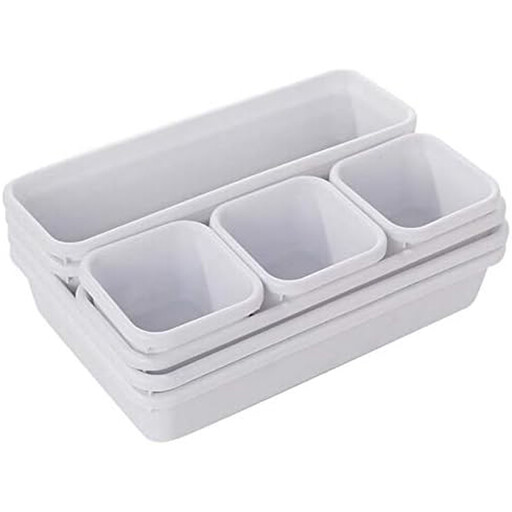
Why this product fits the profile: The boxes with integrated and adjustable dividers are ideal for users who want to adapt their layout to changing kitchen utensils.
Adjustable compartments reduce the risk that fixed divisions are impractical for unusually large or small cutlery items. You should still check your drawer dimensions.
Integrated, adjustable dividers and a white plastic finish for flexible drawer organisation.
We've put together a full, regularly updated list of products that fully meet these strict selection criteria and the safety regulations in force in the EU.
Measure the usable internal length, internal width and height. Take into account runners, stops and any protruding parts. The organiser should have a little clearance on all sides so that the drawer closes smoothly.
A cutlery tray in the drawer is ideal for everyday cutlery and keeps the worktop clear. A cutlery holder makes sense when frequently used cooking utensils need to be within reach next to the hob. For larger households, a combination of both solutions can be practical.
The lifespan depends on the material, load, moisture and cleaning. A well-fitted insert that isn't overloaded and is cared for according to the instructions will generally stay in shape longer. Regularly check the edges, base and dividers for damage.