
Lieferung heute & morgen

Qualitätsgarantie

Willkommens-Angebote freischalten: KOSTENLOSE Lieferung | Bis zu 80 % RABATT | Kostenlose 30-Tage-JoyPlus-Testphase
App herunterladen
A cutting board with a handle can do more than hold ingredients. Depending on its design, you can carry it straight from the worktop to the dining table, hang it up to save space or use it as a serving board. However, models vary considerably in material, stability and care requirements. An attractive wood finish alone doesn’t tell you whether a board will remain practical for everyday use in the kitchen.
Compact boards take up little storage space, but can quickly feel too small when you’re chopping. This is especially inconvenient when preparing vegetables, bread or several ingredients in a row. Before you buy, check the usable cutting surface, not just the overall dimensions. A handle can make a board wider without adding any extra chopping space.
A cutting board with a long handle is easy to carry and hang up. However, if the handle is narrow, poorly integrated or not ergonomically shaped, the board can be difficult to control when carrying it. For large or heavy models, look for a design that you can grip securely with both hands.
Wood, bamboo and fibre-based materials generally need different care from plastic. Claims such as ‘easy to clean’ don’t automatically mean that a board is dishwasher-safe. Hand washing is recommended for the wood and bamboo models featured here. Prolonged soaking, high heat and the dishwasher can encourage warping, cracking or other material damage.
A bamboo cutting board is a good option for many households if you’re looking for a relatively lightweight board with a firm surface. Bamboo models are available in compact sizes for smaller kitchens, as well as larger versions for more extensive food preparation. Check claims such as ‘100% bamboo’ or ‘made from one piece’ in the product description, as construction and finish can vary between models.
A walnut wood cutting board stands out for its dark, natural grain, so it often works well as a kitchen board for chopping and serving. Walnut wood does need some care: dry the board thoroughly after washing and don’t leave it exposed to moisture or direct heat for long periods.
Models made from wheat straw fibre can be an alternative to traditional wood. When considering these products, check the precise material description, recommended cleaning method and durability. Don’t assume a sustainable cutting board is sustainable simply because it has a natural-looking colour. Specific information about the material, construction and care is more useful.
For everyday use, boards measuring around 30 × 20 cm to 38 × 28 cm are often easy to handle. If you want to roll out dough, prepare larger ingredients or keep several ingredients on the board at once, consider a large cutting board measuring 45 × 32 cm or 50 × 35 cm.
The thickness of the material affects both weight and stability. The bamboo models available in 26 mm thickness are designed to provide a firm work surface, while a model measuring 8.5 mm thick is easier to store and carry. A heavier board does take up more space, though, and is less convenient if you regularly want to carry it to the table.
A rectangular cutting board usually makes efficient use of worktop space and fits neatly beside the hob or sink. A round cutting board can look particularly good when serving and is well suited to bread, cheese or smaller displays.
A juice groove is useful when liquids are released during chopping. However, it doesn’t increase the usable cutting surface and can make cleaning a little more involved. Dry storage is important, too. An integrated handle lets you hang the board up, provided your kitchen wall or rail is suitable.
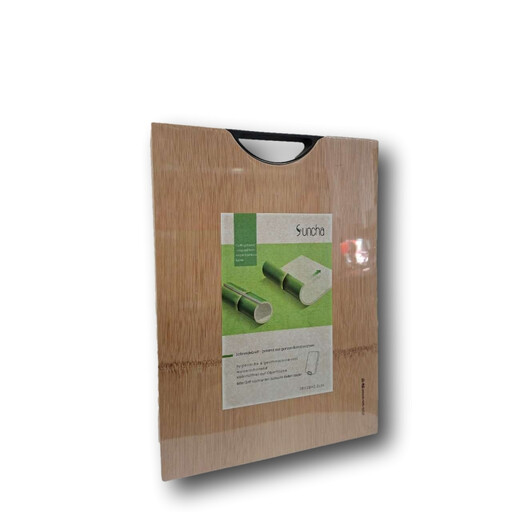
Why this product suits this profile: Its rectangular surface strikes a good balance between working space and a manageable size for everyday kitchen tasks.
The stated dimensions and 26 mm thickness make it easier to assess than a board chosen on looks alone. Hand washing and drying straight away are clearly recommended.
Bamboo construction, an integrated handle and dimensions of 380 × 280 × 26 mm.
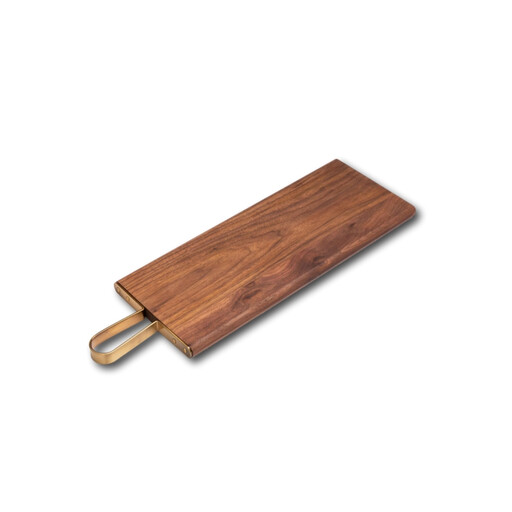
Why this product suits this profile: The walnut wood and elongated shape combine a clearly defined work surface with the option to serve bread or cheese.
The product details list a length of 45 cm, a width of 18 cm and a thickness of 20 mm. This makes it easy to check in advance whether the narrow shape will suit your worktop.
Walnut wood, a weight of 1.24 kg and a double pistol-grip design, according to the product description.
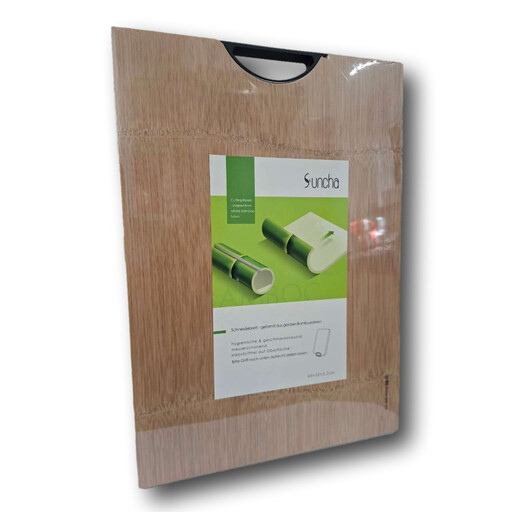
Why this product suits this profile: The large surface is well suited to bigger food preparation jobs and working with dough, and can then be used to serve bread or cheese.
Its dimensions of 45 × 32 cm and 26 mm thickness make the available surface and storage space required clear. This helps you avoid choosing a board based on product photos alone.
Bamboo board weighing 1.99 kg, with an integrated handle and a large work surface.
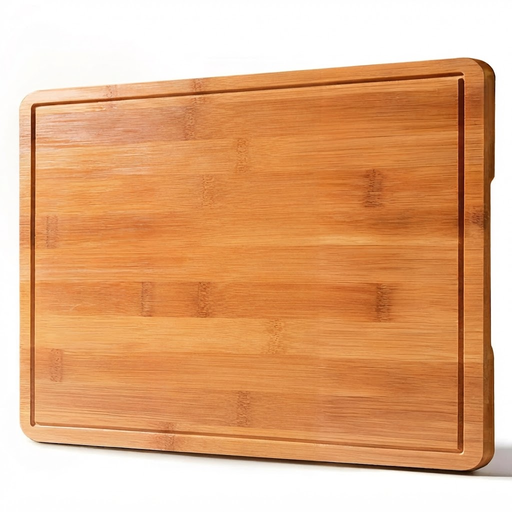
Why this product suits this profile: The juice groove and integrated handles are useful if you want to prepare ingredients and then carry the board to the table.
The groove is a clearly specified feature, not just a decorative detail. At 15 mm thick, the board is also relatively slim.
Bamboo construction, a juice groove, integrated handles and dimensions of 406 × 292 × 15 mm.
We’ve put together a complete, regularly updated list of products that meet these strict selection criteria and fully comply with the safety regulations in force in the EU.
Yes, as long as the size, stability and care requirements suit the way you’ll use it. A compact model is enough for small preparation jobs. If you regularly prepare larger quantities, look for a sufficiently wide surface and a sturdier construction.
There’s no single answer. Its lifespan depends on how it’s used, the pressure applied by knives, exposure to moisture and how well it’s cared for. Storing it dry, washing it by hand and treating it occasionally can help reduce warping and drying out.
A juice groove is useful if you often prepare juicy foods such as tomatoes, citrus fruit or meat. It isn’t essential for bread, herbs or dry ingredients. When choosing a board, weigh up the benefit of the groove against the slightly smaller usable cutting surface.