Homes with low shelves
If you want to remove dry dust from beneath a shelf, the available clearance and the position of the floorhead and tube are key. The Verbraucherzentrale lists ease of use in hard-to-reach places as a buying consideration.


First, measure the clearance beneath the shelf and check whether the floorhead and the angle of the tube will fit through the gap. A narrow crevice tool won’t necessarily reach the whole area. The Verbraucherzentrale lists ease of use as a buying consideration, while the Umweltbundesamt points out that the appliance, tube, floorhead and airflow all work together. For dry dust, you can choose a vacuum with or without a bag. Bags need replacing, while the container and filters on a bagless model need looking after.
If you want to remove dry dust from beneath a shelf, the available clearance and the position of the floorhead and tube are key. The Verbraucherzentrale lists ease of use in hard-to-reach places as a buying consideration.
If you want to handle as little loose dust as possible when emptying the vacuum, compare the bag, container and care requirements of the specific model. Miele advises against using its cylinder vacuums to pick up liquids or damp dirt.
If you want to vacuum under furniture as well as on hard floors or carpets after moving, check the floorhead supplied and the reach of the model. The Umweltbundesamt notes that cleaning performance depends on how the appliance, tube, floorhead and airflow work together.
A good fit if: you want to clean up dry dust and other floors, and would rather change a bag when emptying the vacuum.
Consider: You’ll need to buy replacement bags that fit. A crevice tool doesn’t prove that the floorhead will fit beneath your shelf.
A good fit if: you don’t want to buy vacuum bags and can care for the container and filters according to the model’s instructions.
Consider: You’ll handle loose dust when emptying it. With this type too, access beneath the shelf depends on the shape of the floorhead.
After moving, your main consideration might be the space beneath your shelves, how much dust you handle when emptying the vacuum, or cleaning other floor types. Think about which of these matters most to you.
| What matters to you | What to check before buying | Who it matters most to |
|---|---|---|
| Reaching dust beneath the shelf | Measure the clearance and depth; check the floorhead height and tube angle on the specific model. | If I want to know whether the floorhead will really fit beneath my shelf, I measure the gap and check the position of the floorhead and tube. Around 36% of consumers put access beneath the shelf first. |
| Handling dust when emptying the vacuum | Compare how the vacuum empties, and the bag or filter care required for the exact model variant. | If I want to handle as little loose dust as possible when emptying the vacuum, I compare changing a bag with caring for a container and filter. Around 29% of consumers prioritise keeping dust to a minimum. |
| Cleaning different floor types | Check the model’s floorhead and stated operating radius against your flooring. | If I want to use the same vacuum on the other floors in my new home, I check that the floorhead is suitable for them. Around 21% of consumers prioritise different floor types. |
| Weighing up maintenance and ongoing costs | Check the compatible bag type or filter, as well as the care instructions for the full model number. | If ongoing effort matters to me, I factor in both the cost of replacement bags and the care needed for the container and filter. Around 14% of consumers put these considerations first. |
Wattage alone doesn’t tell you whether the floorhead will fit through the gap, or how well the appliance, tube, floorhead and airflow work together. The Verbraucherzentrale and Umweltbundesamt recommend considering other features too.
Check access and the floorhead first. For information on cleaning performance, look at independent tests rather than relying on wattage alone.
A narrow attachment may reach an edge, but that doesn’t mean it’ll make cleaning the whole area easy.
Measure the height and depth of the gap, then compare them with the shape of the floorhead and tube angle on the specific model.
With a bagless vacuum, you need to empty the container and care for the filter as instructed for that model. Bagged vacuums, on the other hand, need compatible replacement bags.
Before you buy, check the bag type or the instructions for caring for the container and filter, using the exact model number.
The former EU energy label for vacuum cleaners has not been allowed in shops since 19 January 2019. On 29 July 2026, the Verbraucherzentrale confirmed that there is no equivalent EU label.
Compare current model specifications and independent tests rather than using old label ratings as a guide today.
The Guard S1 range includes bagged cylinder vacuums with telescopic tubes.
The Series 8 BGL8XPER is a bagged cylinder vacuum; Bosch also offers bagless models.
The 6000 AB61C1WP is a bagged model with a switchable floorhead.
The BC 7052 Home & Car is a bagged cylinder vacuum with a flexible crevice tool.
The bagged BS 1300 N and bagless BS 1302 N are different options for dry household cleaning.
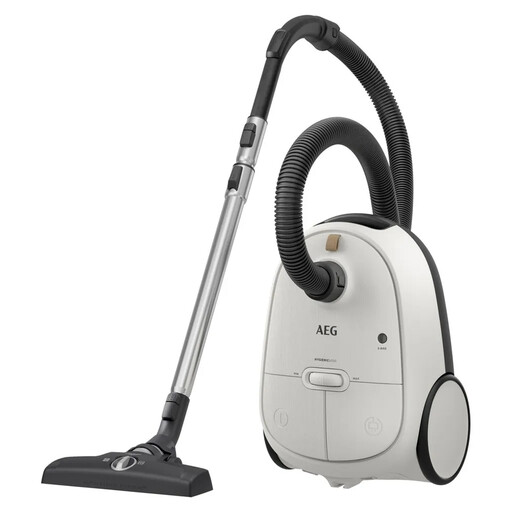
This bagged cylinder vacuum is an option for dry dust and hard-to-reach edges. Before buying, check that its floorhead will fit the space beneath your shelf.
 No image available
For narrow gaps by shelves, the product description mentions a flexible XL crevice tool. Before buying, check whether it will fit beneath your shelf with the tube at the required angle.
The product name specifies a 12 m cable and a power consumption of 850 W. As a bagged model, it needs compatible replacement bags.
Not necessarily. A crevice tool can help with narrow edges, but also measure the height and depth of the gap and check how the floorhead and tube sit on the specific vacuum.
Only if the manufacturer specifically says it’s safe for that model. Miele advises against using its cylinder vacuums to pick up liquids or damp dirt. Check the instruction manual before vacuuming anything wet.
Follow the instructions for your exact model. In its general service instructions, Bosch recommends letting a dust container rinsed according to the instructions dry completely before putting it back. It specifies at least 24 hours at room temperature.
Many online purchases generally come with a 14-day right to cancel. For faulty goods, statutory rights are separate from a voluntary manufacturer’s warranty. The Verbraucherzentrale states that these rights generally last for two years from delivery, and notes that additional rules apply to sales contracts from 31 July 2026. Check the terms that apply to your specific contract.
No. In Germany, old electrical appliances must be collected separately. You can take them to a municipal collection point; retailers also have take-back obligations in certain circumstances, as set out by the Bundesumweltministerium.