People who listen to the radio quietly at home
If you have the news, a conversation or music on in the background, what matters is whether you can hear it clearly from your usual listening spot at low volume. Wattage alone won’t tell you that.


First, check whether your chosen local station is available via DAB+ at your location and whether reception is likely to work indoors. DAB+ Mehr Radio / Digitalradio Deutschland e. V. provides a station map and reception forecast to help you do this. Then choose a radio that’s easy to use and check whether you can hear it clearly at the low volume you normally use. Wattage and general sound-quality claims won’t tell you that. For evening listening, you may also want a clearly specified headphone socket, a dimmable display or a sleep timer.
If you have the news, a conversation or music on in the background, what matters is whether you can hear it clearly from your usual listening spot at low volume. Wattage alone won’t tell you that.
Before choosing a radio, check whether your preferred station is available via DAB+ at your location and whether the reception forecast suggests it will work indoors. DAB+ Mehr Radio / Digitalradio Deutschland e. V. provides a station map and a location-specific forecast.
If you listen near other people or before going to sleep, check for the features you actually need, such as a clearly specified headphone socket, a dimmable display or a sleep timer. Pure lists these features for the Classic H4; MEDION specifies a headphone socket on the LIFE E66880.
First check which stations are available and how reception is expected to be at your intended listening spot. Then decide whether you need a radio for one place or for use on the move, and finally try out the controls and sound at your usual listening volume.
| What you need | What to check before buying | Who is this most important to? |
|---|---|---|
| Clear sound at low volume | Listen to speech and music on the actual radio at the low volume you normally use. Check that the volume and station buttons are easy to reach. | When I have the news or music on in the background, I want to hear it clearly from my usual listening spot and adjust the volume easily. Around 31% of consumers put clear sound at low volume first. |
| Reception for your chosen local station | Find the station on the regional station map and check the indoor reception forecast for your location. FM is only an alternative if that particular station is available there on FM. | If I want to listen to a particular local station, I need to know that it’s actually available where I listen. Around 31% of consumers say reception for their chosen local station is a priority. |
| Listening without disturbing others in the evening | Check specifically whether the radio has a headphone output. If you’ll use it in the evening, also look for a dimmable display and a sleep timer. | If other people are nearby or I listen before bed, I want to be able to listen privately or dim the display. Around 23% of consumers put considerate listening first. |
| Moving between listening spots | Check whether the particular radio can run on a rechargeable battery or disposable batteries, and how it charges or gets its power. Check reception and positioning at each place you plan to use it. | If I regularly take my radio to another room, power and reception in both places are essential. Around 15% of consumers prioritise being able to move between listening spots. |
The stations available and the likelihood of indoor reception depend on your location. So even if a radio supports the right reception method, that doesn’t guarantee your chosen station will work where you plan to listen.
First, find the station on the regional station map, then check the indoor forecast for your location. Once you’ve bought the radio, test reception where you plan to use it.
A rated power output or a general review won’t tell you whether you’ll be able to hear speech clearly at the low volume you want.
If possible, try the specific model with speech playing at the volume you’ll actually use at home.
Hama DR2002 and DR2002BT, as well as Pure Classic H4 and H4i, are different model names. You can’t automatically assume that the features or test results for one version apply to the other.
Check the full model name and look at the specifications for the exact version to confirm its connections and reception options.
The CR-ST85DAB is a compact DAB+/FM radio for home use.
Hama says the DR2002BT is designed to be easy to use, with large buttons, a rotary control and a large display.
The Classic H4 is a home DAB+/FM radio with night-time features; the Classic H4i is a different version with internet radio.
According to the manufacturer, the nuGo! ONE+ combines DAB+/FM with a rechargeable battery and carry handle, making it suitable for moving between listening spots.
The LIFE E66880 is a DAB+/FM radio for which MEDION lists a rechargeable battery and headphone socket.
The DIGITRADIO 3 is a home DAB+/FM option.
This selection includes portable DAB+/FM radios for moving between listening spots, as well as one model with internet radio. Check station reception and how clearly you can hear the radio at low volume for each specific device.
 No image available
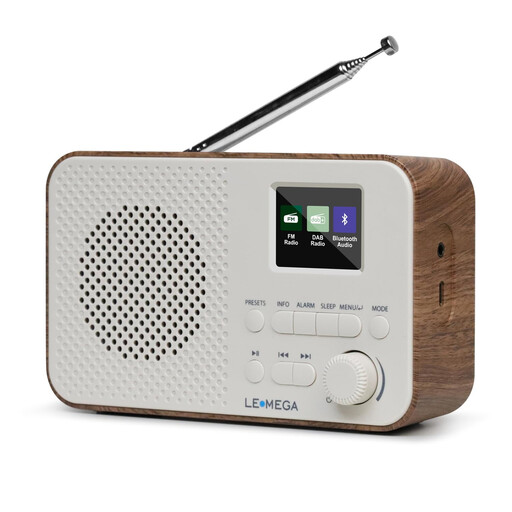
A good option if you want to use DAB+ or FM in different places and connect headphones when needed.
Listed features include Bluetooth, an LCD display, a 2200 mAh rechargeable battery, USB-C charging, a headphone socket and 40 station presets.
 No image available
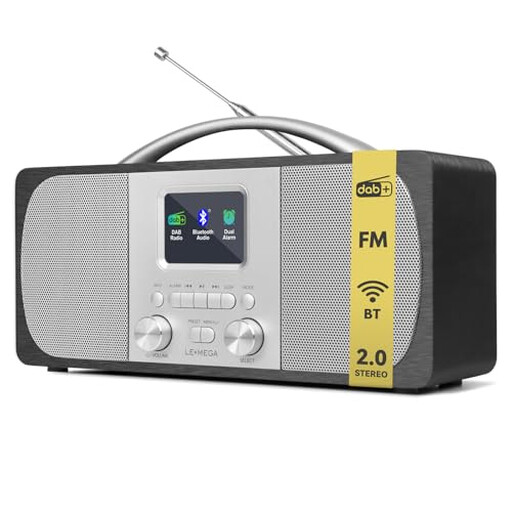
Could suit low-volume or private listening if you need a headphone socket and sleep timer.
The description lists DAB+, FM, Bluetooth, Speech-EQ, 40 station presets and a headphone socket. It can run on mains power or four AA batteries; the batteries are not included, according to the description.
 No image available
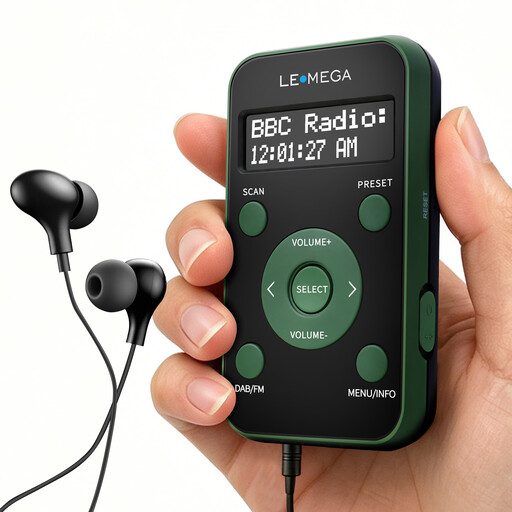
A good option if you’re looking for a portable radio for DAB+ or FM and private listening with the included earphones.
The product title lists a rechargeable battery, LCD display and 20 station presets. According to the description, the supplied earphones also act as the aerial.
 No image available
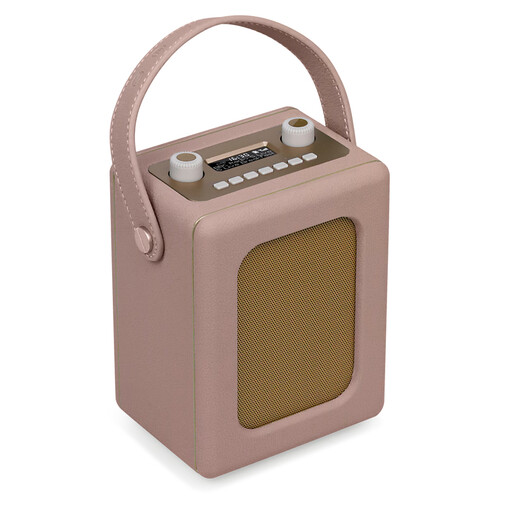
Could work well in one spot or when moving between rooms if you want a sleep timer and headphone socket.
The description lists DAB+, FM, Bluetooth, 60 station presets, two alarm functions, a sleep timer, a headphone socket and EQ modes. Battery operation requires four AA batteries, which are not included according to the description.
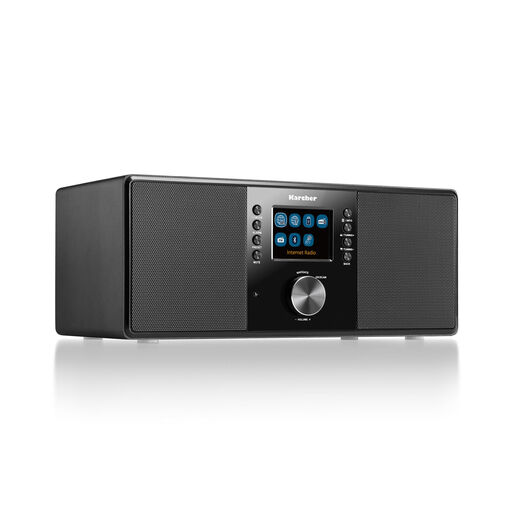 No image available
A good option if you want to listen to internet radio as well as terrestrial radio and have access to a Wi-Fi connection.
The product title lists DAB+, FM, Wi-Fi, Bluetooth, a 2.4-inch colour display, USB, AUX input, line output, headphone socket, alarm and remote control. Internet radio reception also requires Wi-Fi.
No, provided the station is broadcast via DAB+ and you can receive it where you listen. Check the regional station map and the indoor reception forecast for your location. However, if a station is only available as an online stream, you’ll need a suitable internet-enabled device and an internet connection.
First, check the reception forecast for your location and run a station scan on the radio. If reception is weak, trying a different position or adjusting the aerial may help; follow the instructions for your model. For the nuGo! ONE+, Nubert recommends fully extending the aerial and positioning it vertically if needed.
Check specifically whether the radio has a headphone output; an AUX input or Bluetooth reception doesn’t mean it has one. According to its specifications, the Pure Classic H4 has a sleep timer and dimmable display, but no specified audio output. Start listening through headphones at a low volume.