
Lieferung heute & morgen

Qualitätsgarantie

Willkommens-Angebote freischalten: KOSTENLOSE Lieferung | Bis zu 80 % RABATT | Kostenlose 30-Tage-JoyPlus-Testphase
App herunterladen
A DAB radio should work reliably in everyday situations: at breakfast in the kitchen, as a clock radio in the bedroom, in the office or while you’re out and about. The choice ranges from compact pocket radios to portable models with Bluetooth. However, some advertising claims and unclear technical specifications can quickly lead to the wrong purchase.
Not every digital radio automatically supports DAB+. In Germany, DAB+ is the relevant standard for many digital radio programmes. A device that only receives analogue FM radio or AM is not a DAB radio. Before buying, check that the supported reception types are explicitly listed as DAB, DAB+ and FM.
An additional FM tuner is still useful. Reception quality can vary depending on the region, building and location. FM then provides a fallback when a digital station is not available locally.
Figures such as “up to 12, 15 or 20 hours” generally refer to specific volume levels and operating conditions. At a higher volume, with an active Bluetooth connection or the display lighting switched on, actual battery life may differ.
Look out for:
A built-in battery keeps the radio compact, but it cannot be replaced easily. For a radio intended for daily use, a combination of battery power and mains operation is therefore a sensible choice.
An LCD display often shows the station name, time and programme information. An LED display is usually easy to read from a greater distance, but it may seem too bright in the bedroom. Adjustable brightness is therefore a practical feature.
The aerial also affects reception. On some pocket radios, the connected headphone cable acts as the aerial. This is functional, but it means that reception may be limited without headphones, or that the device cannot be used like a conventional speaker radio.
A DAB+ radio should offer an automatic station scan. Depending on the model, you may be able to save, for example, 20 or 40 stations. Plenty of presets make the radio easier to use, but they are only helpful when the buttons and menus are clearly laid out.
For Germany, look for the combination DAB/DAB+, FM. The actual range of stations depends on regional coverage and your location. Indoors, placing the radio near a window or in a raised position may improve reception.
A radio with a mains adapter is suitable for the kitchen and bedroom if it will remain in one place. An akkuradio is more flexible and can be used in the garden, on the balcony or in the office without access to a socket.
If the radio uses AA batteries, check whether they are included. According to the product details, the LEMEGA Class Classic requires four AA batteries; a mains adapter is also provided. Models with an integrated battery, on the other hand, are charged via USB-C.
A radio with Bluetooth can play music, podcasts or audiobooks from a smartphone, tablet or laptop. A radio with an alarm clock should offer at least one alarm time, a snooze function and a sleep timer. For households with different schedules, a model with two alarm times may be useful.
A radio with a headphone socket is suitable for private listening in the bedroom, on the train or while out walking. A pocket radio should also have a key lock, preventing the settings from being changed accidentally in your jacket pocket.
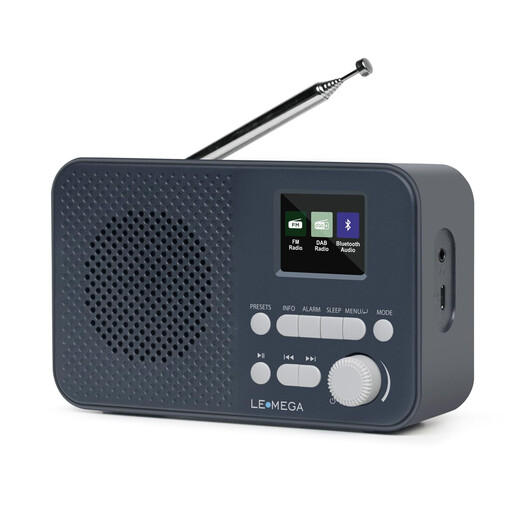
Why this product suits this profile: This portable DAB radio combines DAB+, FM, Bluetooth and mains operation with an integrated battery. It is suitable for the kitchen, bedroom, office or occasional use outdoors.
The reception types are clearly listed as DAB, DAB+ and FM. There is also an automatic station scan and storage for up to 40 presets.
2,200-mAh battery with up to 15 hours of battery life according to the product details, USB-C, colour display, dual alarm and 3.5-mm headphone socket.
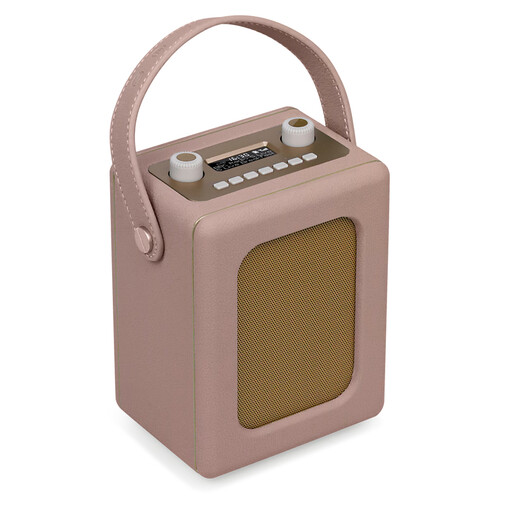
Why this product suits this profile: The larger 13 × 18 × 10 cm housing is designed for use as a kitchen or bedroom radio. Bluetooth, DAB+, FM and an alarm function cover a range of everyday situations.
The radio does not rely solely on battery power: according to the product details, it can also be operated using the supplied mains adapter. The display size and 60 presets make it easier to use.
Large LED display, Bluetooth, dual alarm, sleep timer, headphone socket and EQ modes for music or speech.
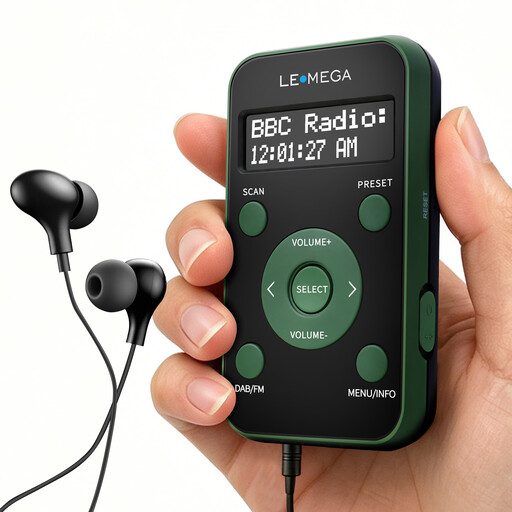
Why this product suits this profile: This pocket radio weighs 65 g and measures 90 × 51 × 16 mm. It is designed for commuting, walking or sports activities and comes with headphones.
The key lock prevents accidental inputs while the radio is in your pocket. The headphones also act as the aerial, which is worth considering before buying.
Integrated 1,000-mAh battery, up to 12 hours of battery life according to the product details, USB-C, LCD display, 40 presets and 3.5-mm socket.
We have put together a complete, regularly updated list of products that fully meet these strict selection criteria and the safety regulations applicable in the EU.
The Sony ICF-C1W is an alternative for users looking for a classic clock radio with an LED display. According to the product details, this model receives FM and AM through an analogue tuner, not DAB or DAB+. It offers mains operation, battery backup and adjustable display brightness.
Connect the device to the mains or charge the battery. Then start the automatic station scan. Position the aerial as unobstructed as possible, then save your preferred stations. With some pocket radios, the supplied headphones must be connected because their cable acts as the aerial.
This depends on battery capacity, volume, display brightness and Bluetooth usage. Depending on the model, the radios listed quote up to 12, 15 or 20 hours. These figures should be understood as manufacturer specifications and may differ in everyday use.
When running on battery power, most of the energy is used during charging. When operated from the mains, consumption depends on the model and how long it is running. A device with a sleep timer can switch off automatically. If you will not be using the radio for an extended period, switch it off completely and unplug it from the mains.