Choose a DAC headphone amplifier based on the file format you actually use, your computer’s connection, and the plug and power requirements of your wired headphones – not the highest sample rate advertised. A USB DAC keeps your set-up simple; extra digital inputs, speaker outputs or DSP features are mainly useful if you’ll actually use them at your desk. Manufacturers’ format and power specifications apply to specific models and connections; they are not comparative listening tests.
Who can benefit from a DAC headphone amplifier at their home-working desk?
Listen to hi-res files on your computer
If you want to play your existing files over USB through wired headphones, check that the file, playback software and DAC input work together. Apple Support (DE) describes the lossless formats available in Apple Music for Windows; FiiO lists different format limits for the K11 depending on the input.
Connect a specific pair of headphones
The plug, impedance and appropriate volume control all matter for your particular headphones. FiiO and iFi audio list connections and power specifications separately for their respective models and outputs.
Use multiple desk sources or active speakers
If you want to switch between your computer and other digital sources, or connect active speakers as well, you’ll need the right inputs and outputs. The manufacturer documentation from FiiO, iFi audio and TOPPING describes the different connection options available on their models.
What should you look for when buying a DAC headphone amplifier?
Compact USB DAC
A good fit if: your computer is your main digital source and you want to connect headphones, and possibly active speakers too.
Consider: whether USB is enough as a digital input for all your devices. The iFi ZEN DAC 3 does not include a separate 5-V power supply, according to the manual.
Desktop DAC with multiple digital inputs
A good fit if: you want to connect an optical or coaxial digital source as well as your computer. According to the manufacturer, the FiiO K11 has USB, optical and coaxial inputs.
Consider: the K11 requires an external 12-V power supply, and its stated format limits vary by input.
DAC with IEM output and DSP
A good fit if: you use sensitive in-ear monitors and want to adjust features such as the equaliser or crossfeed. RME lists these features for the ADI-2 DAC FS.
Consider: extra adjustment options mean more to get to grips with; on their own, they don’t prove an overall sound advantage.
| Buying priority |
What to check before buying |
Who does this matter most to? |
| Files and playback chain |
Match the file format and sample rate to your computer, software and the DAC input you’ll actually use. FiiO specifies up to 32 Bit/384 kHz via USB and up to 24 Bit/96 kHz via optical for the K11. |
If I want to listen to my existing hi-res files on my computer, I need to know whether the software and selected input work together. Around 36% of consumers prioritise file format. |
| Headphone compatibility |
Check the plug, impedance and the manufacturer’s specifications for the output you intend to use. Compare power figures only when the load and stated test conditions are the same. |
If I want to connect my existing headphones, I need the right plug and suitable volume control. Around 29% of consumers put headphone compatibility first. |
| Controls and space |
Check the dimensions, power supply requirements and volume control for the output you’ll use. Turn the volume down before changing the gain setting. |
If I use the DAC at my desk every day, I want to be able to control the volume easily and keep my set-up tidy. Around 21% of consumers prioritise easy desktop operation. |
| Other sources and speakers |
List the digital sources you need and check that the outputs are suitable for connecting your active speakers. |
If I want to switch between devices or connect active speakers, I need the right inputs and outputs. Around 14% of consumers prioritise additional sources and speakers. |
Avoid common DAC buying and connection mistakes
-
Assuming the highest USB sample rate applies to every input
According to the manufacturer, the format limits for USB, coaxial and optical signals differ on the FiiO K11. A figure for USB therefore doesn’t automatically apply to the other inputs.
Check the specifications for the specific input you want to use.
-
Comparing output power without checking the load and socket type
Power specifications can vary depending on the headphone load and output. FiiO lists the K11’s figures for each output and set of conditions.
Only compare figures that use the same load, output type and test conditions.
-
Confusing ‘Fixed’ with a volume-controlled speaker output
On the iFi ZEN DAC 3, the ‘Fixed’ setting bypasses volume control for the rear output, according to the manual.
Check the output mode before connecting and switching on your active speakers, and start at a low volume.
-
Overlooking the power supply and space needed for your set-up
Power requirements vary between models. The FiiO K11 requires an external 12-V power supply; the iFi ZEN DAC 3 does not include a separate 5-V power supply, according to the manual.
Check the power requirements and what’s included with the specific offer before planning your desk space.
A guide to key brands
FiiO
The K11 is a desktop DAC/headphone amplifier for USB and other digital sources. The K11 R2R is a different model variant and should not be confused with the K11.
- FiiO lists several digital inputs, plus 6.35- and 4.4-mm headphone outputs with three gain settings.
- The K11 requires an external 12-V power supply. The maximum supported formats listed depend on the input.
iFi audio
The ZEN DAC 3 is a USB-C DAC/headphone amplifier with outputs for headphones and compatible active speakers.
- The manufacturer’s manual lists two headphone connections, switchable gain, and fixed or variable rear outputs.
- A separate 5-V power supply is not included, according to the manual. The ‘Fixed’ setting bypasses volume control for the rear output.
TOPPING
The DX3 Pro+ is a desktop DAC/headphone amplifier for users who want to connect multiple input sources.
- The manufacturer’s manual lists USB, optical, coaxial and Bluetooth inputs, as well as an RCA line out.
- For direct headphone connection, this model has a 3.5-mm socket, not a 6.35- or 4.4-mm socket, according to the manual.
RME
According to RME, the ADI-2 DAC FS has a dedicated IEM output and features for fine-tuning playback.
- RME lists a remote control, crossfeed and a 5-band parametric EQ.
- The documented features are manufacturer specifications and don’t prove a sound advantage with every pair of headphones.
Joybuy’s desk-friendly product selection
This selection includes a USB DAC with a headphone amplifier for your computer, as well as extra digital inputs for additional sources.
 No image available
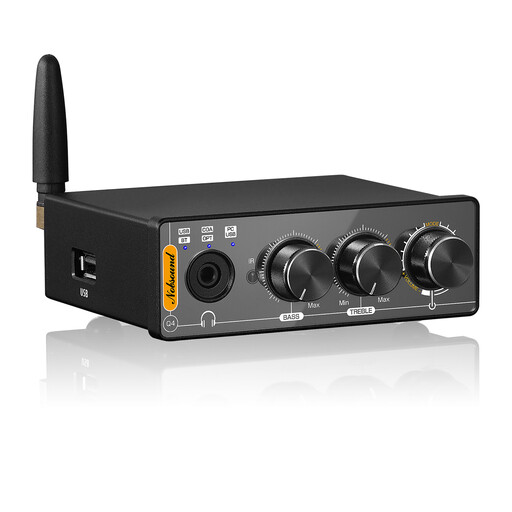
Nobsound Q4 USB audio DAC with Bluetooth
Designed for computer playback via USB and for connecting other digital sources, this model is described as a DAC with a headphone amplifier.
Listed features include USB, optical and coaxial inputs, Bluetooth, RCA outputs and a remote control. The product specifications state support for up to 24 Bit/192 kHz, headphones with 16–300 Ω impedance, and treble and bass controls.
For Bluetooth playback, the product description says you need to unplug the USB drive, as its input takes priority.
View at Joybuy
Frequently asked questions about DAC headphone amplifiers
Does my DAC need to support the highest sample rate advertised?
No. What matters is whether your files can be played using the software and input you actually intend to use. The format limits listed by the manufacturer for the FiiO K11 differ between USB, coaxial and optical.
How can I avoid an unexpectedly high volume when setting it up?
Start with the volume low. The iFi ZEN DAC 3 manual warns against switching PowerMatch at high volume and recommends the low setting for in-ear monitors. If you’re using active speakers, also check whether the rear output is set to ‘Fixed’ or ‘Variable’.
What are my rights if an online purchase is faulty in Germany?
If a product is faulty, your statutory rights against the seller are separate from any voluntary guarantee. Many online purchases are also generally covered by a 14-day right to cancel, although terms and exceptions may depend on the contract. The Verbraucherzentrale explains the differences.
Can I put an old DAC in the household bin?
No. Electrical and electronic waste must be disposed of separately. The Umweltbundesamt says that small waste electrical items up to and including 25 cm in size can be returned free of charge to retailers that are required to accept them, even without buying a replacement. Local collection points are another option.


