If your PC’s existing output powers your headphones cleanly and at a suitable volume, you don’t automatically need an additional DAC headphone amplifier. If it doesn’t, first choose the right PC input and headphone connection, along with gain and volume controls that suit your particular headphones. In a quiet room, a high maximum power output alone isn’t a good reason to choose one. Extra speaker or multiple-source features are only useful if you’ll actually need them in your setup.
Who might benefit from a DAC headphone amplifier?
PC listeners with wired headphones
If you want to use your existing headphones with a desktop PC, the key things to consider are the right input, the headphone plug and easy-to-adjust volume. FiiO and iFi audio list different headphone outputs on their respective models.
Quiet listeners in a home office
If you often listen at low volume, check that the gain settings and volume range work well with your headphones, rather than focusing solely on the maximum power rating. FiiO lists three gain settings for the K11; the iFi ZEN DAC 3 manual describes PowerMatch and recommends the low setting for in-ear headphones.
Listeners with speakers or a second source
If you want to use active speakers as well as headphones at your desk, or genuinely need two audio sources, the right outputs, inputs and controls are essential. iFi audio describes fixed and variable rear outputs on the ZEN DAC 3; Creative lists two USB-C audio inputs with mixing on the Sound Blaster G8.
What should you look for when buying?
First, check whether your PC’s existing output already gives you the listening experience you want. If you need an additional device, make sure its headphone connection and volume controls suit your particular setup. Extra features are only worthwhile if you’ll actually use them.
| What you need |
What to check before buying |
Who is this important to? |
| PC and headphone connections |
Check that the PC interface and headphone plug are compatible. Consider any adapters you’ll need and which output you’ll actually use. |
I want to use my existing headphones with my PC without worrying about connections; around 31% of consumers are likely to prioritise compatibility above all. |
| Quiet listening with precise volume control |
Check that the gain setting and volume control work well with your headphones. FiiO lists three gain settings on the K11; according to the ZEN DAC 3 manual, iFi audio recommends the low PowerMatch setting for in-ear headphones. |
If I mostly listen quietly in a calm room, I need easy-to-adjust volume; around 25% of consumers are likely to put this first. |
| Headphones and speakers |
Check that the line output is suitable and whether its volume is fixed or variable. According to the manual, the rear output on the iFi ZEN DAC 3 bypasses the volume control when set to Fixed. |
If you want to switch between headphones and active speakers at the same desk, check the outputs and how their volume is controlled; around 19% of consumers are likely to consider this especially important. |
| Space and power supply |
Check the dimensions, any power supplies required and how much effort setup will take. FiiO specifies a DC 12 V/2 A power supply for the K11. |
I don’t want to clutter my desk with unnecessary devices and cables, so I also check the power supply; around 19% of consumers are likely to prioritise space and ease of setup. |
| Multiple audio sources |
Consider whether you want to switch between inputs or mix signals at the same time. Creative describes two USB-C audio inputs with mixing on the Sound Blaster G8. |
If I want to use audio from two devices at once, mixing matters more than simply having an extra connection; around 6% of consumers are likely to put multi-source audio first. |
Avoid common buying mistakes
-
Treating the highest milliwatt figure as a universal measure of quality
FiiO lists different power ratings for the K11 depending on the output and load. A figure can’t simply be applied to a different output, and on its own it doesn’t prove you’ll hear an improvement with your headphones.
Only compare power ratings when the output, load and measurement conditions are the same. Then check that the plug and volume controls suit your headphones.
-
Treating a fixed line output as if its volume were adjustable
According to the manual, the rear output on the iFi ZEN DAC 3 bypasses the volume control when set to Fixed. This matters if you’ve connected active speakers.
Before connecting, check which device controls the volume, and start at a low level.
Active speakers may need a separate volume control.
-
Assuming a US version is the right German version just because it has the same model name
For the Atom 2 bundle in the US version described, JDS Labs lists power adapters for 110–120 V. This doesn’t mean the same power supply is suitable for a German version.
Before relying on information about another version, check the power supply, product markings and the relevant contact for Germany for the specific model on offer.
Brands to consider
FiiO
The K11 is a desktop DAC amplifier with USB, optical and coaxial inputs, as well as several headphone and line outputs.
- FiiO lists three gain settings and 6.35 mm and 4.4 mm headphone connections for the K11.
- The model requires DC 12 V/2 A. Power ratings depend on the output and headphone impedance. They are manufacturer specifications, not an independent comparison of sound quality or noise.
iFi audio
The ZEN DAC 3 is designed for a USB-C setup with headphones and, if needed, active speakers.
- The manual lists 6.3 mm and 4.4 mm headphone outputs, PowerMatch, and fixed or variable rear outputs.
- When set to Fixed, the rear output isn’t controlled by the volume adjustment, according to the manual. The manufacturer’s claim about XBass+ doesn’t prove an independently verified sound improvement with every pair of headphones.
Creative
The Sound Blaster G8 is an external DAC amplifier for PC setups where USB audio mixing is useful.
- Creative describes two USB-C audio inputs with mixing on the G8, a specific feature for using multiple sources.
- This extra feature alone doesn’t guarantee a general sound advantage when listening to music from a single PC.
JDS Labs
The Atom DAC 2 and Atom Amp 2 make up a separate DAC and amplifier combination, rather than an all-in-one unit.
- JDS Labs describes USB-C on the DAC, analogue connections to the amplifier and headphone outputs on the amp.
- The US version of the bundle described comes with adapters for 110–120 V. This doesn’t mean it includes a suitable power supply for Germany.
Suitable Joybuy products
This selection is for USB DACs with an integrated headphone amplifier for PC use.
 No image available
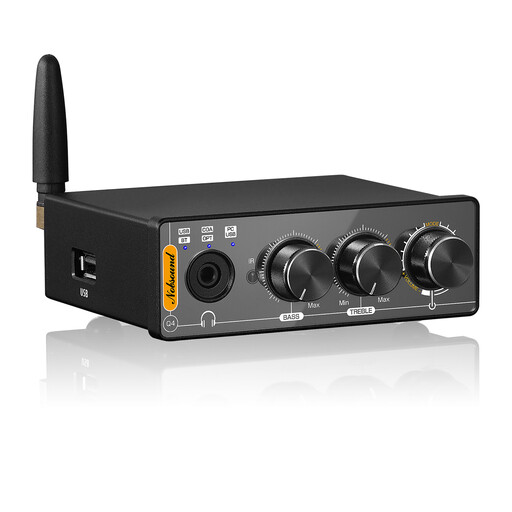
Nobsound Q4 USB audio DAC with Bluetooth headphone amplifier
The product title describes this model as a USB audio DAC with a headphone amplifier for PC.
The title also mentions Bluetooth, an optical input, 24-bit/192-kHz, treble and depth controls, and a remote control. When choosing, make sure the headphone connection and volume controls suit your setup.
View at Joybuy
Frequently asked questions
What should I do if there’s no sound from my USB DAC on a Windows PC?
First, check in Windows Sound settings that the DAC is selected as the output device. Microsoft Support also points out that individual apps may use a different output device, so check the audio output settings in the app you’re using as well.
Can I keep the volume the same when changing the gain setting?
No. Turn the volume down before switching to a higher gain setting. The iFi ZEN DAC 3 manual warns against starting at a high volume; the WHO also points out that both volume level and listening time affect the risk to your hearing.
What applies in Germany if a product develops a fault: a guarantee or a warranty?
Your statutory rights are with the seller; a guarantee is an additional voluntary promise with its own terms. The Verbraucherzentrale distinguishes between these two claims. The rules on the right to repair introduced in July 2026 don’t establish that a DAC headphone amplifier is among the product groups covered.
What should I look for in terms of product safety and disposal?
For electrical equipment sold in Germany, check that the product and manufacturer details are correct and that it has the required markings and German-language information. The European Union describes CE marking as the manufacturer’s declaration that a product meets the relevant requirements, not as an independent quality mark. The Umweltbundesamt points out that waste electrical equipment must be collected separately.


