When choosing gingerbread before training, a high cocoa content alone isn’t a decisive factor. Compare the portion you plan to eat, along with its carbohydrates, fat and fibre, against your needs and what you personally tolerate. The German Nutrition Society (DGE) highlights the role of carbohydrates in sport, while noting that requirements vary according to factors such as the type and duration of training, and the individual. Check the ingredients and allergen information on the specific pack.
Who should take care when choosing?
Those who keep an eye on carbohydrates
You want to choose a small sweet snack based on its nutritional values, rather than being swayed by dark chocolate. According to the DGE, carbohydrates play an important role in providing energy for sport; individual requirements depend, among other things, on the duration and intensity of your training.
Fans of a rich cocoa flavour
You want to know whether “dark” describes only the chocolate coating or whether the dough also contains cocoa. If a particular cocoa percentage matters to you, check which ingredient the figure refers to.
Shoppers looking for vegan or allergen-conscious options
You’re looking for a variety explicitly labelled vegan, or need to avoid certain ingredients and allergens. The information on the specific pack is what matters: a vegan label doesn’t tell you whether the product contains wheat or soya, or may contain traces of other allergens.
What should you look for when buying?
Start by comparing the nutritional values with the portion you actually plan to eat. Whether you prefer a dark chocolate coating, a filling or cocoa in the dough is a separate matter of taste.
| What to consider |
What to check |
Who it matters to |
| Carbohydrates |
Compare the carbohydrate content per 100 g and calculate it for your planned portion; the dark colour doesn’t tell you this. |
If I want a snack that’s high in carbohydrates before training, I look at the nutritional values rather than the cocoa coating. This is a priority for around 36% of consumers. |
| Portion and tolerance |
Check the weight per piece, fat and fibre per 100 g, then consider what portion works for you. |
I wouldn’t choose a variety with lots of nuts, or a larger portion, based on its dark appearance alone. Portion size and personal tolerance come first for around 29% of consumers. |
| Vegan labelling and allergens |
Read the vegan label, ingredients, highlighted allergens and any precautionary trace warnings on the pack. |
I want to avoid animal-derived ingredients or need to be particularly careful about certain allergens. This is the top priority for around 21% of consumers. |
| Cocoa flavour |
Look for a stated cocoa percentage for the chocolate or cocoa in the dough’s ingredients list. |
A pronounced cocoa flavour matters more to me than choosing based solely on carbohydrate or fat content. Around 14% of consumers value this most. |
Common misconceptions
-
Assuming “dark chocolate” means a set cocoa percentage
A dark coating on its own doesn’t tell you how much cocoa the chocolate contains or how the nutritional values of the whole gingerbread are made up. For example, REWE states that the chocolate in Leupoldt Bio Lebkuchen Zartbitter contains at least 70% cocoa, but makes up 17% of the product.
Check what a stated cocoa percentage refers to, then look separately at carbohydrates, fat and portion size.
-
Assuming a dark Elise variety makes for a light portion
Lebkuchen-Schmidt lists 22.6 g of fat per 100 g for its Schwarze Mini-Elise. You can’t tell the nutritional value of a specific variety from its colour.
For Elisen gingerbread, compare the nutritional values per 100 g with the size of each piece, and choose according to what you personally tolerate.
-
Equating “vegan” with “allergen-free”
Even dark chocolate gingerbread labelled vegan may contain wheat or soya. Information about possible traces of other allergens is different from the declaration of allergenic ingredients that have been intentionally used.
If you need to avoid an allergen, read the ingredients list and trace warnings on the specific pack. Don’t assume a product is suitable just because it’s labelled vegan.
Brands to consider
Lebkuchen-Schmidt
The range includes Schwarze Elise, made with cocoa in the dough, as well as smaller Schwarze Mini-Elisen.
- If you’re looking for cocoa in the gingerbread dough too, Schwarze Elise is one variety to compare; the information about cocoa in the dough comes from the manufacturer.
- According to Lebkuchen-Schmidt, Schwarze Mini-Elise contains 22.6 g of fat per 100 g. For your portion, also check the ingredients and allergens.
Wicklein
Wicklein’s range includes Elisen, chocolate and organic gingerbread.
- The different types of gingerbread give you options for choosing a coating and recipe to suit your taste.
- When choosing a snack before training, the ingredients and nutritional values of the specific variety are what matter.
EDEKA Herzstücke / GUT&GÜNSTIG
EDEKA lists both plain and filled dark chocolate gingerbread.
- For GUT&GÜNSTIG dark chocolate hearts, stars and pretzels, EDEKA lists 65.2 g of carbohydrates and 11.2 g of fat per 100 g. Its filled dark chocolate hearts contain 66.9 g and 7.8 g per 100 g respectively.
- For the pack you choose, also compare the size of each piece, ingredients and allergens; the values for these two varieties aren’t interchangeable.
Weiss
Weiss offers dark chocolate gingerbread hearts; the 300 g variety listed by REWE is labelled vegan.
- For Weiss dark chocolate gingerbread hearts, 300 g, REWE lists 64.5 g of carbohydrates and 11.8 g of fat per 100 g.
- The vegan label applies to the variety identified as such. For allergens, check the ingredients and trace warnings on the specific pack.
Dark gingerbread at Joybuy
This selection includes filled gingerbread hearts and chocolate gingerbread in a range of shapes. If you’re considering one as a snack before training, compare the pack information for the portion you want to eat; a dark coating alone doesn’t make it especially suitable.
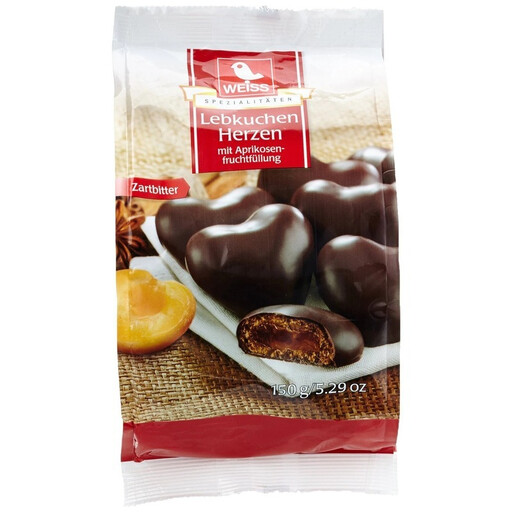 Image unavailable
Weiss gingerbread hearts with dark chocolate filling, 150 g
This variety could suit you if you prefer filled gingerbread hearts and want to decide for yourself how much to eat before training.
Compare the size of each piece with the nutritional values on the pack. If you have allergen-related requirements, also check the ingredients and trace warnings.
View at Joybuy
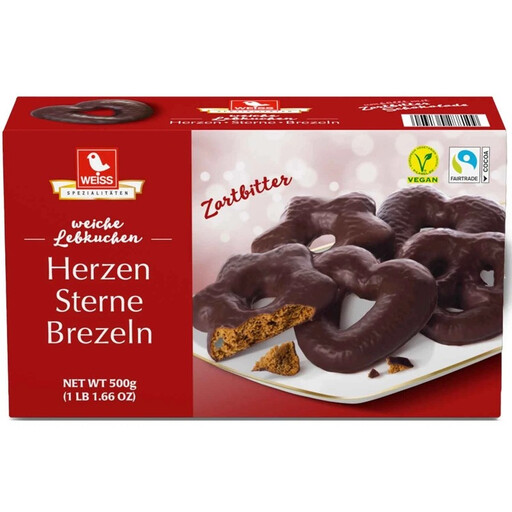 Image unavailable
Weiss chocolate gingerbread with dark chocolate, hearts, stars and plaits, 500 g tin
This tin could suit you if you’re looking for gingerbread with dark chocolate in a range of shapes.
For a snack before training, the amount per piece matters more than the total weight of the tin. Also check the nutritional values, ingredients and allergens on the pack.
View at Joybuy
Frequently asked questions
Is gingerbread with a high cocoa content automatically a better choice before training?
No, cocoa content alone doesn’t answer that question. The DGE describes carbohydrates as important for providing energy during sport, while the type and duration of training, as well as individual factors, affect your requirements. So compare the nutritional values of the variety with the portion you plan to eat.
How can I tell if the gingerbread dough contains cocoa, rather than just the coating?
Check the dough’s ingredients list; a percentage given for the chocolate initially describes only that ingredient. Lebkuchen-Schmidt says its Schwarze Elise contains cocoa in the gingerbread mixture, while the cocoa percentage REWE gives for Leupoldt Bio Lebkuchen Zartbitter refers to its chocolate coating.
Is vegan dark chocolate gingerbread suitable for people with allergies?
Not just because it’s labelled vegan. In the examples described by REWE and EDEKA, wheat and soya, as well as possible traces of other allergens, may be relevant. Check the ingredients and allergen information on the specific pack.
Which details on the pack help when comparing two varieties?
Compare the nutritional values per 100 g, your planned portion size and the ingredients list. If you need to avoid certain ingredients, also check the highlighted allergens and any trace warnings; declarations of allergenic ingredients and voluntary trace warnings mean different things.


