When choosing dark biscuits as part of an organic shop, first check the organic certification and any dietary requirements that are essential for you. If a high cocoa content is your priority, the words ‘dark chocolate’ aren’t enough: look for a specific percentage and check whether it refers to the chocolate or the biscuit as a whole. Oat biscuits and filled sandwich biscuits also differ in their grain base, filling and allergen information.
Which option is right for you?
Checking organic certification and cocoa content
If you’re looking for dark biscuits as part of an organic shop, check the organic certification and the specific cocoa information separately. The proportion of dark chocolate in a biscuit isn’t automatically the cocoa content of that chocolate.
For vegan or gluten-free shoppers
If the recipe needs to meet vegan or gluten-free requirements, check the product’s explicit labelling, as well as the ingredients and allergen information on the specific pack. A vegan claim alone doesn’t tell you whether the product contains gluten or may contain traces.
For shoppers considering pack size and store availability
If you’d like to pick up biscuits as part of your regular food shop, compare the pack size and specific recipe, and check whether your store stocks the variant you want. Information on a retailer’s website may differ from what’s on the current pack.
What should you look for when buying?
Start by checking what matters most to you – organic certification, cocoa information or dietary requirements – then compare pack sizes and store availability.
| Criteria |
What to check |
Who it matters to |
| Organic certification |
For pre-packed organic biscuits, check for the EU organic logo and the control body code. Ökolandbau.de explains this labelling for organic food. |
I want to be sure that a biscuit is clearly labelled as an organic product when I’m doing an organic shop, rather than simply looking the part. This is the top priority for around 31% of consumers. |
| Cocoa content |
Look for a specific percentage and check whether it refers to the cocoa in the chocolate or to a chocolate component in the biscuit. |
I’m looking for a pronounced cocoa flavour and don’t want to rely on the words ‘dark chocolate’ alone. For around 31% of consumers, clear information about cocoa content takes priority. |
| Dietary requirements |
Check for vegan or gluten-free labelling, as well as the grains, highlighted allergens and trace warnings shown on the pack. |
If I need to avoid gluten or want a vegan recipe, the specific variant must meet that requirement. This is the most important factor for around 23% of consumers. |
| Pack and store |
Compare pack sizes and, if suppliers change, check the ingredients and nutrition information on the current pack. |
I want to buy a suitable pack size without relying on out-of-date range information. This practical consideration is the deciding factor for around 15% of consumers. |
Which common mix-ups should you avoid?
-
Reading ‘dark chocolate’ as a cocoa percentage
EDEKA states that its organic oat biscuit contains 25% dark chocolate. This figure describes the proportion of the chocolate component, not its cocoa content.
If cocoa content matters to you, check the pack for a percentage that explicitly refers to it.
-
Assuming vegan means gluten-free or allergen-free
The vegan dmBio spelt sandwich biscuit contains spelt, a type of wheat. A vegan recipe also doesn’t rule out possible traces of other allergens.
If you have specific dietary requirements, check the grains, highlighted allergens and trace warnings on the particular pack.
-
Assuming ‘organic’ tells you about the nutritional values
Organic certification doesn’t tell you how much sugar a product contains. EDEKA states that its organic oat biscuit contains 27.4 g of sugar per 100 g, while dm lists 27 g per 100 g for its organic spelt sandwich biscuit.
If nutritional values matter to your choice, compare the figures per 100 g and take the serving size into account.
-
Assuming online information applies to every pack
ALDI SÜD notes that the nutritional information for its organic oat biscuit may vary depending on the supplier. EDEKA also warns that product information may differ from the packaging.
Check the ingredients and allergens on the pack again when you shop, and check what your store stocks before making a special trip.
If the variant you want isn’t available in store, another trip to the shops could take extra time and travel.
Brands and product ranges to help you choose
These examples show a range of biscuit types. The labelling on each specific product will tell you whether it meets your organic, cocoa or dietary requirements.
EDEKA Bio
The organic oat biscuit with dark chocolate combines oat biscuits with dark chocolate. EDEKA states that dark chocolate makes up 25% of the biscuit.
- This specific variant is described as vegan.
- It contains oats and wheat; also check the trace warnings and the current packaging.
ALDI BIO
ALDI SÜD and ALDI Nord list organic oat biscuits with dark chocolate. ALDI Nord describes its dark chocolate variant as vegan.
- The oat biscuit varieties combine organic certification with dark chocolate.
- ALDI SÜD notes that products may vary depending on the supplier, so check the specific pack.
Bahlsen
Bahlsen describes Choco LEIBNIZ Dark as a crisp biscuit covered with a layer of dark chocolate.
- The combination of biscuit and chocolate is clearly described.
- If organic certification or a specific cocoa content is essential, check both on the particular pack.
Gullón
Gullón describes Chip Choco Zero as a biscuit with dark chocolate chips. The recipe lists the sweeteners maltitol and isomalt.
- The ingredient information makes it easier to compare recipes closely.
- If you’re shopping for organic products or have allergen requirements, check the labelling on the specific variant separately.
dmBio
dmBio offers a vegan spelt sandwich biscuit with 30% dark chocolate cream filling, as well as a sandwich biscuit with cocoa cream described as gluten-free and vegan.
- You can distinguish between the two variants by their filling and whether they’re explicitly labelled gluten-free.
- Spelt is a type of wheat; the gluten-free variant is described as having cocoa cream, not dark chocolate cream.
Dark organic biscuits at Joybuy
This sandwich biscuit is an option for an organic shop if you’re looking for dark chocolate. If a specific cocoa content or dietary requirement is important, check the information on the particular pack before choosing.
 No image available
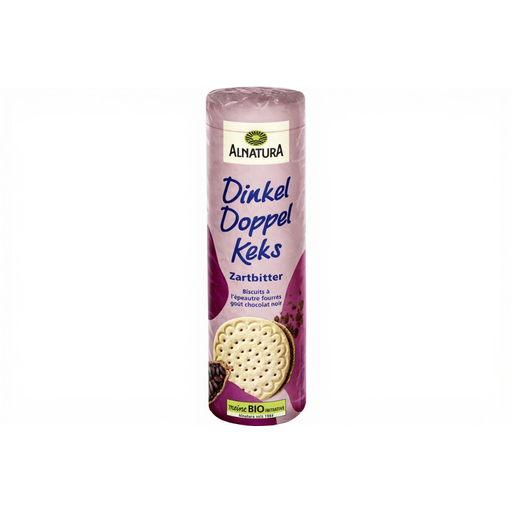
Alnatura organic spelt sandwich biscuits with dark chocolate, 330 g
A sandwich biscuit option if you’re looking for dark chocolate as part of an organic shop.
The pack contains 330 g. Spelt is a type of wheat, so if you avoid gluten, check whether it’s suitable by looking at the current labelling. If a specific cocoa content is essential, look for a percentage that explicitly refers to it.
View at Joybuy
Frequently asked questions
How can I identify a pre-packed organic biscuit?
Check the pack for the EU organic logo and control body code. Ökolandbau.de explains that the EU organic logo is used to label pre-packed organic food. You can then use the ingredients list to choose the recipe that suits you.
Does ‘dark chocolate’ mean a high cocoa content?
No. The wording alone doesn’t give a cocoa percentage. For example, EDEKA’s claim that its organic oat biscuit contains 25% dark chocolate refers to the proportion of chocolate in the biscuit, not the cocoa content of the chocolate. Check what each percentage refers to.
Are vegan dark biscuits gluten-free too?
Not necessarily: the vegan dmBio spelt sandwich biscuit contains spelt. If you need to avoid gluten, look for a product that’s explicitly labelled gluten-free and check its ingredients and allergen information.
Which information should I rely on if the recipe has changed?
For your choice, rely on the labelling on the pack you’re actually buying. ALDI SÜD notes that its organic oat biscuits may vary depending on the supplier, so check the ingredients, allergens and nutritional information again.


