A bar with 80–85% cocoa can make a good small pre-workout snack if you enjoy its bitter taste. If you want to plan your carbohydrate intake for a longer or more intense session, don’t rely on dark chocolate alone: consider the cocoa content, carbohydrates and fat together for the specific variety. If you’re sensitive to caffeine or have allergies, always check the ingredients and information on the packaging.
Who might choose dark chocolate?
Cocoa fans looking for a small snack
If you’d rather enjoy a small piece before your workout than focus on getting a specific amount of carbohydrates, bars with 80–85% cocoa may be worth considering. Whether you enjoy the bitter taste is a matter of personal preference.
People who prioritise carbohydrates
Carbohydrates can be an important part of your nutrition plan for longer or more intense sessions. The German Nutrition Society explains their role in sports nutrition, but a high-cocoa bar shouldn’t be chosen for this purpose on the basis of its cocoa content alone.
People with allergies or caffeine sensitivity
Cocoa naturally contains caffeine, as explained by the German Federal Institute for Risk Assessment. Depending on the variety, you should also check for milk ingredients and warnings about possible traces of allergens such as nuts and soya. The information on the specific product packaging is what matters.
What should you look for when choosing?
First decide whether taste, carbohydrates, how well it suits you or easy portioning matters most. Then compare the information for the specific variety.
| Criterion |
What to check |
Who it matters to |
| Cocoa and sugar |
Compare cocoa content, sugar and fat per 100 g. If the cocoa content is high, consider whether you enjoy a more bitter taste. |
I want a small piece with a strong flavour before my workout, rather than a sweeter bar. For around 36% of consumers, this cocoa and sugar profile is the top priority. |
| Carbohydrates |
Consider carbohydrates and fat per 100 g together, and distinguish the chocolate portion from the rest of your nutrition plan for longer or more intense sessions. |
I want to plan my carbohydrate intake before a longer session, rather than assume a bar is suitable based on its cocoa content alone. This is a priority for around 29% of consumers. |
| Suitability |
Check the ingredients, highlighted allergens and trace warnings for the variety. If you’re sensitive to caffeine, take other sources of caffeine into account too. |
If I need to watch out for certain ingredients or caffeine, the information on the specific product determines my choice. Around 21% of consumers put suitability first. |
| Portioning |
Check the pack size and portion information. Don’t confuse nutrition information per 100 g with values per portion. |
When I’m out and about, I want to be able to portion out a small amount easily without taking the whole bar with me. For around 14% of consumers, this is the most important criterion. |
Common misconceptions
-
A high cocoa content means it’s the right workout fuel
The German Nutrition Society highlights the role of carbohydrates in sport. However, a high cocoa content doesn’t tell you whether a bar meets the carbohydrate needs of a particular session. The 85% varieties considered here also contain significant amounts of fat, as well as carbohydrates.
Choose a high-cocoa bar for its flavour profile, and check the carbohydrates and fat per 100 g separately from the rest of your nutrition plan.
-
Overlooking caffeine in cocoa
According to the German Federal Institute for Risk Assessment, caffeine occurs naturally in cocoa beans. For people who are sensitive to caffeine, the total amount consumed and other sources may also matter.
Factor in coffee, tea and caffeinated pre-workout products when deciding how much chocolate to have.
-
Assuming “dark” means milk-free or allergen-free
Dark chocolate varieties differ in their ingredients and trace warnings. The Milka Darkmilk Kakao Splitter considered here contains milk ingredients; high-cocoa bars may also carry warnings about possible traces of allergens.
For each variety, check the ingredients list and allergen information on the specific packaging rather than looking at the cocoa content alone.
-
Assuming a small pack makes nutrition comparisons easy
Individually wrapped pieces and bars are easy to portion. But their format alone tells you nothing about their sugar, fat or cocoa content.
Compare the nutrition information per 100 g and, where provided, per portion. This makes it clear what quantity each value refers to.
Brands to consider
Lindt
Lindt Excellence 85% is a 100 g dark chocolate bar for people looking for a high cocoa content.
- Lindt Germany lists at least 85% cocoa, 13 g of sugar and 22 g of carbohydrates per 100 g for this variety.
- These figures apply to this variety, not every Lindt bar. If you have allergies, check the ingredients and trace warnings on the packaging.
Ritter Sport
The Kakao-Klasse range can be a useful guide if 85% cocoa tastes too bitter.
- In 2020, Ritter Sport described varieties with 55%, 61% and 74% cocoa.
- The 55% variety described contains whole milk powder. Check the ingredients and nutrition information for the variety you choose.
REWE Beste Wahl / REWE Bio
These two 85% bars let you compare the nutrition information for specific products with similar cocoa content.
- REWE lists 12.7 g of sugar and 17.9 g of carbohydrates per 100 g for Beste Wahl 85%; for Bio Edel-Bitter 85%, the figures are 14.1 g of sugar and 23.8 g of carbohydrates per 100 g.
- The same cocoa content doesn’t mean the same nutritional values. Also check the ingredients and any trace warnings for each bar.
Schogetten
The individually portioned pieces may appeal if easy portioning matters more to you than a particularly high cocoa content.
- REWE lists at least 50% cocoa for the dark variety considered here.
- This variety isn’t an 80–85% cocoa bar. The product information warns that it may contain traces of other allergens, including peanuts and tree nuts.
Milka
Darkmilk Kakao Splitter is a milder option containing milk ingredients, rather than a high-cocoa dark chocolate bar.
- For the dark chocolate in this variety, REWE lists at least 46% cocoa and 49 g of sugar per 100 g.
- This variety contains milk ingredients and won’t meet the needs of anyone looking for a bar with 80–85% cocoa.
Kinder
Kinder Chocolate is a portioned milk chocolate bar, included here to show how it differs from dark, high-cocoa bars.
- The individual bars make it easy to keep track of your portion.
- Kinder Germany lists 13% cocoa and 53.3 g of sugar per 100 g for the product as a whole; it isn’t a high-cocoa dark chocolate.
Dark chocolate at Joybuy
This bar is for people who want to enjoy a small portion of high-cocoa dark chocolate before a workout. If you’re planning your carbohydrate intake, assess the nutrition information on the specific packaging separately.
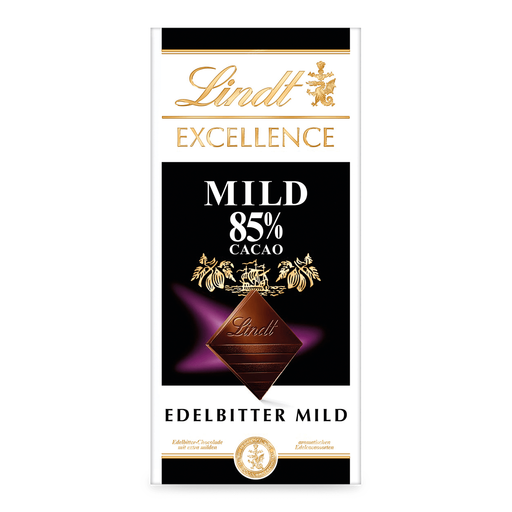 Image unavailable
Lindt Excellence 85% Cocoa Mild dark chocolate, 100 g
A good choice for a small treat if a high cocoa content is your priority and you don’t want the chocolate to be your only source of carbohydrates.
The 100 g bar is labelled as containing 85% cocoa. Check the nutrition information, ingredients and allergen warnings on the specific packaging for the portion you choose.
View at Joybuy
Frequently asked questions
Does more cocoa automatically make it a better choice before a workout?
No. A high cocoa content may suit you if you like a bitter taste, but it doesn’t determine on its own whether the chocolate makes a suitable snack. The 85% bars considered here contain plenty of fat as well as carbohydrates. For longer or more intense sessions, consider your carbohydrate intake separately. The German Nutrition Society explains the importance of carbohydrates in sports nutrition.
How much chocolate should you have before a workout?
There’s no one-size-fits-all portion. If you want to eat chocolate before a workout, stick to a small amount that you know suits you, and distinguish the figures per portion from the nutrition information per 100 g.
Does dark chocolate contain caffeine?
Yes. Caffeine occurs naturally in cocoa beans, as explained by the German Federal Institute for Risk Assessment. If you’re sensitive to it, remember to take other sources into account too, such as coffee and caffeinated pre-workout products.
Are bars with 85% cocoa automatically vegan or allergen-free?
No. The cocoa content alone doesn’t prove that a product is vegan or free from allergens. Check the ingredients and trace warnings for the specific variety. Even a bar labelled as vegan may carry a warning about possible traces of certain allergens.


