
Lieferung heute & morgen

Qualitätsgarantie

Willkommens-Angebote freischalten: KOSTENLOSE Lieferung | Bis zu 80 % RABATT | Kostenlose 30-Tage-JoyPlus-Testphase
App herunterladen
A 4-channel dash cam provides a comprehensive solution for vehicle surveillance. Unlike conventional models that only cover the front view or the front and rear, this type of car camera kit captures the vehicle's entire surroundings. This is achieved through the simultaneous recording of four separate cameras: one facing forward, one facing backward, and two others covering the interior or the sides of the vehicle. The result is a near-seamless 360-degree dash cam view, which can be highly valuable for detailed evidence collection in cases of traffic accidents, parking scrapes, or vandalism.
Choosing a suitable system depends on specific technical parameters. An informed decision is based on an analysis of resolution, sensor technology, connectivity, and additional features.
Resolution is a critical factor for the level of detail in the recordings. A 4K dash cam for the front camera (3840 x 2160 pixels) allows for the clear capture of license plates and road signs, even from a greater distance. For the side and rear cameras, a resolution of 1080p (Full HD) is generally sufficient.
Low-light performance, also known as night vision car camera capability, is determined by the combination of a bright lens (low f-number, e.g., f/1.8), a high-quality image sensor (e.g., Sony STARVIS), and technologies like WDR (Wide Dynamic Range). WDR balances strong differences in brightness and prevents overexposed or underexposed areas in the image.
A dash cam with parking mode also protects the vehicle while it is parked. Various modes exist:
A permanent power supply is necessary for 24/7 operation. This is achieved with a hardwire kit that connects the dash cam directly to the vehicle's fuse box. An integrated voltage monitor prevents the car battery from being drained. Systems with supercapacitors instead of lithium-ion batteries offer greater heat resistance and longevity.
A dash cam with GPS and WiFi offers extended functionality. The GPS module continuously records location, speed, and driving route. In the event of an incident, this data can serve as corroborating evidence.
Via WiFi (often on the 5 GHz band for faster transfers), the dash cam can connect to a smartphone. This allows for easy configuration, viewing live footage, and quickly downloading video files through a companion app, all without needing to remove the memory card. Some models offer an optional 4G LTE connection for remote access to the camera.
Based on the aforementioned technical criteria, we present three models that provide comprehensive surveillance.
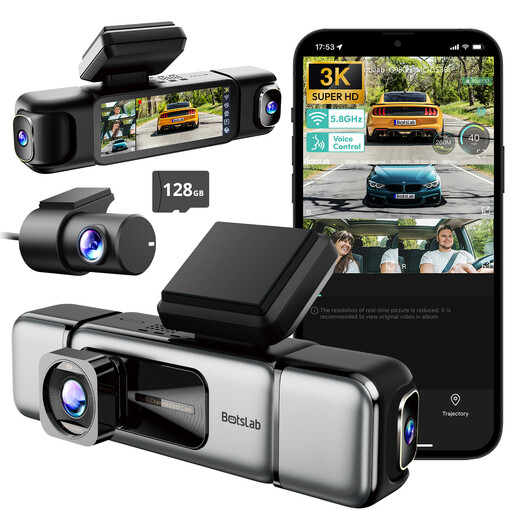
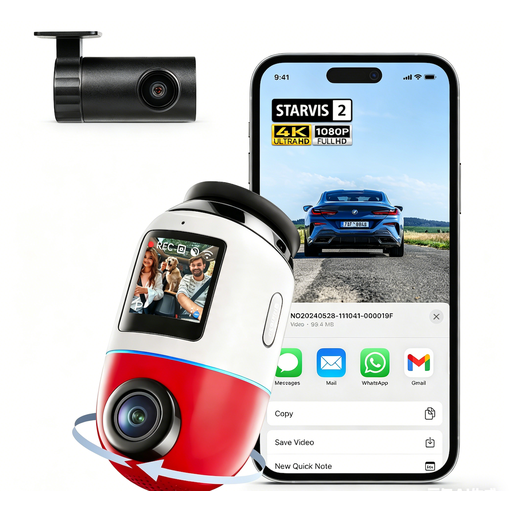
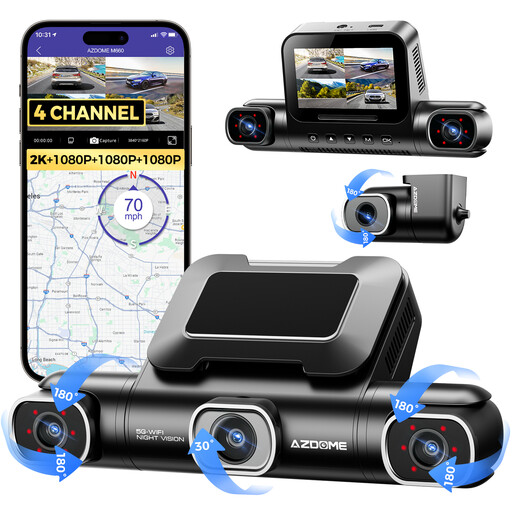
While a comprehensive dash cam system is a dedicated investment in vehicle safety, our assortment includes a wide range of products for your car and leisure activities. If you are looking for other accessories or tech gadgets, you may find interesting alternatives in our categories. For example, discover our selection of Dart Accessories.
1. Are 4-channel dash cams legal in Germany? The use of dash cams to document traffic events is generally permitted in Germany. Under certain circumstances, the recordings may be admissible as evidence in court. However, it is important to comply with data protection regulations. Permanent, non-event-triggered recording of public spaces is not allowed. Most dash cams operate with a loop recording function that overwrites old footage and only permanently saves the relevant sequence in the event of an incident (e.g., triggered by the G-sensor).
2. What is the advantage of a dash cam with GPS and WiFi? An integrated GPS module logs the vehicle's exact route, location, and speed. This geodata can strengthen the evidentiary value of a video recording in a dispute. WiFi significantly simplifies usability, as videos can be transferred directly to a smartphone for viewing without having to remove the memory card from the camera.
3. Does a dash cam with parking surveillance require a permanent power supply? Yes, for functional 24/7 parking surveillance, the dash cam must be continuously powered. This is done using a hardwire kit, which is connected to the vehicle's fuse box. Such a kit includes a voltage monitor that cuts off power to the dash cam before the car battery's voltage drops to a critical level, ensuring the engine can still start.